
Triskele Meaning: Ireland's Ancient Triple Spiral
The Triskele is one of Ireland's oldest symbols, carved into the entrance stone at Newgrange over 5,000 years ago — older than Stonehenge and the Egyptian pyramids. Its three spirals represent life, death, and rebirth. In modern Irish culture, the triskele symbolizes personal growth, forward motion, and the belief that all things move in cycles.
A Triskele (Triskelion) is three connected spirals radiating from a center — open curves that suggest motion, unlike closed Celtic knot lines. While spirals appear across Europe, the triple spiral at Newgrange in County Meath became the iconic Irish reference for triskele meaning and triple spiral symbolism.

What Is a Triskele?
A Triskele is three spirals from one hub—Greek triskeles suggests “three-legged” motion. Unlike Celtic knots, the lines stay open and expanding, so the eye reads growth and rotation. Irish discussion usually ties the form to Newgrange’s triple spiral and broader Celtic spiral meaning.
The Triskele (also spelled Triskelion) is a symbol made of three connected spirals radiating from a central point. The word comes from the Greek triskeles, meaning “three-legged,” and the design evokes a sense of constant, rotational movement.
Unlike Celtic knots, which use interlaced lines, the Triskele uses open spirals — curves that expand outward rather than looping back on themselves. This gives the symbol a feeling of forward motion, growth, and expansion that sets it apart from other Celtic designs.
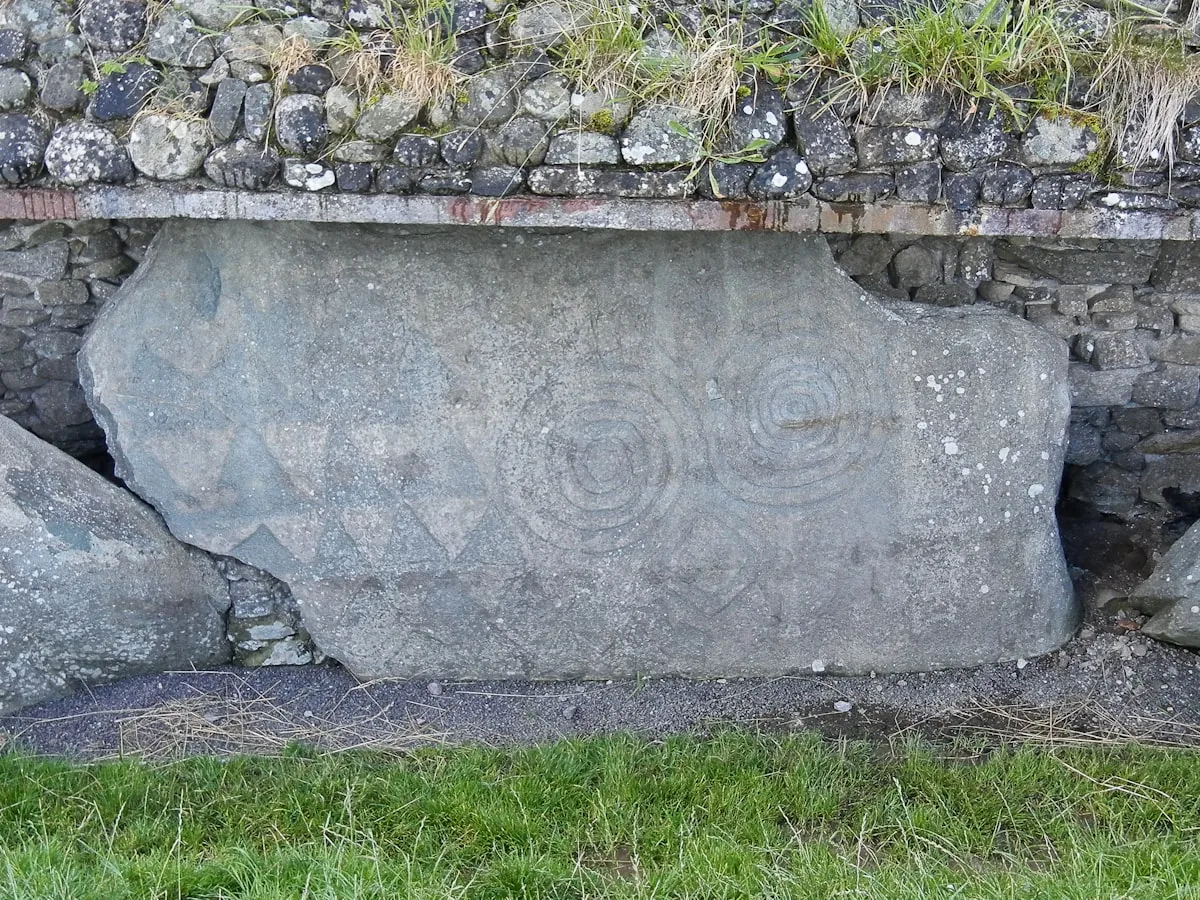
The Triskele is not just an Irish symbol. Variations appear in ancient Greek, Sicilian, and Neolithic European art. But nowhere is it more iconic than at Newgrange in County Meath, Ireland, where the triple spiral was carved into the entrance kerbstone more than 5,000 years ago by people whose names and language have been lost to time.
The Triskele is a triple spiral symbol on the entrance kerbstone at Newgrange, Ireland, dating to approximately 3200 BC, making it over 5,000 years old, predating both Stonehenge and the Egyptian pyramids. It represents growth, cycles, and the interconnection of three forces.
Newgrange — Where the Triskele Was Born
Newgrange in County Meath is a roughly 5,200-year-old passage tomb famous for the triple spiral carved on its entrance kerbstone (K1). On the winter solstice, a beam enters through the roof box and reaches the inner chamber along the passage — a different location from that entrance art. It predates Stonehenge and the pyramids, which frames the Triskele as one of humanity’s oldest visual motifs.
Newgrange is a massive passage tomb in the Boyne Valley of County Meath, Ireland. Built around 3200 BC, it is older than Stonehenge by roughly 500 years and older than the Great Pyramid of Giza by over 600 years. It is one of the most important prehistoric structures in Europe.
The entrance stone at Newgrange (Kerbstone 1) is covered in carved spirals, the most prominent being a large triple spiral, the Triskele — one of the best-known examples of Neolithic art in Europe. That famous carving sits on the outer kerb at the tomb entrance; it is not the same surface illuminated by the winter solstice beam deep inside the passage tomb.
The Winter Solstice Alignment
Newgrange is not just a tomb. It is an astronomical instrument. On the winter solstice (around December 21st each year), a narrow beam of sunlight enters through a roof box above the entrance and travels down the 19-meter passage, illuminating the inner chamber for approximately 17 minutes.
This alignment was not accidental. The builders of Newgrange calculated the solstice with extraordinary precision, positioning the passage so that the shortest day of the year would be the one day when light penetrated the deepest darkness.
The solstice alignment lights the inner chamber after sunlight travels down the passage — a feat of Neolithic astronomy separate from the entrance kerbstone triple spiral. Even so, many readers connect spirals at Newgrange broadly to the cycle of the sun — the shortest day as a turning point toward longer light — while keeping the kerb carving and the chamber illumination distinct.
Three Spirals, Three Meanings
Sacred triads map easily onto the Triskele: land, sea, and sky; life, death, and rebirth; past, present, and future; body, mind, and spirit; or family triads. The design holds multiple readings at once, which is why triskele symbolism stays vivid in Irish spiral art and modern jewelry.
The number three was sacred to the ancient Celts. The Triskele's three spirals have been interpreted in many ways, and the symbol's power lies in holding all of these meanings simultaneously.
Land, Sea, and Sky
Across land, sea, and sky, every living thing existed within the intersection of these three planes. The Triskele represents the totality of existence. There is nothing outside these three.
Life, Death, and Rebirth
In nature, the ancient Irish observed a cycle: the seed grows, the plant dies, the seed returns. The winter solstice alignment at Newgrange reinforces this reading: the darkest day is not the end, but the turning point toward light.
Past, Present, and Future
Past, present, and future appear as stages of time bound together in a single moment. The spiral moves forward. It does not loop back. It suggests that while the past informs us, the direction of life is always outward, always expanding.
Body, Mind, and Spirit
A more modern interpretation, but one that resonates with the symbol's continuous motion. The three spirals represent the complete human experience — physical, intellectual, and spiritual — all connected, all moving together.
Mother, Father, and Child
In the context of family, the three spirals represent the family unit, three individuals bound by a bond that spirals outward through generations.
Triskele vs Trinity Knot — What Is the Difference?
Both use “three,” but the Triskele spins open spirals outward while the Trinity Knot locks three loops in one endless line. Neolithic spirals at Newgrange vastly predate medieval Triquetra manuscripts—motion versus still unity is the usual design contrast.
| Feature | Triskele | Trinity Knot (Triquetra) |
|---|---|---|
| Design | Three open spirals | Three interlocking loops |
| Line style | Spirals expand outward | Continuous interlace, closed |
| Age | ~3200 BC (Neolithic) | ~600 AD (Early Medieval) |
| Feeling | Movement, expansion, growth | Unity, eternity, stillness |
For more on the Trinity Knot, see our Trinity Knot Meaning guide.
Triskele Jewelry
Triskele pendants, rings, earrings, and brooches lean into motion—spirals draw the eye around the piece. Wearers often cite Irish pre-Christian heritage or personal growth. Look for precious metal hallmarked at Dublin Castle when buying Irish triskele jewelry.
The Triskele's flowing, dynamic shape translates beautifully into jewelry. Its three spirals create natural visual movement that draws the eye, making it one of the most visually striking Celtic designs.
- Triskele pendants, the spirals create a natural circular frame, ideal for necklaces
- Triskele rings, the spiral pattern wraps around the band, suggesting continuous motion
- Triskele earrings, the balanced three-fold design works perfectly in symmetrical pairs
- Triskele brooches, a modern take on ancient Irish metalwork
Explore Irish heritage
The Irish Heritage Quiz asks seven questions about your connection to Irish symbols and traditions — try it after reading, or keep exploring the guides.
Seven questions, then a personal result linking your preferences to Irish heritage.
Frequently asked questions
Quick takes on triskele meaning, age at Newgrange, contrast with the Trinity Knot, solstice context, and why jewelers still carve triple spirals today.
What does the Triskele mean?
As a triple spiral, the Triskele (or Triskelion) represents cycles, growth, and forward motion. Its three spirals are interpreted as life, death, and rebirth; past, present, and future; or land, sea, and sky. The most famous example is carved on the entrance kerbstone at Newgrange, Ireland, dating to approximately 3200 BC, over 5,000 years old.
How old is the Triskele?
At Newgrange in Ireland, the Triskele dates to approximately 3200 BC, making it over 5,000 years old. This predates Stonehenge by about 500 years and the Great Pyramid of Giza by over 600 years.
What is the difference between a Triskele and a Trinity Knot?
By design, the Triskele uses three open spirals that expand outward, representing motion and growth. The Trinity Knot uses three interlocking closed loops, representing unity and eternity. The Triskele is much older than the Trinity Knot.
What does the triple spiral at Newgrange mean?
The iconic triple spiral is carved on the entrance kerbstone (K1); winter solstice light reaches the inner chamber via the passage and roof box — not that kerb carving. People still often read spirals at the site in terms of solar cycles, death-and-rebirth, and renewal.
Why is the Triskele popular in Irish jewelry?
Spirals imply motion, appeal to fans of Ireland’s deep past, and fit pendants, rings, and earrings—often with Dublin Castle hallmarks for certified metal.