
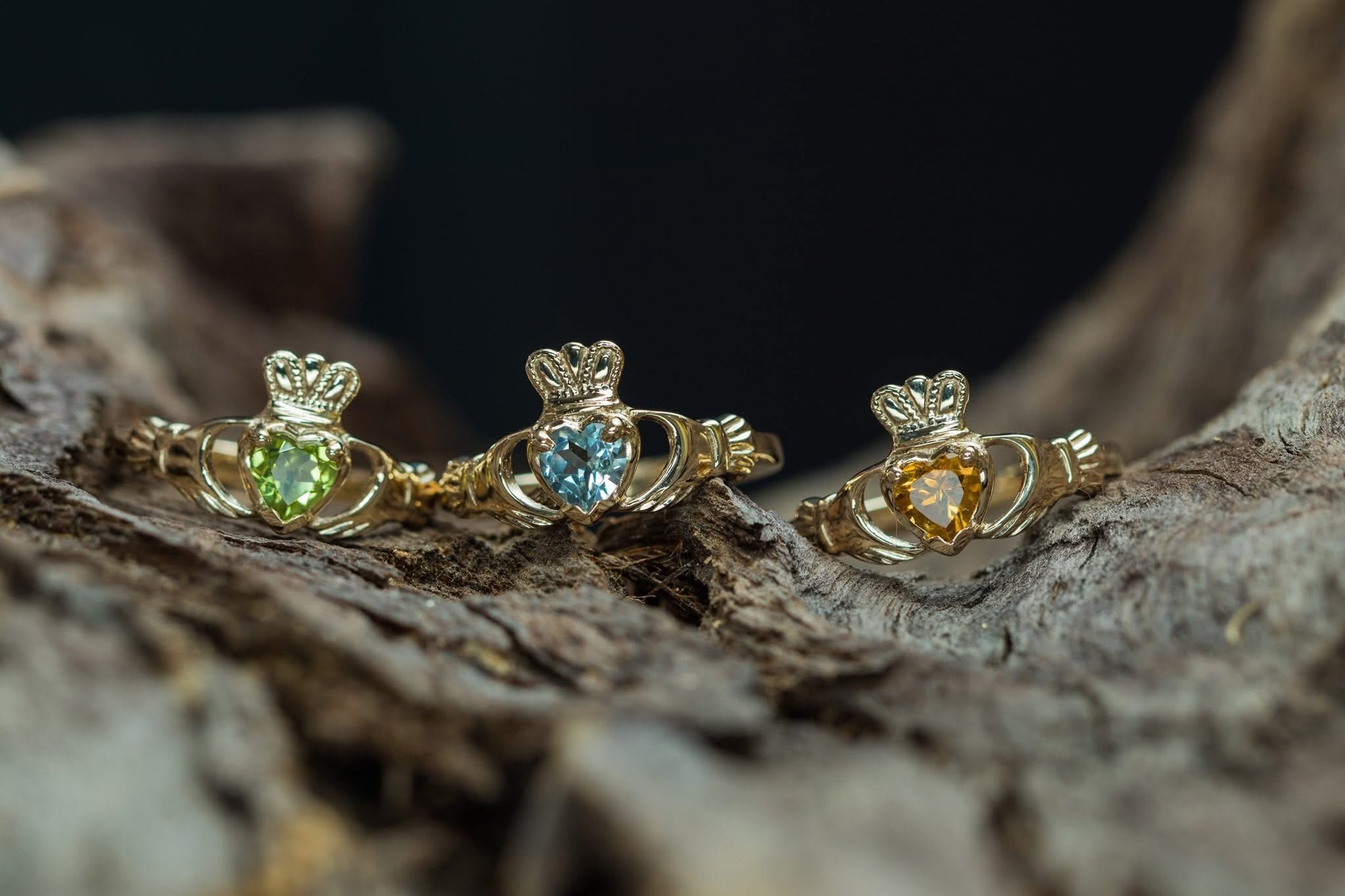

What Makes a Claddagh Birthstone Ring Special?
A Claddagh birthstone ring places a gemstone representing a birth month inside the heart of a traditional Irish Claddagh ring. The Claddagh's three symbols — heart (love), hands (friendship), crown (loyalty) — combine with the personal significance of the wearer's birth month. Claddagh birthstone rings are available in both gold and sterling silver settings.
A standard Claddagh ring has a plain metal heart — gold or silver, smooth and unadorned. A Claddagh birthstone ring replaces that plain heart with a gemstone matched to a specific birth month.
The result is two layers of meaning in one ring. The Claddagh itself carries love, loyalty, and friendship. The birthstone adds something personal — a specific month, a specific identity, a connection to the wearer that goes beyond the universal Irish symbolism.
This is why birthstone Claddagh rings are one of the most gifted styles:
- A mother receiving her child's birthstone — the heart holds the person she loves most
- A daughter receiving her own birthstone — the ring is hers, specifically and unmistakably
- A partner choosing their loved one's birth month — declaring: this heart represents you
The stone sits inside the heart shape, cradled between the two hands. Crowned from above. It is, visually and symbolically, a protected gem at the center of three promises.
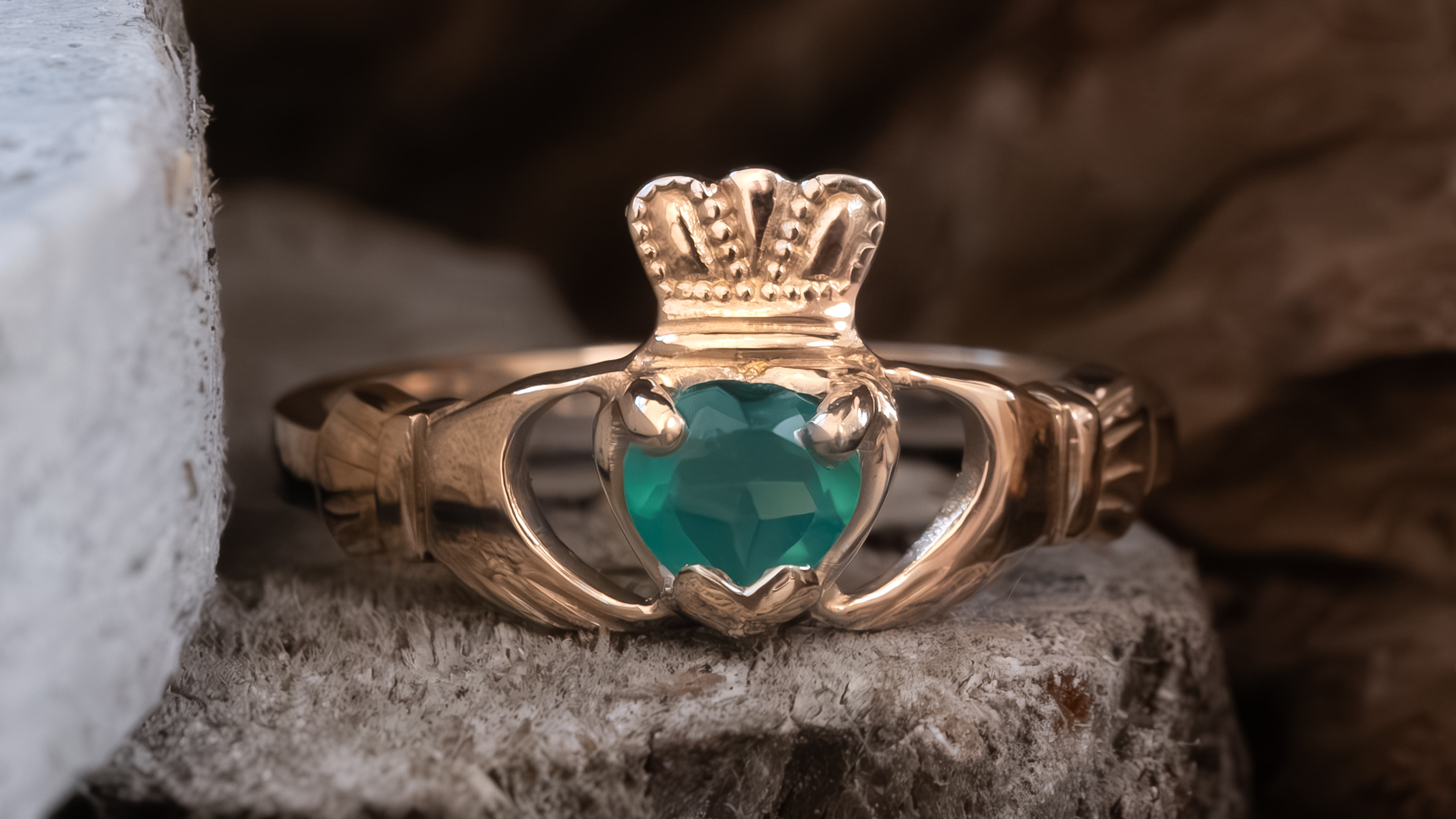
Claddagh Birthstone Chart — Every Month, Every Stone
| Month | Birthstone | Color | Mohs Hardness | Daily Wear? | Meaning |
|---|---|---|---|---|---|
| January | Garnet | Deep red | 7.5 | ✅ Excellent | Constancy, trust, friendship |
| February | Amethyst | Purple | 7 | ✅ Good | Clarity, calm, wisdom |
| March | Aquamarine | Pale blue | 7.5-8 | ✅ Excellent | Courage, serenity, safe voyage |
| April | Diamond / White Topaz | Colorless | 10 / 8 | ✅ Excellent | Eternal love, strength |
| May | Emerald | Green | 7.5-8 | ⚠️ Careful | Rebirth, love, Ireland |
| June | Alexandrite / Moonstone | Color-change / White | 8.5 / 6-6.5 | ✅ / ⚠️ | Transformation, intuition |
| July | Ruby | Red | 9 | ✅ Excellent | Passion, protection, vitality |
| August | Peridot | Yellow-green | 6.5-7 | ⚠️ Careful | Growth, prosperity, nature |
| September | Sapphire | Blue | 9 | ✅ Excellent | Wisdom, loyalty, nobility |
| October | Tourmaline / Opal | Various / Rainbow | 7-7.5 / 5.5-6.5 | ✅ / ❌ | Creativity, hope |
| November | Citrine / Topaz | Golden / Blue | 7 / 8 | ✅ Good | Abundance, joy, warmth |
| December | Blue Topaz / Tanzanite | Blue / Violet-blue | 8 / 6-6.5 | ✅ / ⚠️ | Communication, truth, calm |
Your Birth Month — Stone Properties & What to Know
Each birth month has a designated gemstone that can be set in a Claddagh ring's heart. The most durable stones for daily wear are garnet (January, Mohs 7.5), sapphire (September, Mohs 9), ruby (July, Mohs 9), and blue topaz (December, Mohs 8). Emerald (May) represents Ireland but requires a protective bezel setting.
January — Garnet
Deep red, naturally untreated, and one of the most durable colored stones for daily ring wear (Mohs 7.5). Garnet in a Claddagh heart looks like a declaration — love made visible in red. The stone requires almost no special care. A garnet Claddagh ring worn every day for thirty years will look essentially the same.
February — Amethyst
Purple with a quiet depth. Amethyst is the classic meditation stone — clarity, calm, and focus. One thing to know: amethyst can lighten with prolonged exposure to direct sunlight. Store it away from windows when you are not wearing it. The stone is durable enough for daily wear (Mohs 7) and eye-clean at AA grade.
March — Aquamarine
Pale, icy blue — "water of the sea" in Latin. Aquamarine belongs to the same mineral family as emerald (beryl) but is significantly more durable and affordable. In an Irish context, aquamarine connects to the maritime heritage of the Claddagh village — a stone named for the sea, set in a ring born by the sea.
April — Diamond
The obvious choice for an engagement Claddagh ring. In a birthstone context, a diamond Claddagh ring gives April-born wearers a reason beyond engagement — it is their stone. A well-cut diamond in the 0.25-0.50ct range fits the heart shape comfortably. Cut quality matters more than carat weight at this scale. White topaz serves as a credible, affordable alternative.
May — Emerald
Ireland's stone. Green is Ireland's color. An emerald in a Claddagh heart is the most distinctly Irish combination possible.
Know this: approximately 95% of emeralds are oiled or resin-filled to improve clarity. This is standard industry practice, not a defect. The level of oiling (minor, moderate, significant) affects value. A "minor oil" stone with good saturation is the sweet spot for a Claddagh setting. Emeralds are softer than rubies or sapphires (Mohs 7.5-8 vs 9), so a bezel setting protects the stone better than prongs for daily wear.
June — Alexandrite
The chameleon stone — green in daylight, reddish-purple under incandescent light. Natural alexandrite is extremely rare and expensive. Lab-grown alexandrite is chemically identical and captures the same color-change effect at an accessible price. Moonstone is the traditional alternative — a floating blue sheen that connects to Celtic moon goddess traditions.
July — Ruby
The hardest colored stone after sapphire (Mohs 9). A ruby Claddagh ring will outlast the metal. Ruby in the heart represents passion — combined with the Claddagh's love, it is an intensified declaration. Heat treatment is universal in rubies and fully accepted — it improves color and clarity permanently.
August — Peridot
Vivid yellow-green, naturally formed in volcanic rock (and occasionally in meteorites — the only gemstone found in space). Peridot is softer than some birthstones (Mohs 6.5-7), so treat it with a bit more care in a ring setting. The green connects to Ireland's landscape. Affordable and eye-catching.
September — Sapphire
Blue and virtually indestructible (Mohs 9). Sapphire is the safest colored stone for a daily-wear Claddagh ring — it will not scratch, chip, or fade under normal conditions. Kate Middleton's engagement ring famously revived sapphire demand worldwide. In a Claddagh setting, sapphire represents wisdom and loyalty — doubling down on the Claddagh's own loyalty promise.
October — Tourmaline
Available in every color, but pink tourmaline is the most popular for October birthstone settings. Tourmaline is durable (Mohs 7-7.5) and naturally vivid. Opal is the traditional alternative but is too soft (Mohs 5.5-6.5) for ring settings — it cracks, chips, and contains water that can dry out. For a Claddagh ring, tourmaline is the better choice.
November — Citrine
Warm golden yellow — the "merchant's stone," associated with prosperity and abundance. Most commercial citrine is heat-treated amethyst, which is permanent and stable. Topaz is the traditional alternative — Swiss Blue Topaz (vivid medium blue) is the most popular November/December crossover stone.
December — Blue Topaz
Swiss Blue Topaz is the definitive December Claddagh birthstone — vivid, ice-blue, and extremely durable (Mohs 8). The blue is achieved through irradiation and heat treatment, both permanent and completely stable. The stone will never change color. Tanzanite is the luxury alternative — deeper violet-blue, but softer (Mohs 6-6.5) and not ideal for daily ring wear.
Choosing the Right Claddagh Birthstone Ring
Whose birthstone? The most common choice is the wearer's own birth month. But mothers choose their child's birthstone. Partners choose their loved one's month. Some choose a stone because they love the color, regardless of the month. All of these are valid.
Gold or silver? Silver pairs better with cool-toned stones — blue topaz, amethyst, aquamarine. Gold pairs better with warm-toned stones — garnet, citrine, ruby, emerald. Both work with all stones — this is preference, not a rule.
Durability matters. If this is a daily ring, prioritize stones with Mohs 7 or higher. If it is an occasional piece, anything works. Emeralds and opals need more care than sapphires and garnets.
Natural or lab-grown? For precious stones (ruby, sapphire, emerald, alexandrite), lab-grown options are chemically identical and significantly more affordable. Natural stones carry the narrative of something formed deep in the earth over millions of years. Both choices are legitimate.
Claddagh Birthstone Rings for Men — Personal Heritage
Men's birthstone Claddagh rings add a personal dimension to an already meaningful ring. The stone sits in the heart of a wider, bolder design — the same symbol, made personal.
Most popular men's birthstone choices:
- Garnet (January) — deep red in a gold or silver band. Bold and understated at the same time.
- Sapphire (September) — blue and nearly indestructible. A man can wear a sapphire Claddagh ring through any kind of work.
- Emerald (May) — Ireland's green. In a bezel-set men's ring, the emerald is protected and prominent.
- Blue Topaz (December) — vivid blue, durable, affordable. A strong visual in a wide silver band.
Men also choose birthstones for their children or partners — the meaning shifts from "this is my month" to "this is the person my heart belongs to."
Claddagh Birthstone Rings for Women — The Most Personal Irish Ring
Women's birthstone Claddagh rings are the most gifted style of Claddagh ring. The combination of personal gemstone, traditional symbolism, and the Claddagh's four-position wearing system makes them uniquely meaningful.
Most popular women's birthstone choices:
- Emerald (May) — Ireland's stone in Ireland's ring. The most requested women's Claddagh birthstone.
- Sapphire (September) — classic blue, pairs beautifully with both gold and silver settings.
- Amethyst (February) — purple against silver is one of the most elegant Claddagh combinations.
- Diamond / White Topaz (April) — turns the ring into an engagement piece or a heritage daily ring.
- Garnet (January) — deep red heart against polished gold. Traditional and striking.
Gift occasions: Mother's Day (child's birthstone), birthday (own birthstone), anniversary (partner's birthstone), graduation (own birthstone as a milestone marker).
Explore the Claddagh Collection
- Claddagh Ring Meaning — Love, loyalty & friendship
- Gold Claddagh Ring — 10K, 14K & 18K gold styles
- Silver Claddagh Ring — Sterling silver & care
- How to Wear a Claddagh Ring — Four positions, four meanings
- Women's Claddagh Ring — Styles, metals & gemstones
- Claddagh Engagement Ring — Diamond & emerald engagement
- ← Back to all symbols — The complete guide