

What Is the Book of Kells?
The Book of Kells is an illuminated manuscript of the four Gospels created around 800 AD, likely begun at the monastery on Iona and completed at the monastery of Kells in County Meath. It consists of 340 folios of decorated vellum. At least three artist-scribes contributed to its creation. It has been held at Trinity College Dublin since 1661 and is considered the greatest example of Insular art.
The Book of Kells is a Latin manuscript of the four Gospels (Matthew, Mark, Luke, and John), created around 800 AD. It is 340 folios (680 pages) of decorated vellum (calfskin), measuring approximately 33 by 25 centimeters. The manuscript is considered one of the greatest achievements of medieval European art and the single most important example of Insular art, the tradition of manuscript production developed in monasteries across Ireland and Scotland.
The book's artwork goes far beyond illustration. Every page contains ornamental elements: spirals, knots, animal interlace, figures of humans and beasts entangled in geometric patterns, and full-page illuminations (known as "carpet pages") that transform the text into visual art. The Chi Rho page (folio 34r), which introduces the account of Christ's birth, is considered the most elaborate single page of medieval manuscript art in existence.
The Book of Kells was not created by a single person. Scholars have identified at least three distinct artist-scribes based on differences in handwriting and artistic style. The book was never finished, as several pages have incomplete decoration, suggesting the work was interrupted, likely by the Viking raids that forced the monks to abandon Iona.
The title "Book of Kells" comes from the monastery at Kells in County Meath, where the manuscript spent most of its known history. It was donated to Trinity College Dublin in 1661 by Henry Jones, Bishop of Clogher, and has been displayed there ever since.
The Stops Along the Book of Kells Journey
This trail follows the manuscript's historical path, from its creation on Iona to its permanent home in Dublin.
H3: 1. Iona, Scotland (Where It Began)
Saint Columba (Colm Cille) left Ireland in 563 AD and founded a monastery on the small island of Iona, off the western coast of Scotland. The monastery became one of the most important centers of Celtic Christianity, training missionaries and producing manuscripts in its scriptorium.
The Book of Kells was almost certainly begun here, in the monastery's scriptorium, around 800 AD. But between 795 and 806 AD, Viking raiders attacked Iona repeatedly. In 806 AD, 68 monks were killed in a single raid. The surviving community made the decision to move to Ireland.
Iona today is accessible by ferry from the Isle of Mull. The restored abbey, the surviving high crosses, and the ancient burial ground (Reilig Odhrain, where early Scottish kings were buried) remain.
Getting there: Fly to Glasgow, drive to Oban (2.5 hours), ferry to Mull (45 min), drive across Mull (40 min), ferry to Iona (10 min).
H3: 2. Kells, County Meath (Where It Survived)
Around 807 AD, the Columban monks established a new monastery at Kells. They brought their most precious possession with them: the unfinished manuscript. The book was completed at Kells and remained there for over 600 years.
In 1007 AD, the Annals of Ulster record that the "great Gospel of Columkille" was stolen from Kells and recovered months later, stripped of its bejeweled gold cover but with the manuscript itself intact. The theft confirms the manuscript's extraordinary value in medieval Ireland.
Kells today retains a round tower and several high crosses in the churchyard of St. Columba's Church. The town is a stop on the Ireland's Ancient East route.
Drive from Dublin: Approximately 1 hour (70 km).
H3: 3. Trinity College Dublin (Where It Lives)
In 1661, the manuscript was donated to Trinity College Dublin, where it has remained ever since. The Book of Kells exhibition, located in the Old Library, displays two of the four volumes at a time, one open to a major decorated page and the other to a page of text, with the pages turned regularly.
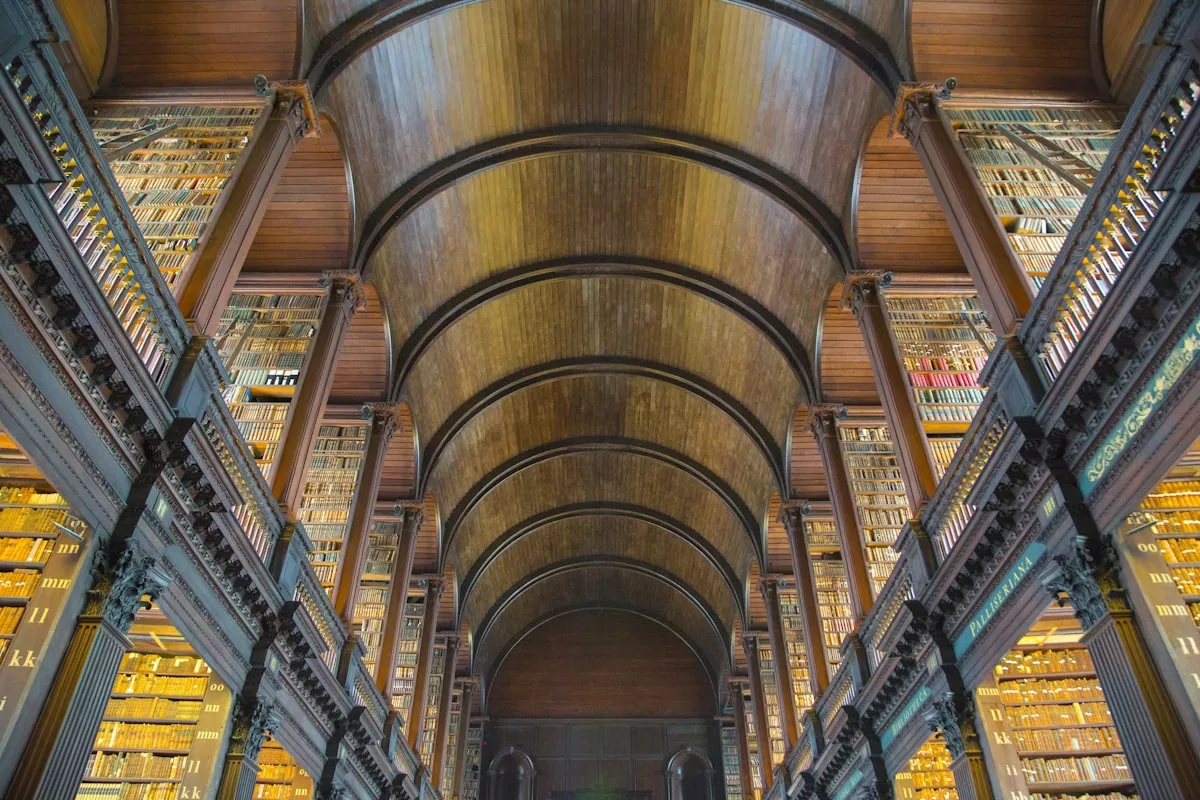
The Old Library's Long Room, a 65-meter barrel-vaulted chamber holding 200,000 of Trinity's oldest volumes, is one of the most photographed libraries in the world. The display includes contextual panels explaining the manuscript's history, production techniques, and symbolism.
Advance booking is recommended, particularly from April to October, when the exhibition can attract over 5,000 visitors per day.
Location: College Green, Dublin city center.
H3: 4. National Museum of Ireland (Related Artifacts)
The National Museum on Kildare Street in Dublin holds related Insular art treasures, including the Ardagh Chalice and the Tara Brooch, both created in the same artistic tradition as the Book of Kells. Seen together with the manuscript, these objects show the full range of the Insular art style that monasteries in Ireland and Scotland produced between the 6th and 10th centuries.
Walk from Trinity College: Approximately 10 minutes.
H3: 5. Monasterboice, County Louth (The Companion High Crosses)
Monasterboice's high crosses are the three-dimensional counterpart to the Book of Kells. The same interlace patterns, the same biblical scenes, the same artistic vocabulary. The crosses at Monasterboice show how the illumination tradition translated from manuscript page to carved stone. See our Ireland's Ancient East guide for details.
Drive from Dublin: Approximately 1 hour (55 km).
Visiting the Book of Kells: What You Need to Know
The Book of Kells is displayed at Trinity College Dublin in the Old Library. Advance booking is recommended, especially April to October when the exhibition can receive over 5,000 visitors daily. The display includes two of the four manuscript volumes shown at a time, plus the 65-meter Long Room library.
The manuscript is the most visited single artifact in Ireland.
| Detail | Information |
|---|---|
| Location | Trinity College Dublin, College Green, Dublin 2 |
| Booking | Advance booking strongly recommended. Tickets available at visittrinity.ie. |
| Peak times | April to October. Over 5,000 visitors per day in summer. |
| Best time to visit | Early morning or late afternoon to avoid peak crowds. |
| Admission | Paid admission. Includes both the Book of Kells exhibition and the Long Room. |
| Photography | Photography is restricted in the exhibition. The Long Room allows photography. |
| Duration | Allow 1-1.5 hours for the full exhibition and Long Room. |
| Nearby | National Museum (10-minute walk), Dublin Castle (15-minute walk). |
The Book of Kells and Celtic Jewelry
The visual language of the Book of Kells is the foundation of modern Celtic jewelry design.
The interlace knotwork, spirals, and zoomorphic (animal-form) patterns that decorate the manuscript's pages are the same motifs used in Celtic rings, pendants, and brooches today. When you see a Trinity knot on a piece of Irish jewelry, you are looking at a design tradition that can be traced directly to the scriptoria of Iona and Kells.
The triskele spiral at the center of many Celtic designs appears throughout the manuscript in varying forms. The endless knot patterns that appear on Celtic wedding bands mirror the continuous interlace found on the manuscript's carpet pages. The connection is not symbolic but literal: modern Celtic jewelers work from the same design vocabulary that 8th-century monks perfected.
The Tara Brooch and the Ardagh Chalice, created in the same period and tradition, demonstrate how these manuscript designs translated into metalwork. The same spirals, the same interlace, the same technical precision, executed in silver and gold rather than ink and pigment.
See our guides on Celtic Symbols and Meanings and Trinity Knot Meaning for the full stories behind these designs.
Explore Celtic Knotwork Jewelry →
Explore More Heritage Trails
- Ireland's Ancient East: Kells and Monasterboice are key stops on this broader heritage route
- Celtic Monastery Trail: Iona, Glendalough, Clonmacnoise, and the great Irish and Scottish monasteries
- Viking Trail: The Norse raiders who drove the monks from Iona to Kells
- Wild Atlantic Way: Skellig Michael's surviving monastic scriptorium