
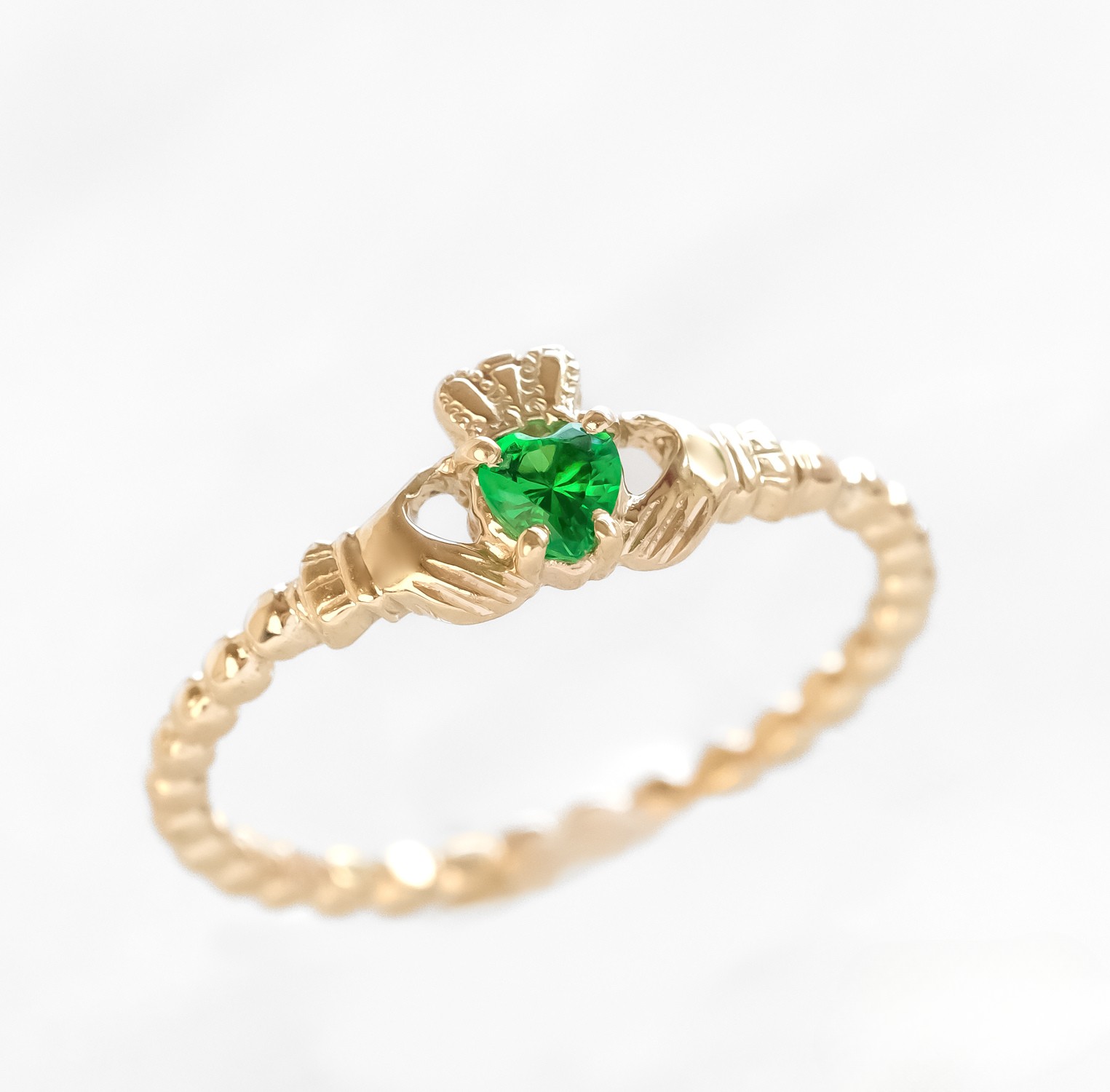

Why Sterling Silver Is the Most Popular Claddagh Metal
Sterling silver Claddagh rings are .925 silver (92.5% pure silver, 7.5% copper), hallmarked at Dublin Castle by the Irish Assay Office — the same government mark applied to gold. Silver outsells every other Claddagh metal. Same hallmark, same symbolism, same three promises. Lower price.
Gold came first. Gold is the traditional Claddagh metal and always will be. But silver is how most people actually start.
A teenager gets one at 16. A college student buys one because it costs less than a textbook. Someone in Boston with Irish grandparents sees it online, reads about the three promises, and thinks — that's the one. Silver is where the Claddagh tradition begins for most people alive today.
And it has its own look. Silver sits quieter on the hand than gold. There is a coolness to it, a softness that catches light without shouting. Women who own gold rings still reach for their silver Claddagh some mornings. It fits a different mood.
The numbers back this up: searches for "sterling silver claddagh ring" grew +190% year-over-year — faster than any other Claddagh keyword.
What Does .925 Sterling Silver Mean?
It is an alloy: 92.5% pure silver, 7.5% copper. The copper is what gives the metal backbone — enough hardness to hold the Claddagh's crown spires and clasped hands without bending. Pure silver (99.9%) is too soft. You could dent it with your thumbnail.
The ".925" stamp inside the band confirms this ratio. On Irish-made sterling, you will also find the Dublin Castle hallmark — a crowned harp, applied by the Irish Assay Office after independent testing. Same mark they put on gold and platinum.
Watch out for labels like "silver plated," "silver tone," or "nickel silver." These contain little to no actual silver. No .925 stamp, no hallmark — not sterling.
How to Verify Authentic Sterling Silver
- Check inside the band for the .925 engraving
- Irish pieces carry the Dublin Castle hallmark — a crowned harp
- Pick it up. Sterling has weight. Plated rings feel hollow, almost plasticky
- Try a magnet. Silver is not magnetic. If it sticks, walk away
Does Silver Tarnish? Yes — And Here Is Why It Is Not a Problem
Sterling silver tarnishes when exposed to sulfur in the air. This is chemistry, not a flaw. A polishing cloth removes it in seconds. Wearing the ring daily actually slows tarnish — skin oils form a natural barrier. Take it off before chlorinated pools.
Look — every sterling silver ring tarnishes. Every single one. Sulfur in the air reacts with the surface and darkens it. Normal.
Some people love it. A Claddagh with a slight patina looks like it has been somewhere — worn, lived in, carried through actual years. The darkened recesses make the heart, hands, and crown pop against the polished surfaces. It gains character.
Others want it bright. Fine. Thirty seconds with a polishing cloth and it is back. Cloths cost almost nothing and you can find them anywhere.
How to Prevent and Remove Tarnish
| Method | What It Does | How Often |
|---|---|---|
| Polishing cloth | Removes surface tarnish instantly | As needed |
| Store in airtight bag | Prevents air exposure that causes tarnish | When not wearing |
| Wear it daily | Natural skin oils slow tarnish formation | Always helps |
| Avoid sulfur | Eggs, hot springs, rubber bands accelerate tarnish | Ongoing |
| Remove before swimming | Chlorine damages silver finish | Every time |
Best thing you can do for a silver Claddagh? Wear it. Rings in drawers tarnish. Rings on fingers stay brighter — your skin does the work for you.
Silver Claddagh Ring vs Gold — An Honest Comparison
| Factor | Sterling Silver | Gold (14K) |
|---|---|---|
| Price | $ (most affordable precious metal) | $$$ (3-5× silver) |
| Tarnish | Yes — needs occasional polishing | No — stays bright forever |
| Weight | Lighter on hand | Heavier, more substantial feel |
| Durability | Good (Mohs ~3) — scratches over years | Better (harder alloy) |
| Hallmark | Dublin Castle .925 hallmark | Dublin Castle fineness mark |
| Allergies | Rare — .925 is hypoallergenic for most | 14K+ is hypoallergenic |
| Tradition | Popular from 19th century onward | The original Claddagh metal |
| Heirloom value | Moderate — needs maintenance over decades | High — unchanged for generations |
So which one? If you want zero maintenance and a ring you will never think about caring for — gold. If you want a genuine, hallmarked Irish Claddagh and you like how silver looks — sterling silver. Both carry the Dublin Castle stamp. Both mean the same thing.
A lot of families do both. Silver first — at 16, at 18, at graduation. Gold comes later for an engagement or a milestone birthday. The silver ring does not get retired. It moves to the right hand. The gold takes the left.
Sterling Silver Claddagh Rings with Gemstones
Sterling silver Claddagh rings are often set with gemstones in the heart — cubic zirconia, amethyst, blue topaz, garnet, emerald, and every birthstone month. Because silver costs less than gold, you can put a better stone in the heart without the total price climbing.
Colored stones look different in silver than in gold. Cooler. Sharper. The silver does not compete with the color — it frames it.
What works well:
- Cubic Zirconia — bright, clear, and at Claddagh-heart scale you genuinely cannot tell it from diamond. It is what it is. In silver, it makes a sharp daily ring.
- Purple amethyst against silver's cool tone is striking (February birthstone). One thing — keep it out of direct sunlight for long stretches. UV can lighten the color over time.
- Blue Topaz in Swiss Blue — vivid blue on sterling silver. December birthstone. Hard to beat that pairing.
- Deep red garnet (January). Naturally untreated, Mohs 7.5, tough as nails. Garnet in silver has an old-world, almost antique quality to it.
- Emerald — May birthstone and Ireland's green stone. If you go emerald in silver, look for a bezel setting rather than claws. Emerald is softer (Mohs 7.5–8) and the bezel wraps around to protect it.
- Every birthstone month is available. A silver Claddagh with your birth month stone — that is a personal gift, and it does not cost much.
Sterling Silver Claddagh Rings for Men — Mens Claddagh Ring in .925 Silver
Men's sterling silver Claddagh rings carry the Dublin Castle hallmark, come in substantial 5mm–7mm band widths, and are available in polished or oxidized finishes. Sterling silver is lighter than gold, making it a comfortable first ring. Prices for men's silver Claddagh bands start around $100–$165.
The difference between a men's silver Claddagh and a gold one comes down to weight, price, and how the ring wears. Silver is lighter on the finger — for a guy who has never worn a ring, that matters.
Bands run 5mm to 7mm wide. Go wider if you want the Claddagh design to read clearly — the crown, heart, and hands need room. Wider bands also feel more substantial on a bigger hand. Narrower bands look cleaner but the details get tight.
Some men's versions use oxidized silver — the recesses are darkened on purpose so the design stands out in heavy contrast. It gives the ring a rugged, worn-in look straight out of the box. If you do not want to wait for a patina to develop naturally, oxidized is the shortcut.
It will scratch. All silver does. Brushed finishes hide the scratches better than polished — and a brushed finish on a men's Claddagh ring has a more understated, everyday look anyway.
Tarnish? A ring you wear every day barely tarnishes at all. One that sits in a drawer for months will darken. Polishing cloth. Thirty seconds. Done.
Sterling Silver Claddagh Rings for Women
Women's silver Claddagh rings have finer bands — 2mm to 4mm — and the polished finish catches light differently than the wider men's versions. Most are plain sterling or set with a gemstone heart.
Polished silver has brightness to it. Matte silver is quieter, more understated. Both are traditional. It depends on whether you want the ring to catch attention or sit close to the skin.
Because silver keeps the price low, you can add a genuine birthstone or emerald without a big jump in cost. That is why silver Claddagh rings are the go-to birthday and graduation gift — personal, Irish, and affordable enough to give generously.
They stack well too. A silver Claddagh next to a Celtic knot band or a Trinity Knot ring on the same hand — that layered look works. Mix metals if you want, but silver-on-silver is cleaner.
A lot of women get their first Claddagh in silver. Sixteen, eighteen, graduation. Gold comes later. But the silver one stays — it just moves to the other hand.
One more thing: some silver Claddagh rings come rhodium-plated. Rhodium is a thin coating that keeps the silver brighter and resists tarnish longer. It will wear through eventually, but any jeweler can reapply it.
Explore More Claddagh Guides
- Claddagh Ring Meaning — Love, loyalty & friendship — the full symbol guide
- Gold Claddagh Ring — 10K, 14K & 18K gold styles
- How to Wear a Claddagh Ring — Four positions, four meanings
- Claddagh Birthstone Ring — Every month, every stone
- Women's Claddagh Ring — Styles, metals & gemstones
- Men's Irish Rings — Men's Claddagh styles & fit
- Claddagh Ring History — The legend of Richard Joyce
- ← Back to all symbols — The complete guide