
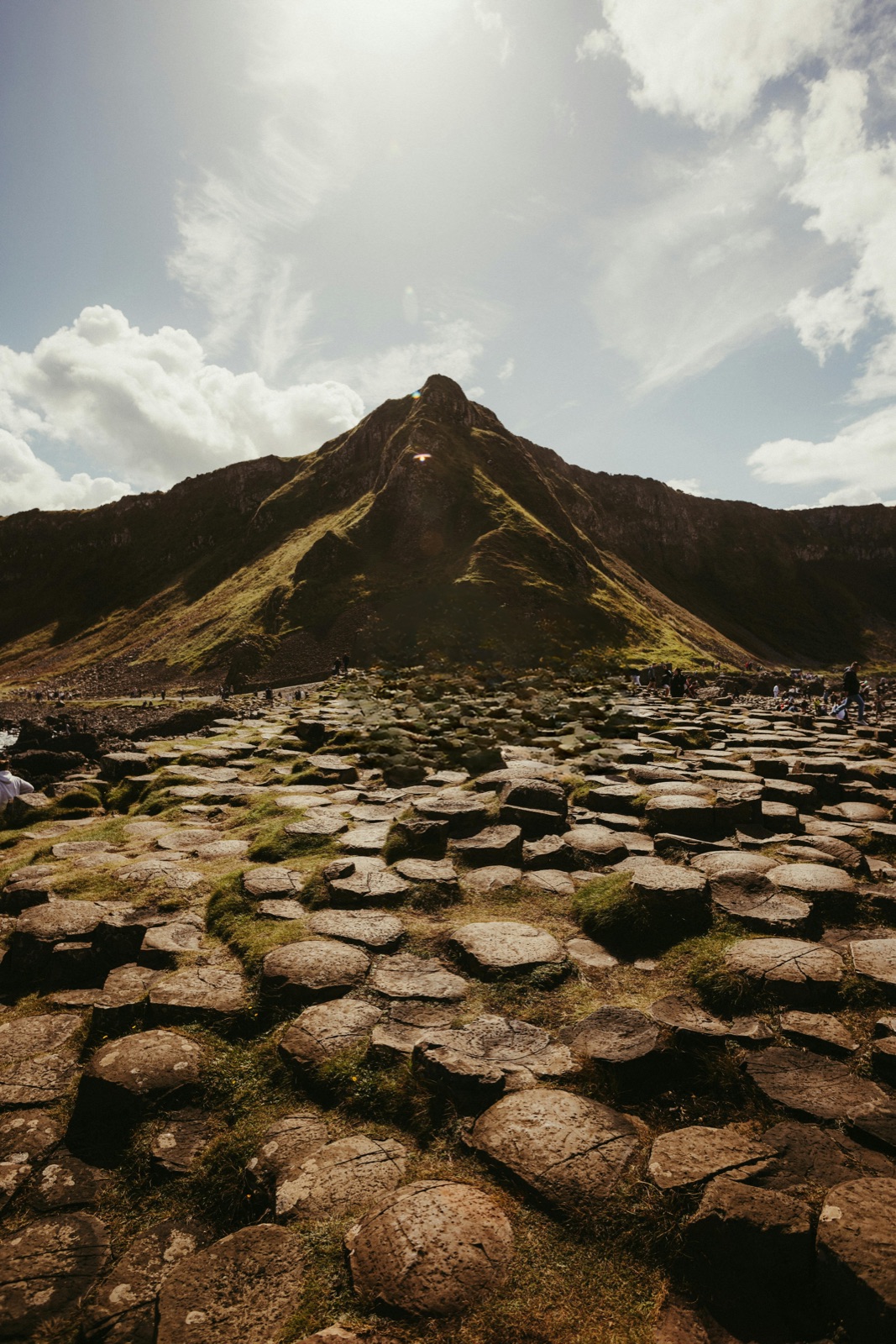

What Is the Giant's Causeway?
Forty thousand columns of stone, standing at the edge of the Atlantic like a staircase built for something much larger than a person.
The Giant's Causeway — in Irish, Clochán na bhFomhórach, meaning "stepping stones of the Fomorians" — is a stretch of coastline in County Antrim, Northern Ireland, where basalt rock has fractured into tens of thousands of interlocking polygonal columns. Most are hexagonal — six-sided pillars, packed together like cells in a honeycomb. Some have four sides. Some have five, seven, or eight. They fit together so precisely that they look engineered.
They are not. They are the result of lava cooling 50 to 60 million years ago. But standing among them, that is hard to believe. They look intentional. They look like someone put them there.
The site sits roughly three miles northeast of the town of Bushmills (yes, the whiskey town). It was declared a UNESCO World Heritage Site in 1986. A dedicated visitor center recorded 1,011,473 visitors in 2018, and nearly one million came again in 2019. It is Northern Ireland's most visited attraction.
The Causeway has been famous for centuries. It appeared in European scientific debates in the 1600s — was it the work of nature or the work of giants? — and it has never stopped drawing attention. The science is extraordinary. The legend is better.
The Giant's Causeway consists of approximately 40,000 interlocking basalt columns on the north coast of County Antrim, Northern Ireland, three miles northeast of Bushmills. The columns formed during a volcanic fissure eruption 50 to 60 million years ago in the Paleocene Epoch. The site was designated a UNESCO World Heritage Site in 1986 and receives nearly one million visitors annually.
How Were the Giant's Causeway Columns Formed?
The Causeway was created by an ancient volcanic fissure eruption during the Paleocene Epoch, roughly 50 to 60 million years ago.
Here is what happened. A rift opened in the earth's crust. Highly fluid molten basalt — hot enough to melt almost anything it touched — intruded through existing chalk beds and spread outward to form a vast lava plateau. Think of thick black liquid pouring across a landscape and hardening into stone.
As the basalt cooled, it contracted. And as it contracted, it fractured — in the same way that drying mud cracks into polygonal shapes. The fractures ran vertically, splitting the rock into columns. The process was slow and even, which is why the columns are so regular. Nature did the geometry.
Most columns are hexagonal, but perfect hexagons are not universal. You will see columns with four, five, seven, and eight sides. The number depends on the rate of cooling and the stress patterns in the rock. Hexagons dominate because they are the most efficient way for cracks to distribute stress evenly — the same reason honeycombs are hexagonal.
The tallest columns stand about 12 meters (39 feet) high. The lava in the cliffs is up to 28 meters (90 feet) thick in places.
Look closely at the columns and you will notice "ball and socket" joints — where horizontal contraction fractured the pillars into disc-shaped segments (called "biscuits" by geologists) with concave and convex faces that fit together like stacking cups. These joints are part of what makes the columns interlock so precisely.
Quick Geology Facts
| Fact | Detail |
|---|---|
| Age | 50-60 million years (Paleocene Epoch) |
| Formation | Volcanic fissure eruption through chalk beds |
| Rock type | Tholeiitic basalt |
| Column count | ~40,000 |
| Most common shape | Hexagonal (6 sides) |
| Other shapes | 4, 5, 7, 8 sides |
| Tallest columns | ~12 meters (39 feet) |
| UNESCO designation | 1986 |
The Legend of Finn McCool
The science explains the columns. The legend explains why anyone cares.
Fionn mac Cumhaill (anglicized as Finn McCool) was an Irish giant. Not a mythological abstraction — an actual giant who walked the land. According to legend, Fionn was challenged to a fight by Benandonner, a Scottish giant. Fionn could not cross the sea to reach him, so he did the obvious thing: he built a causeway.
Fionn tore up columns of basalt and laid them across the North Channel — the narrow strait between Ireland and Scotland — creating a stone path that connected the two countries. Then he walked across to fight Benandonner.
What happened next depends on which version of the story you hear. In the most popular telling, Fionn arrived in Scotland and discovered that Benandonner was far larger than he expected. Enormous. Fionn turned around and ran home.
Benandonner followed. He crossed the causeway and came to Fionn's house. But Fionn's wife — Oona (sometimes called Sadhbh) — had a plan. She dressed Fionn as a baby and placed him in an enormous cradle.
When Benandonner saw the "baby," he did the math. If the baby was this big, what size was the father? Terrified, he turned and fled back to Scotland, ripping up the causeway behind him so Fionn could not follow.
That is why the causeway exists today as fragments — broken at the sea, with matching columns appearing on the Scottish side at Fingal's Cave on the Isle of Staffa.
The legend is charming. But it is also a "geomyth" — a story that ancient people created to explain a geological feature they could not otherwise account for. The causeway exists. The columns exist on both sides of the sea. The legend connects them.
What to See at the Giant's Causeway
Millions of years of weathering and erosion have shaped the columns into formations that look like objects. Visitors and locals have been naming them for centuries.
The Grand Causeway
The main attraction — the largest expanse of columns, stepping down from the cliff face into the sea. This is where most photographs are taken. The columns here are the most uniform, the most tightly packed, and the most obviously hexagonal. Walk out onto them and you are standing on 60-million-year-old lava.
The Organ
A cluster of tall, thin columns standing vertically against the cliff face, resembling the pipes of a church organ. One of the most photographed features.
The Giant's Boot
A basalt formation shaped like an enormous boot, sitting among the columns as if a giant left it behind. Fionn's boot, naturally.
The Chimney Stacks
Freestanding rock pillars separated from the mainland by erosion. They stand offshore like sentinels. In the 1500s, ships of the Spanish Armada mistook them for chimneys of a town — and fired cannons at them.
The Giant's Gate
A natural archway in the basalt cliff. One of the more dramatic formations along the coastal path.
The Honeycomb
A lower section of columns where the hexagonal pattern is especially visible — the tops of the columns creating a surface that looks exactly like a honeycomb.
The Camel's Hump
A formation in the cliff face that, with the right angle and the right imagination, resembles a camel lying down. Geology does not explain why there is a camel in County Antrim.
What Connects the Giant's Causeway to Fingal's Cave in Scotland?
The same lava flow that created the Giant's Causeway also created Fingal's Cave on the Isle of Staffa, off the west coast of Scotland.
This is not legend. It is geology. The Paleocene volcanic eruption that produced the Causeway columns spread across the North Channel. The same basalt, the same hexagonal columns, the same cooling fractures — on both sides of the sea, separated by 80 miles of water.
In Irish mythology, this is where the story comes from. If identical columns exist on both shores, there must once have been a bridge connecting them. Fionn built that bridge. Benandonner destroyed it. The geological evidence lines up with the legend — not because the legend is true, but because the legend was invented to explain what people could see with their own eyes.
Fingal's Cave was made famous by the composer Felix Mendelssohn, who visited Staffa in 1829 and wrote the Hebrides Overture (also called "Fingal's Cave Overture") inspired by the experience. The cave's acoustics — the way the sea echoes inside the basalt chamber — are unlike anything else in nature.
The name "Fingal" is itself a version of Fionn mac Cumhaill — popularized by the Scottish poet James Macpherson in his 18th-century Ossian poems. Same giant, different language. The geology confirms what the myth always claimed: these two places are connected.
Visiting both the Giant's Causeway and Fingal's Cave gives you both ends of the same geological event — and both halves of the same story.
How to Visit the Giant's Causeway
Getting There
The Giant's Causeway is on the B147 road in County Antrim, Northern Ireland.
- From Belfast: ~1.5 hours drive (60 miles / 97 km via the A26 and A44)
- From Dublin: ~3.5 hours (165 miles / 265 km via the M1 and A26)
- From Bushmills: 3 miles (5 minutes by car, 45-minute walk along the coast)
- From Derry/Londonderry: ~1 hour (30 miles / 48 km)
The Visitor Centre
The Giant's Causeway Visitor Centre is managed by the National Trust. It includes an exhibition on the geology and legends of the site, a café, and a shop. An audio guide is available.
Access to the Causeway itself is free — it is open coastline and you can walk to the columns without paying. The National Trust charges for the car park and visitor centre access.
Practical Tips
- Wear proper shoes. The columns are slippery when wet, and they are wet often. The Atlantic coast of Northern Ireland is not known for dry weather.
- Walk the cliff path. The columns are the main draw, but the cliff-top walk to the Shepherd's Steps and along the headland gives you the best aerial views of the entire formation.
- Go early. By mid-morning in summer, the Causeway is crowded. Arrive before 10am for the best experience.
- Combine with the Causeway Coastal Route. The B147/A2 road from Belfast to Derry is one of the most scenic drives in the world. The Giant's Causeway is the centerpiece, but the route includes Dunluce Castle, Carrick-a-Rede rope bridge, the Glens of Antrim, and Bushmills Distillery.
Quick Facts
| Detail | Info |
|---|---|
| Location | County Antrim, Northern Ireland |
| Nearest town | Bushmills (3 miles / 4.8 km) |
| UNESCO designation | 1986 |
| Managed by | National Trust |
| Annual visitors | ~1 million |
| Admission | Free (car park fee applies) |
| Best time to visit | May–September |
| Website | nationaltrust.org.uk/giants-causeway |
Explore Ireland's North
- Causeway Coastal Route — The full driving route from Belfast to Derry
- Irish Mythology & Legends — Fionn mac Cumhaill, Cú Chulainn & the Tuatha Dé Danann
- Celtic vs. Viking — Two cultures that shaped Ireland's north
- Wild Atlantic Way — Ireland's 2,500 km coastal route
- Irish History Guide — 5,000 years that shaped Ireland
- Irish Castles — Dunluce Castle is 3 miles from the Causeway
- ← Back to all guides — The complete Irish heritage hub