
Chapter 1 — The Village
In the shadow of Galway Bay, where the River Corrib meets the Atlantic, lay the ancient fishing village of Claddagh. Its people lived by the sea, bound by tradition and the rhythms of the tide.
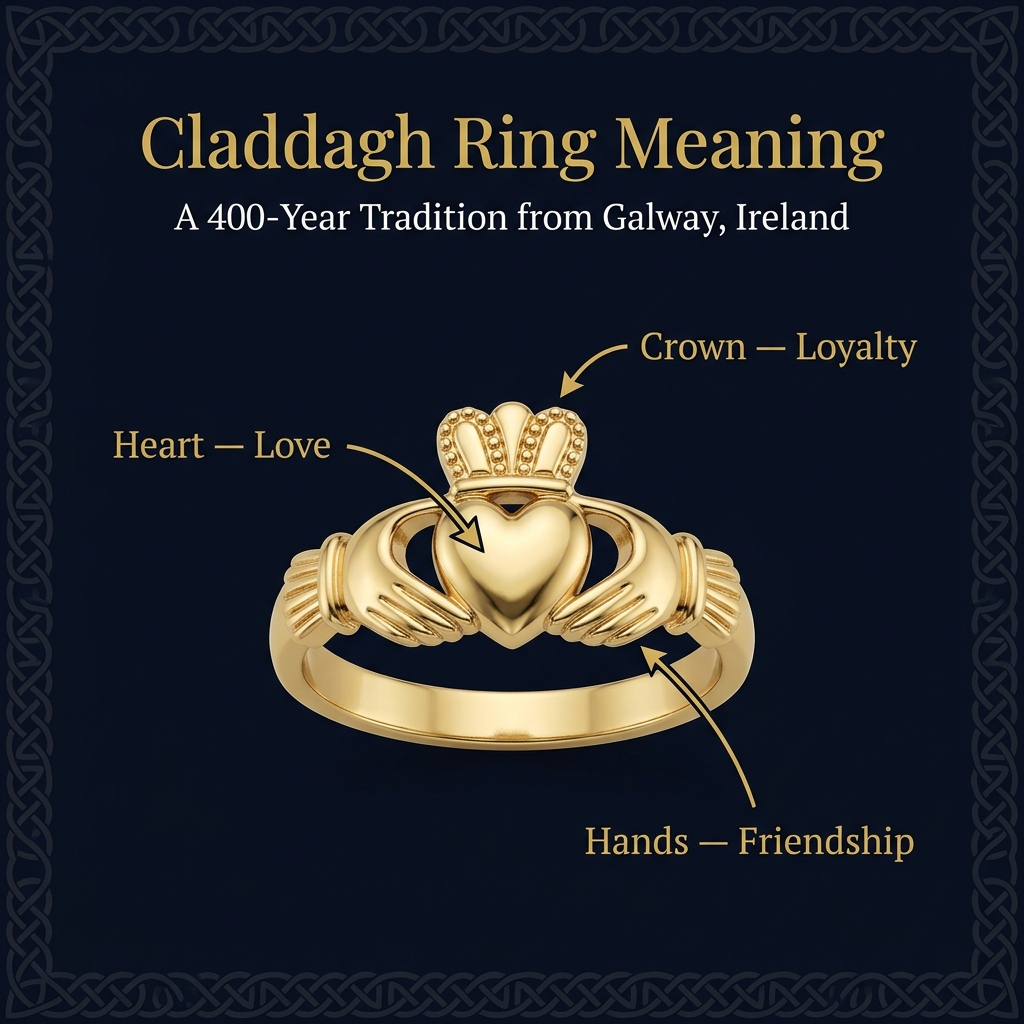
Love. Loyalty. Friendship. A 400-year tradition from Galway, Ireland.
The Claddagh ring is a traditional Irish ring that symbolizes three core values: the heart represents love, the crown represents loyalty, and the two hands represent friendship. Originating from the fishing village of Claddagh in Galway over 400 years ago, it remains one of the world's most recognized symbols of devotion. Irish-made precious metal jewelry is often hallmarked at Dublin Castle — see our Dublin Castle hallmark guide for how to read the marks.
Hallmarked at Dublin Castle · From Galway, Ireland · Irish Assay Office certified

The Claddagh ring is a traditional Irish ring from Galway representing three values: the heart symbolizes love, the crown represents loyalty, and the two clasped hands stand for friendship. Originating in the 17th century, it is worn worldwide as a symbol of Irish heritage and romantic commitment.
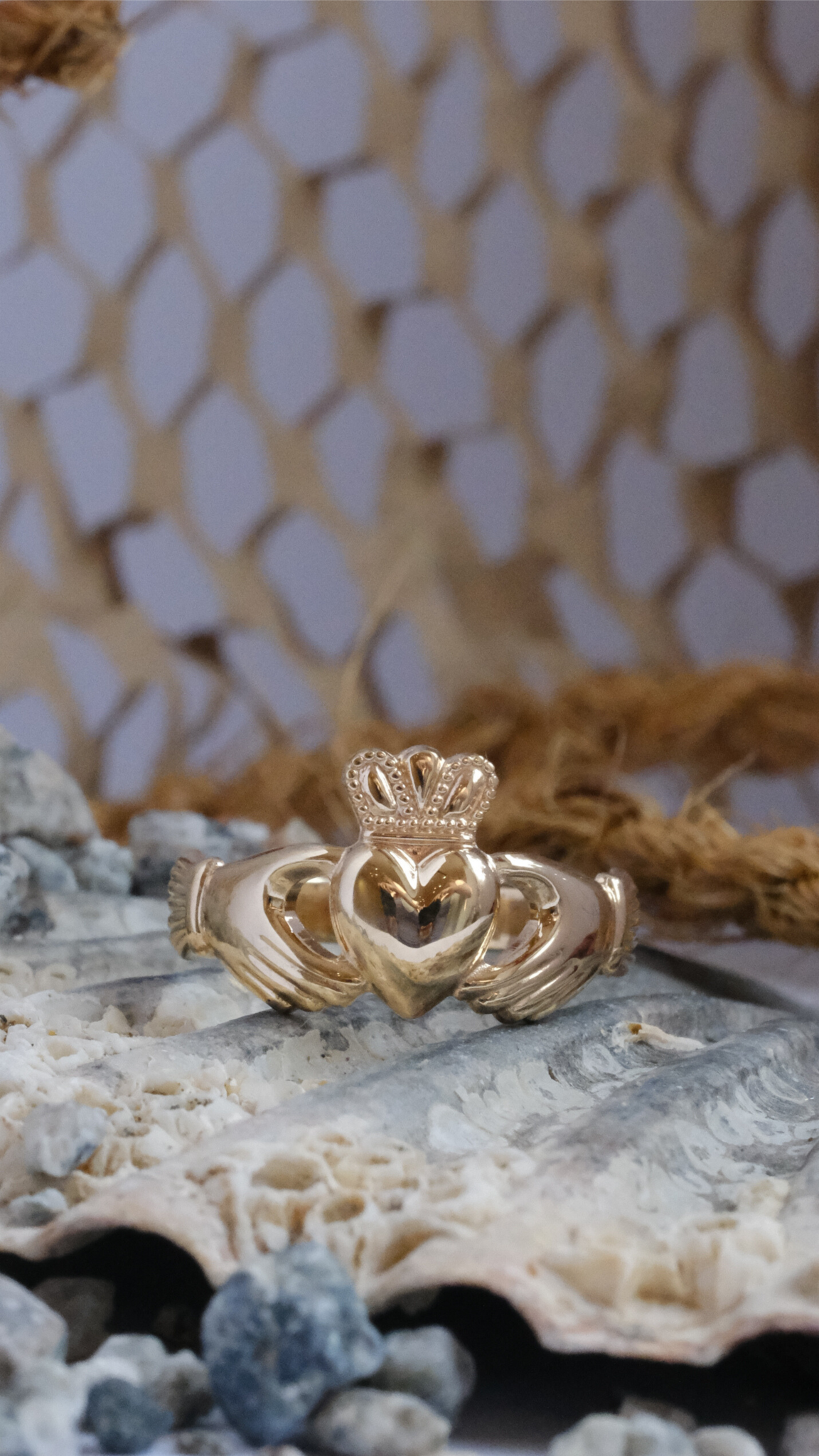
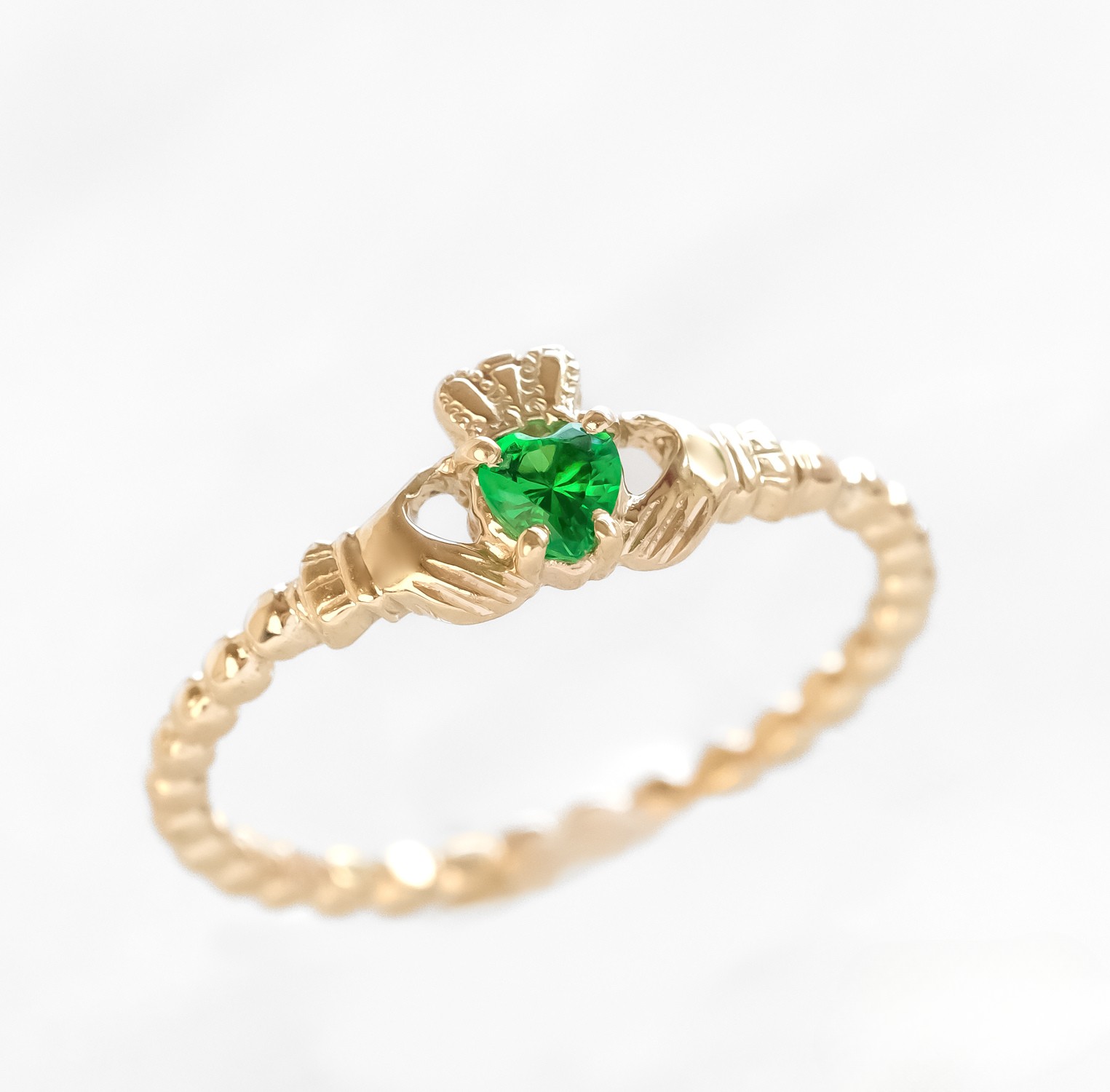
The three symbols of the Claddagh ring each carry a distinct meaning rooted in Irish tradition. The heart at the center represents love, the crown above it represents loyalty, and the two hands holding them represent friendship. Together, these three elements form a complete symbol of devotion that has endured for over 400 years.
Each element carries centuries of meaning. Tap to discover.
Grá
Heart. Love
The heart at the center of every Claddagh ring represents love, not only romantic love, but the deep, lasting love that connects families, friends, and communities across generations. In Irish tradition, giving a Claddagh ring is one of the strongest declarations of affection.
Dílseacht
Crown. Loyalty
The crown resting above the heart symbolizes loyalty: a commitment that never falters. In the words of Irish tradition, the crown declares "with this I give you my loyalty." It speaks to faithfulness in all relationships.
Cairdeas
Hands. Friendship
Two hands cradle the heart and crown, representing friendship, the foundation of all lasting bonds. The hands remind us that true love and loyalty are impossible without genuine friendship.
Hallmarked at Dublin Castle · From Galway, Ireland · Irish Assay Office certified
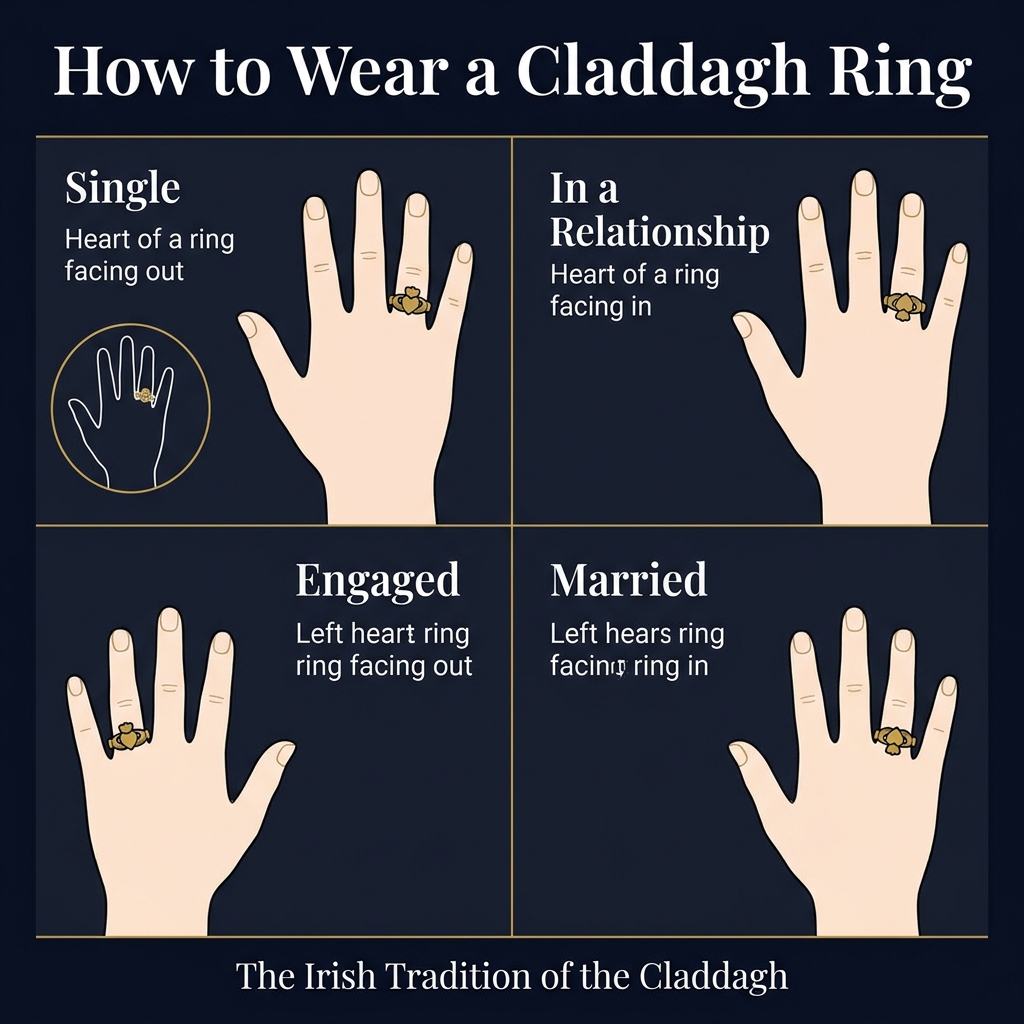
A Claddagh ring is worn differently to signal relationship status. On the right hand with heart facing out means single. Right hand with heart inward means in a relationship. Left hand with heart out means engaged. Left hand with heart facing inward means married.
The way you wear a Claddagh ring signals your relationship status. On the right hand with the heart pointing outward (toward the fingertips) means you are single. Right hand with heart pointing inward (toward the wrist) means you are in a relationship. Left hand with heart pointing outward means you are engaged. Left hand with heart pointing inward means you are married.
Hallmarked at Dublin Castle · From Galway, Ireland · Irish Assay Office certified
Oidhreacht
The Claddagh ring was first created by Richard Joyce, a Galway fisherman captured by Algerian pirates in the 17th century. While enslaved, he learned goldsmithing and crafted the ring as a symbol of his enduring love. Upon his release, he returned to Galway and gave the ring to his beloved.
The Claddagh ring originates from the fishing village of Claddagh in Galway, Ireland. According to legend, Richard Joyce was captured by Algerian pirates and enslaved, where he learned the goldsmith trade. He crafted the first Claddagh ring as a symbol of his enduring love and returned to Galway to give it to his beloved.
In the shadow of Galway Bay, where the River Corrib meets the Atlantic, lay the ancient fishing village of Claddagh. Its people lived by the sea, bound by tradition and the rhythms of the tide.
During the late 17th century, a young man named Richard Joyce was seized from a fishing boat by Algerian pirates. He was taken across the Mediterranean and sold into slavery, a world away from the shores he loved. According to the Galway City Museum, Joyce's captivity lasted approximately 14 years before William III secured the release of British subjects in 1689.
In captivity, Joyce was apprenticed to a Moorish goldsmith. Over the long years, he mastered the art of metalwork. And in the quiet hours, he fashioned a ring — a ring that held everything he longed for: love, loyalty, and the friendship of home.
When William III secured the release of British subjects from slavery, Joyce returned to Galway. He carried with him the ring he had crafted — and gave it to the woman who had waited for him.
Over 30 million Americans claim Irish heritage (U.S. Census Bureau). The Claddagh ring has traveled from a single village in Galway to become one of the world's most recognized symbols of devotion. It is worn in over 100 countries, passed down through generations, given at weddings, engagements, and moments of deep connection. The earliest surviving example, dating to the 1680s, is held by the National Museum of Ireland in Dublin.
Men's Claddagh rings use heavier bands and bolder Celtic details. Read the complete men's guide → for metals, fits, and styles.
Women's styles often feature finer bands, gem-set hearts, and a wider metal range. See our women's Claddagh ring guide → for birthstones, diamonds, platinum, and wearing traditions.
For proposals, read the Claddagh engagement ring guide →. For the village, Richard Joyce, and Fede ring roots, see Claddagh ring history →. For every major Celtic motif in one place, open Celtic symbols and meanings →.
Beyond the Claddagh, Irish and Celtic jewelry draws on knots, crosses, spirals, and other motifs. Celtic knots suggest eternity through endless lines. The Trinity Knot and Triskele express unity and motion. The Celtic cross blends faith with Ireland’s stone-cross tradition. Together these symbols map a visual language of heritage people still wear today.
The Claddagh is one of many powerful symbols in Celtic tradition. Each carries its own meaning and story. Start with the complete Celtic symbols chart → for Claddagh, knots, cross, triskele, Tree of Life, and more. For the Tree of Life (Crann Bethadh) →, Celtic tattoo meanings →, or Irish blessings →, we have dedicated guides.
Next on this site: How to wear a Claddagh ring → · Men's Irish rings → · Women's Claddagh →
A Celtic knot is a pattern of interwoven lines with no clear beginning or end. In Irish art it represents eternity, continuity, and the connection between all things. Knotwork appears in the Book of Kells, on stone crosses, and in modern Celtic jewelry.
The Claddagh symbol combines a heart, crown, and two hands to represent the three pillars of any meaningful bond: love, loyalty, and friendship. Originating from Galway, Ireland, it is given as a token of deep connection and worn to signal one's relationship status.
The Trinity Knot, or Triquetra, is one of the oldest Celtic symbols. Its three interlocking loops have no beginning and no end, representing eternity and the interconnection of life's forces. In Christian tradition, it symbolizes the Holy Trinity; in Celtic tradition, earth, sea, and sky.
The Celtic cross combines a Christian cross with a circle at the intersection, symbolizing the union of heaven and earth. Originating in early medieval Ireland, these crosses dot the countryside as ancient high crosses carved from stone over 1,000 years ago.
The Celtic Tree of Life, or Crann Bethadh, shows a tree with roots and branches intertwined in a circle. It represents the connection between heaven and earth, the balance of nature, and the strength of family bonds that grow deeper with time.
Connemara Marble is found only in the mountains of Connemara, County Galway. At over 900 million years old, it is one of the oldest marbles on earth. Its distinctive green color has made it a beloved symbol of Ireland and a prized material for Celtic jewelry.
St. Brigid's Cross is a traditional Irish cross woven from rushes. Associated with St. Brigid of Kildare, it is placed in homes for protection and blessing. The four-armed design symbolizes the four seasons and the turning of the year in Celtic spiritual tradition.
The Celtic Warrior design draws from Ireland's ancient warrior tradition, featuring bold shield motifs and interlocking knotwork. Worn by those who value strength, resilience, and the courage to protect what matters most. A favorite in men's rings and statement pieces.
The Irish Heritage Quiz asks seven questions about your connection to Irish symbols and traditions — try it after reading, or keep exploring the guides.
Seven questions, then a personal result linking your preferences to Irish heritage.
Hallmarked at Dublin Castle · From Galway, Ireland · Irish Assay Office certified
The heart represents love, the crown represents loyalty, and the two hands represent friendship. It originates from the fishing village of Claddagh in Galway, Ireland, over 400 years ago.
Heart for love, crown for loyalty, hands for friendship. Together they form a complete symbol of devotion that has endured since the late 17th century.
Right hand, heart out: single. Right hand, heart in: in a relationship. Left hand, heart out: engaged. Left hand, heart in: married.
From the fishing village of Claddagh in Galway, Ireland. According to legend, Richard Joyce crafted the first ring while enslaved in North Africa and brought it home around 1689.
Yes. While Claddagh rings are often given as gifts of love or friendship, buying one for yourself is common, particularly as a connection to Irish heritage or as a personal symbol of your values.
The Irish heart ring is called a Claddagh ring. Its distinctive design — a heart held by two hands beneath a crown — originated in Galway and is now worn in over 100 countries.
It can be. Worn on the left hand with the heart pointing inward, a Claddagh ring traditionally signals marriage. Many couples use it as an engagement or wedding ring, especially those with Irish heritage.
Traditionally the ring finger. On the right hand for single or dating, on the left hand for engaged or married. The direction the heart points signals your relationship status.
The tradition dates to the late 1600s. The earliest surviving Claddagh ring, held by the National Museum of Ireland, dates to the 1680s, placing the design's origin in 17th-century Galway.
Men's Claddagh rings feature heavier builds, wider bands, and bolder designs than women's styles. Available in sterling silver and gold, they range from classic to modern Celtic Warrior designs.