

What Is Samhain?
Samhain is the night the door opens.
That is how the ancient Irish understood it. On the evening of October 31, the boundary between the living world and the Otherworld — the realm of the dead, the aos sí, the supernatural — became thin enough to pass through. Spirits could cross into the living world. The living could glimpse the dead. The normal rules did not apply.
The festival falls on November 1 in the Celtic calendar, but celebrations begin at sunset the previous evening because the Celts measured days from sunset to sunset. So October 31 — the evening before — is when Samhain actually starts. That is why Halloween happens on October 31, not November 1.
In Modern Irish, Samhain (pronounced roughly "SOW-in") is simply the word for the month of November. But the original meaning was bigger than a month. Linguists trace the word to Proto-Celtic samoni, meaning "reunion" or "assembly." It was a time when communities gathered — to bring livestock in from summer pastures, to slaughter animals for winter stores, to settle debts, and to honor the dead.
Samhain is one of four major fire festivals in the Celtic calendar. The others are Imbolc (February 1), Beltane (May 1), and Lughnasadh (August 1). Together they divide the year into four quarters. Samhain is the hinge between the light half and the dark half — the moment when summer ends and winter begins.
Early medieval texts describe the festival lasting a full week — three days before, three days after, and the day of Samhain itself. This was not a single night of bonfires. It was a sustained communal event.
Samhain is a Celtic festival observed on November 1, with celebrations beginning at sunset on October 31. It marks the end of the harvest and the start of the "darker half" of the year. The word derives from Proto-Celtic samoni, meaning "reunion" or "assembly." It is the direct ancestor of Halloween — the name "Halloween" is a contraction of "All Hallows' Eve."
How Did Samhain Become Halloween?
The short version: the Church put a Christian holiday on top of a pagan one.
In the 9th century, the Western Church moved the feast of All Saints' Day (All Hallows' Day) to November 1 — directly on top of Samhain. The evening before the feast became "All Hallows' Eve." Say that quickly a few hundred times over a few hundred years and you get Halloween.
This was not an accident. The Church regularly placed Christian feasts on existing pagan dates to ease conversion. The idea: people are already celebrating on this day, so give them something Christian to celebrate instead. Same date, new meaning.
But the old customs did not disappear. They blended. The result was a three-day observance called Allhallowtide — October 31 (All Hallows' Eve), November 1 (All Saints' Day), and November 2 (All Souls' Day). Pagan bonfires continued. Costumes continued. Offerings for the dead continued. The Church absorbed Samhain, but Samhain did not go quietly.
For centuries, Halloween remained an Irish and Scottish tradition — a regional observance tied to Celtic culture. That changed in the 19th century.
Mass Irish and Scottish emigration — driven by the Great Famine (1845-1852) and economic hardship — carried Halloween across the Atlantic. The emigrants brought their customs: turnip lanterns, guising, apple games, bonfires. At first, these traditions were confined to Irish and Scottish immigrant communities. By the early 20th century, they had been adopted into mainstream American culture.
America turned Halloween into a commercial holiday. Ireland gave it the bones.
Was Samhain the Celtic New Year?
This is one of those facts that everyone knows — and that may not be true.
In the 19th century, Celtic scholars John Rhys and James Frazer proposed that Samhain was the "Celtic New Year" — the first day of the Celtic calendar. The idea took hold. It appears in textbooks, museum displays, and countless Halloween articles. It sounds right. The year begins with darkness. The Celts counted from dark to light.
The problem: medieval Irish sources do not say this explicitly. Historian Ronald Hutton and others have pointed out that the early texts describe Samhain as a great assembly and a festival, but they do not call it a "New Year." The concept of a formal new year — January 1, a fixed calendar reset — may not have applied to the Celtic world in the same way.
What we can say with confidence:
- Samhain marked a major division of the year — the start of the dark half
- It was the most important of the four fire festivals
- Legal contracts and debts were settled at Samhain
- The great assemblies held at Samhain functioned like a yearly reset for communities
Whether you call that a "New Year" depends on how strictly you define the term. The Celts may not have used that label. But the function — the sense that something ends and something begins — was there.
Where Is the Birthplace of Halloween in Ireland?
Two sites compete for the title.
Tlachtga — The Hill of Ward
Tlachtga (the Hill of Ward) is a hilltop site in County Meath, about 12 miles from the Hill of Tara. The 17th-century historian Geoffrey Keating wrote that druids lit a great sacred fire here at Samhain. From this fire, all the hearth fires in Ireland were relit — every household's flame began at Tlachtga.
The idea is powerful: one fire, on one hilltop, spreading across an entire island. Darkness made light.
Modern historians like Ronald Hutton note that early medieval records do not explicitly confirm these specific druidic rites. The rituals may have happened. The written evidence is thin. But the site itself is real — a large hilltop enclosure with earthworks that date to the Iron Age.
Today, Tlachtga hosts an annual Samhain fire festival that draws thousands. The fire is lit on the hilltop at sunset on October 31, just as it may have been two thousand years ago.
The Hill of Tara
The Mound of the Hostages (Dumha na nGiall) at the Hill of Tara — Ireland's most important ceremonial site — is aligned with the Samhain sunrise. Light enters the passage tomb on the mornings around November 1 and February 1 (Samhain and Imbolc).
This alignment was built into the tomb roughly 5,000 years ago — at least 3,000 years before anyone wrote down the word "Samhain." The builders of Neolithic Ireland already marked this date. Whatever they called it, they knew it mattered.
The Cave of Cruachan
The Oweynagat ("Cave of the Cats") at Rathcroghan in County Roscommon is described in Irish mythology as a gateway to the Otherworld. Creatures and spirits emerged from this cave during Samhain. The site is a narrow, low cave entrance in a field — unremarkable to look at, enormous in mythology.
Why Were Jack-o'-Lanterns Originally Turnips?
Because pumpkins do not grow in Ireland.
The tradition of carving faces into vegetables at Halloween began in Ireland and Scotland. The lanterns were made from turnips or mangel wurzels (a type of beet) — hard root vegetables hollowed out with a knife. The carved faces were grotesque. The candle inside threw distorted shadows. The purpose was to represent spirits or to ward off evil on the night when the boundary between worlds was thin.
The carved turnip is not a friendly decoration. If you have never seen one, look up a picture. They are unsettling in a way that pumpkin jack-o'-lanterns are not. Pumpkins are round and orange and almost cheerful. A carved turnip looks like something that crawled out of the ground — which, in a sense, it did.
When Irish emigrants arrived in North America in the 19th century, they found pumpkins — a New World crop that was larger, softer, and far easier to carve. The tradition transferred. The vegetable changed. The meaning stayed.
The name "jack-o'-lantern" comes from the Irish legend of Stingy Jack — a man who tricked the Devil and was condemned to wander the earth with only a carved turnip lantern to light his way. He could not enter heaven. The Devil would not take him back to hell. So he walks. The lantern is all he has.
What Ancient Samhain Rituals Survive Today?
More than you think.
Bonfires
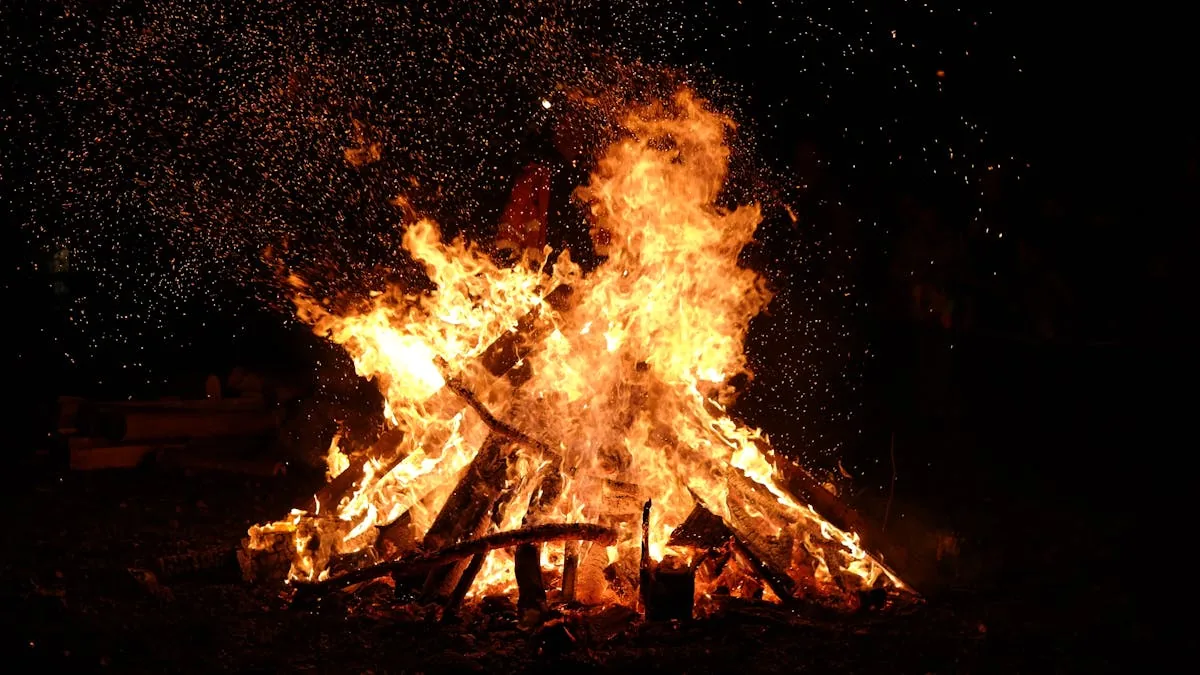
The oldest and most persistent. Samhain bonfires were lit on hilltops across Ireland — a form of "imitative magic" meant to mimic the sun and hold back the approaching darkness of winter. The fire was protection. Stand near it and you were safe. Walk away and you were in the dark, where anything could be.
Bonfires are still lit on Halloween night across Ireland. In some Dublin neighborhoods, building the bonfire is a weeks-long communal project involving wooden pallets stacked three stories high.
Guising (Costumes)
From at least the 16th century, people in Ireland and Scotland practiced "guising" — going house-to-house in disguise, performing songs or verses in exchange for food or drink. The disguises served a purpose: they allowed you to impersonate the aos sí (spirits) and receive offerings on their behalf, or to hide from real spirits who might recognize you.
This is the direct ancestor of trick-or-treating. The costumes are the same idea. The treats are the same idea. The origin is a 500-year-old Irish custom.
Divination Games
Samhain was the night when the future could be seen. Divination games were played with apples and nuts:
- Apple-bobbing — catching an apple with your teeth from a basin of water. The first person to catch one would be the first to marry.
- Nut-crack night — two hazelnuts placed on the fire, one named for each half of a couple. If they burned steadily, the relationship was strong. If one popped and flew away — trouble.
- Colcannon rings — a ring hidden in a dish of colcannon (mashed potatoes with cabbage). Whoever found the ring in their portion would marry within the year.
These games survive as Halloween party activities. The divinatory meaning is mostly forgotten. The games themselves are not.
Is There Archaeological Evidence for Samhain?
Yes. And it goes back further than you expect.
The Coligny Calendar
The strongest pre-medieval evidence comes from the Coligny Calendar — a 2nd-century CE bronze tablet found in Coligny, France. It records a Gaulish calendar in the Celtic language. The calendar names the month SAMON and includes a three-night festival called TRINOX SAMONI — "three nights of Samoni." This is the earliest written reference to something recognizably connected to Samhain.
The calendar is Gaulish, not Irish. But it demonstrates that a festival on this date was observed across the Celtic world — not just in Ireland and Scotland, but in continental Europe.
Passage Tomb Alignments
The Mound of the Hostages at the Hill of Tara is aligned with the sunrise at Samhain and Imbolc — built around 3200 BC, roughly the same age as Newgrange. The builders chose this alignment deliberately. They could have aligned it with any sunrise. They chose the ones that mark the Celtic fire festivals.
Bog Bodies
Some archaeologists believe that ancient bog bodies — preserved human remains found in Irish peat bogs — represent people who were ritually sacrificed around the time of Samhain. Old Croghan Man, found in County Offaly and dating to 362-175 BC, shows signs of ritualized killing: nipples sliced (to deny him sovereignty, according to one theory), arms pierced with hazel rods, body placed at a territorial boundary.
The connection to Samhain is circumstantial but persistent. The dates, the locations (boundary sites), and the nature of the killings point to seasonal sacrifice connected to the turning of the year.
Explore Ireland's Heritage
- Celtic Festivals — Samhain, Imbolc, Beltane & Lughnasadh
- Irish Mythology & Legends — The Tuatha Dé Danann, Cú Chulainn & more
- Irish History Guide — 5,000 years that shaped Ireland
- Celtic Symbol for Protection — Shield Knot, Brigid's Cross & Irish wards
- Brigid's Cross Meaning — Imbolc, the festival that mirrors Samhain
- St. Patrick's Day — Ireland's other great festival
- ← Back to all guides — The complete Irish heritage hub