

Why the Irish Harp? Ireland's Official Symbol
The harp has been Ireland's official national emblem for centuries — the only country on Earth to use a musical instrument as its state symbol. It appears on Irish euro coins, passports, and the presidential seal. The design comes from the medieval Trinity College harp, a 14th-century instrument preserved at Trinity College Dublin. Wearing a harp means wearing Ireland itself.
The Irish harp, or cláirseach, holds a position unlike any other symbol. It is not folklore or mythology — it is the legal emblem of the Republic of Ireland. When you hold an Irish euro coin, you're holding the harp. When you open an Irish passport, it's on the cover. The harp that appears on all of this is based on one specific object: the Trinity College harp, a 14th-century medieval instrument displayed at Trinity College Dublin, metres from the Book of Kells.
Harpists were among the highest-ranked members of Gaelic society, equal in status to the poet and the judge. A chieftain without a harpist was considered incomplete. When English colonial rule attempted to suppress Gaelic culture, the harp became a symbol of resistance. It survived. Today it is the state emblem.
→ For the full history of the harp symbol, see our Irish Harp Meaning guide.
Irish Harp Pendants — The Most Popular Style
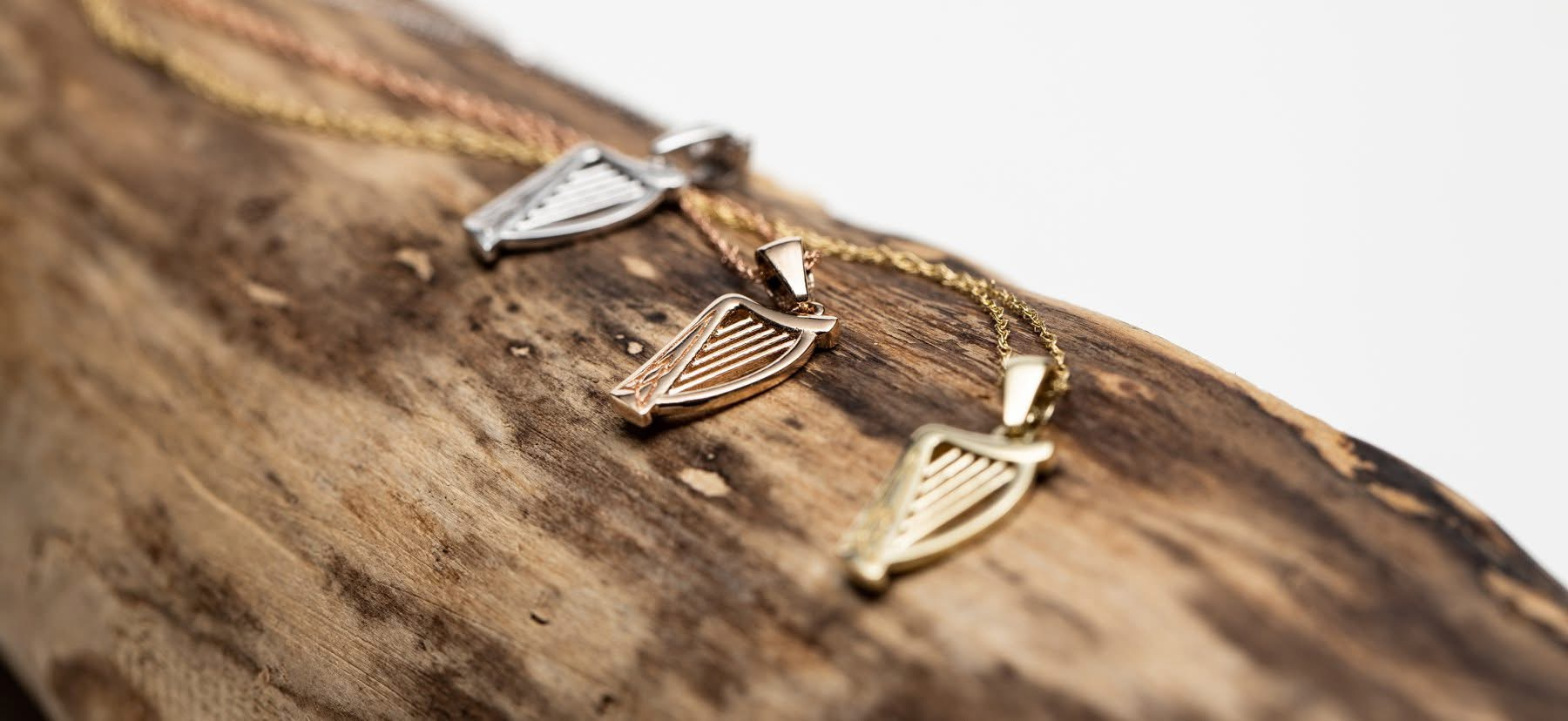
Irish harp pendants are modelled on the Trinity College harp — a 14th-century Gaelic instrument at Trinity College Dublin that provides the blueprint for the national emblem. Available in sterling silver (from ~€49) and 9kt or 10kt yellow gold (from ~€215). Stone variants include Cubic Zirconia accents and Connemara marble, Ireland's native green stone.
The pendant is the most common way to wear the harp. Most designs replicate the distinctive silhouette of the Trinity College harp — its curved forepillar, triangular frame, and row of string pins that inspired Ireland's coat of arms.
Sterling silver options are the starting point — classic, everyday pieces that work as birthstone gifts and Irish heritage keepsakes. CZ-accented versions catch the light against the harp's strings. The entry price for a silver harp pendant and chain sits around €49–72.
9kt yellow gold elevates the harp to heirloom territory. A simple gold harp pendant starts at ~€215; larger versions with Celtic knotwork framing it rise to €525 and beyond. Gold carries the Dublin Castle hallmark — the legal proof that the piece was assayed and certified in Ireland.
Connemara marble variants combine two Irish symbols in one piece: the national harp and the native green stone quarried in Connemara, County Galway. The marble's distinctive green veining against polished silver is one of the most distinctively Irish combinations in jewelry.
Harp Earrings — From Studs to Statement Drops
Irish harp earrings range from small sterling silver studs (~€39) to rose gold drop earrings (~€204). Styles include stud earrings for everyday wear, drop earrings for formal occasions, and Connemara marble harp drops that pair the national emblem with Ireland's native green stone.
The earring range covers every occasion:
- Harp stud earrings in sterling silver — the subtlest version, ~€39–50. Understated Irish identity for daily wear.
- Harp drop earrings in silver — the harp shape pendant on a post, ~€80–92. Clear visual, feminine silhouette.
- Connemara marble harp drop earrings — marble disc with harp motif, ~€77. Pairs Ireland's national symbol with its geological signature.
- Rose gold and silver harp earrings — the warmest, most contemporary finish. Statement earrings for events, ~€189–204.
Harp earrings work as a standalone Irish heritage gift or as a matching set alongside a harp pendant.
Harp Jewelry as an Irish Gift
Irish harp jewelry is a common gift for the Irish diaspora — particularly for St Patrick's Day, graduations, and birthdays. The harp is Ireland's legal national emblem, giving harp jewelry a significance that generic Celtic gifts lack. Sterling silver pieces from ~€49 make accessible Irish heritage gifts; gold harp pieces serve as milestone gifts.
The harp's position as the actual state symbol of Ireland gives harp jewelry a meaning that shamrock designs cannot match. When someone in Boston, Chicago, or Sydney receives a harp pendant, they are receiving Ireland's national emblem — not a tourist souvenir, but the same image that appears on the country's coins and official documents.
When to give:
- St Patrick's Day — the most popular occasion for Irish heritage gifts to diaspora family
- Graduations — a gold harp pendant or charm marks a milestone with lasting significance
- Birthdays for Irish-American relatives — connecting second and third-generation Irish to their heritage
- Weddings — a harp and Claddagh combination covers both Irish symbolism and Irish love traditions
- Christmas — the harp has year-round relevance, not the seasonal limitation of shamrock designs
How to Choose Irish Harp Jewelry
Choose sterling silver for everyday wear at €49–107; 9kt gold for milestone gifts at €215–545. CZ accents suit those wanting sparkle; Connemara marble suits those wanting Irish provenance. Pendants are the most versatile style; studs work for daily wear. All authentic pieces carry Dublin Castle hallmarks certifying the metal was assayed in Ireland.
Metal:
Sterling silver is practical and affordable for daily wear. Yellow gold — 9kt or 10kt — is for milestone gifts: the piece someone keeps for decades. All authentic Irish gold and silver carries the Dublin Castle hallmark, the legal assay mark certifying the metal in Ireland.
Stone or plain?
Plain metal: clean, classic, works with everything.
CZ accents: adds sparkle without the cost of diamonds.
Connemara marble: adds Irish geological provenance — the stone itself is from Ireland.
Style:
Pendant — most versatile, visible, easiest to gift.
Earrings — better for those who wear minimal necklaces.
Charm — works on bracelet or chain, adaptable.
Matching a Claddagh ring:
The Claddagh (love, loyalty, friendship) and the harp (national identity, cultural heritage) are complementary rather than competing. A silver harp pendant alongside a silver Claddagh ring is a coherent, full Irish identity look.