

How Did the Celtic Calendar Work?
The four major Celtic festivals (Samhain, Imbolc, Beltane, and Lughnasadh) divided the Irish year into quarters. They are fire festivals aligned with the cross-quarter days of the astronomical calendar. Samhain marked the Celtic New Year and is the direct origin of modern Halloween. The oldest evidence for this calendar is the 2nd-century Coligny Calendar from Gaul. These festivals have been observed in Ireland for over 2,000 years.
The Celts divided the year into two halves: the dark half (winter, beginning at Samhain) and the light half (summer, beginning at Beltane). Each half was further divided by a midpoint festival, creating the four great fire festivals. These fall on what astronomers call "cross-quarter days," roughly midway between the solstices and equinoxes. Archaeological evidence confirms the connection: the Mound of the Hostages at Tara and Cairn L at Slieve na Calliagh are aligned with the sunrise at Samhain and Imbolc.
| Festival | Date | Season | Meaning |
|---|---|---|---|
| Samhain | November 1 | Start of winter / Celtic New Year | The veil between worlds thins |
| Imbolc | February 1 | First stirrings of spring | Saint Brigid's Day, purification |
| Beltane | May 1 | Start of summer | Fire, fertility, growth |
| Lughnasadh | August 1 | Start of harvest | First fruits, games, gatherings |
These festivals were rooted in the pastoral and agricultural calendar, the rhythms of livestock breeding, planting, and harvest that governed everyday life in ancient Ireland. But they were also mapped to astronomical events, as the passage tombs prove.
The oldest evidence for these celebrations comes from outside Ireland entirely. The Coligny Calendar, a 2nd-century bronze tablet found in Gaul (modern France), identifies a month named SAMON and a specific three-night festival called TRINOX SAMONI. Researchers believe this is the Continental Celtic precursor to the Irish Samhain.
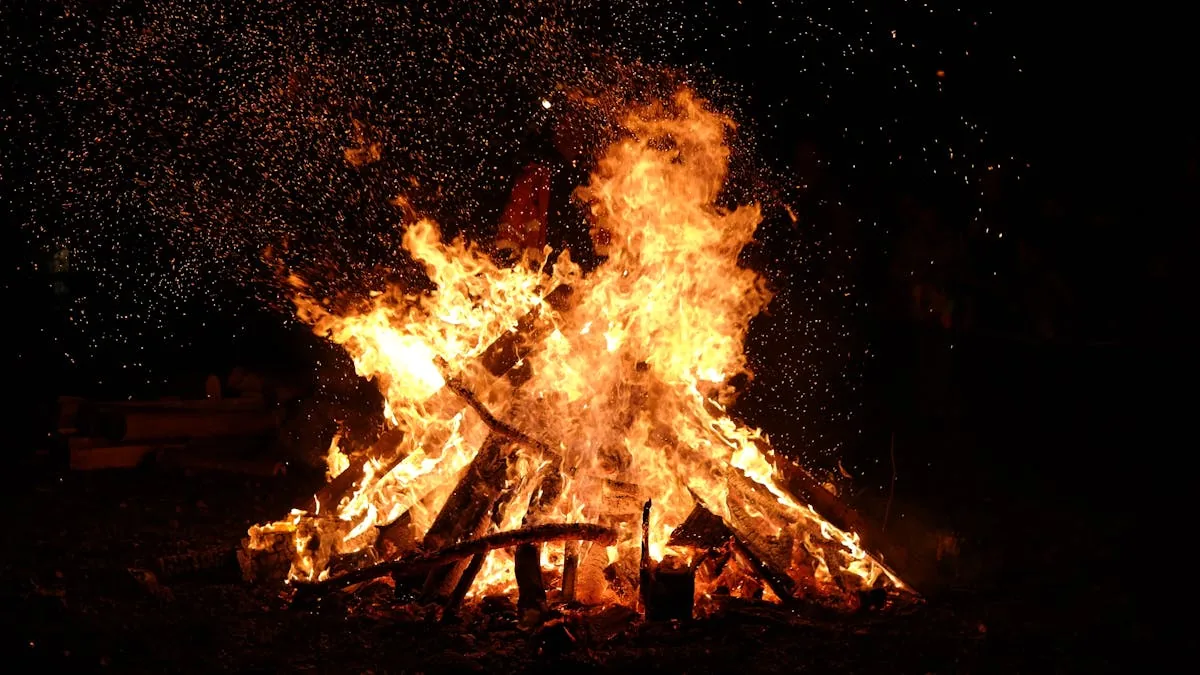
The festivals were marked by fire. Great bonfires were lit on hilltops, sometimes two fires side by side, with cattle driven between them for purification. Fire was understood as a transformative force, capable of cleansing, protecting, and marking the passage from one season to the next.
Samhain — The Origin of Halloween
Halloween originated from the ancient Irish festival of Samhain (pronounced SOW-in), celebrated on October 31–November 1. The Celts believed the boundary between the living and spirit worlds thinned on this night. Irish traditions of costumes, carved turnips, bonfires, and leaving food for spirits were brought to America by Irish immigrants in the 19th century.
Date: October 31 – November 1
Pronunciation: SOW-in (rhymes with "cow-in")
Search volume: 60,500/mo
Samhain is the ancestor of Halloween. Every element of the modern holiday — costumes, carved lanterns, trick-or-treating, ghost stories — traces directly back to this ancient Irish festival.
Samhain marked the end of the harvest season and the beginning of the Celtic New Year. On this night, the Celts believed that the boundary between the living world and the Otherworld (the realm of spirits, gods, and the dead) grew thin enough to cross. The word "Samhain" was long translated as "summer's end," but modern linguists now trace it to the Proto-Celtic samoni, meaning "assembly" or "reunion."
What happened at Samhain:
| Tradition | Purpose | Modern Equivalent |
|---|---|---|
| Bonfires on hilltops | Cleansing, protection, guiding spirits | Halloween bonfires |
| Disguises and costumes | Confusing or hiding from spirits who crossed the veil | Halloween costumes |
| Carved turnips with candles | Jack-o'-lanterns to ward off evil spirits | Carved pumpkins (Irish immigrants switched to pumpkins in America) |
| Leaving food at the door | Offerings for visiting spirits | Trick-or-treating |
| Divination games | Predicting marriages, futures, fortunes | Apple bobbing, fortune-telling |
| Dumb suppers | Silent meals set for the dead | Day of the Dead traditions |
The connection between Samhain and Halloween is not metaphorical. It is direct and documented. When Irish emigrants arrived in America in the 19th century, they brought Samhain traditions with them. American Halloween is Irish Samhain, adapted to a new country with different produce (pumpkins instead of turnips).
According to the Fenian Cycle, every Samhain for 23 years, a fire-breathing being named Aillen emerged from the Otherworld to lull the court at Tara to sleep with music and burn down the royal palace. This ended only when the young Fionn mac Cumhaill stayed awake by pressing a red-hot spear against his own forehead, then slew the creature.
H3: The Hill of Tlachtga — Ireland's Samhain Capital
The ancient Samhain fire festival centered on the Hill of Tlachtga (now called the Hill of Ward) near Athboy in County Meath, just 12 miles from the Hill of Tara. The great Samhain bonfire was lit here first, and its flames signaled other hilltop fires to be lit across the country.
Imbolc — Saint Brigid's Day and the First Light of Spring
Date: February 1
Pronunciation: IM-bulk
Search volume: 22,200/mo
Imbolc marks the first stirrings of spring, the moment when the days begin to lengthen noticeably and the first ewes begin to lactate. The word "imbolc" likely derives from "i mbolg" meaning "in the belly," referring to pregnant ewes.
This festival belongs to Brigid, both the Celtic goddess of fire, poetry, and healing, AND Saint Brigid of Kildare, one of Ireland's three patron saints. The two figures are almost certainly connected. Saint Brigid absorbed the mythology and sacred sites of her pagan predecessor.
Traditional weather lore held that Imbolc was the day the Cailleach (the divine hag of winter) gathered her firewood for the rest of the season. If Imbolc was sunny, she was gathering extra wood to make winter last longer. Foul weather on February 1 was welcomed as a sign that the Cailleach was asleep and winter was nearly over.
Imbolc traditions:
- Saint Brigid's crosses: woven from rushes on the eve of Imbolc and placed above doorways for protection. This tradition is practiced throughout Ireland to this day
- Spring cleaning: symbolic purification of the home after winter
- Lighting candles: representing the return of light
- Visiting holy wells: Brigid's wells are found across Ireland, many still decorated with offerings
In 2023, Ireland made February 1 an official public holiday — Saint Brigid's Day — making it the newest addition to the Irish calendar and the first Irish public holiday named after a woman.
Beltane — Fire and the Beginning of Summer
Beltane (May 1) is the ancient Celtic festival marking the beginning of summer. The word is linked to "bright fire." Two great bonfires were lit, and cattle were driven between them for purification. It is the counterpart to Samhain: Beltane opens the light half of the year, Samhain opens the dark.
Date: May 1
Pronunciation: BEL-tane
Search volume: 33,100/mo
Beltane marks the beginning of summer, the moment when cattle were driven to their summer pastures and the land burst into full growth. It is the counterpart to Samhain: if Samhain opens the dark half of the year, Beltane opens the light.
The word "Beltane" is often linked to "bright fire," though some scholars have connected it to a Celtic god Bel (Belenus). The evidence for this link is thin; it rests almost entirely on a single 10th-century text, Sanas Cormaic, and some researchers believe the author was attempting to create a false connection to the Biblical Baal. What is certain is that fire was the defining ritual: two great bonfires were lit on hilltops, and cattle were driven between them. The smoke and heat were believed to purify and protect the herd from disease for the coming season.
Beltane traditions:
- Twin bonfires: cattle driven between for purification
- Hawthorn decorations: hawthorn (the "fairy tree") blossoms in May; branches were brought into homes
- May Bush: a decorated bush or branch placed outside the home, hung with ribbons, flowers, and bright cloth
- Dew washing: walking barefoot in the morning dew for health and beauty. Rolling in the dew was believed to bring good fortune
- Maypole dancing: associated more with English tradition but observed in some Irish communities
Lughnasadh — The Harvest Festival
Date: August 1
Pronunciation: LOO-na-sa
Search volume: 9,900/mo
Lughnasadh is the harvest festival, the celebration of the first fruits of the season. It is named after Lugh, the Celtic god of light, skill, and craftsmanship, who established the festival as funeral games in honor of his foster mother Tailtiu, who died from clearing the plains of Ireland for agriculture.
Lughnasadh was the great gathering festival. Communities came together for fairs, athletic competitions, horse races, matchmaking, and feasting. The most famous gathering was the Tailteann Games, an Irish equivalent of the Olympic Games held annually at Teltown in County Meath.
Lughnasadh traditions:
- First harvest offerings: the first grain was cut and baked into a ceremonial loaf
- Hilltop gatherings: climbing local hills and mountains to celebrate. The Reek Sunday pilgrimage up Croagh Patrick preserves this tradition
- Athletic games and competitions: running, wrestling, horse racing
- Trial marriages: at Lughnasadh fairs, young couples could join hands through a hole in a wooden door to be "married" for a year and a day. At the next Lughnasadh, they could either make the arrangement permanent or dissolve it without legal consequences
- Bilberry picking: gathering wild bilberries (fraughan) on hilltops. "Fraughan Sunday" is still celebrated in some Irish communities
H3: Croagh Patrick — Where Lughnasadh Lives On
The annual pilgrimage up Croagh Patrick in County Mayo, known as "Reek Sunday" and held on the last Sunday of July, is a direct continuation of the Lughnasadh tradition of hilltop gatherings. Over 25,000 people climb the mountain each year, many barefoot, in an unbroken tradition stretching back thousands of years.
Celtic Festival Symbols in Irish Jewelry
The symbols and themes of the four Celtic festivals are woven into Irish jewelry design:
| Festival | Symbol | In Jewelry |
|---|---|---|
| Samhain | The spiral, the raven | Triskele spirals representing the cycle of death and rebirth |
| Imbolc | Saint Brigid's Cross, the flame | Brigid's Cross pendants, fire-inspired designs |
| Beltane | The tree, the green man | Tree of Life pendants, nature motifs |
| Lughnasadh | The wheat sheaf, interlace | Celtic knotwork representing the interconnection of community |
Celtic jewelry carries the same understanding of cycles that the festivals express. The knotwork has no beginning and no end, just as the Celtic year is a wheel that turns continuously through dark and light, death and life, winter and summer.
Explore More Irish Heritage
- Celtic Symbols and Meanings: The complete symbol guide
- Triskele Meaning: Ireland's ancient spiral
- Irish History: From the Celts to modern Ireland
- St. Patrick's Day: Ireland's patron saint
- ← Back to all guides: Irish heritage hub