
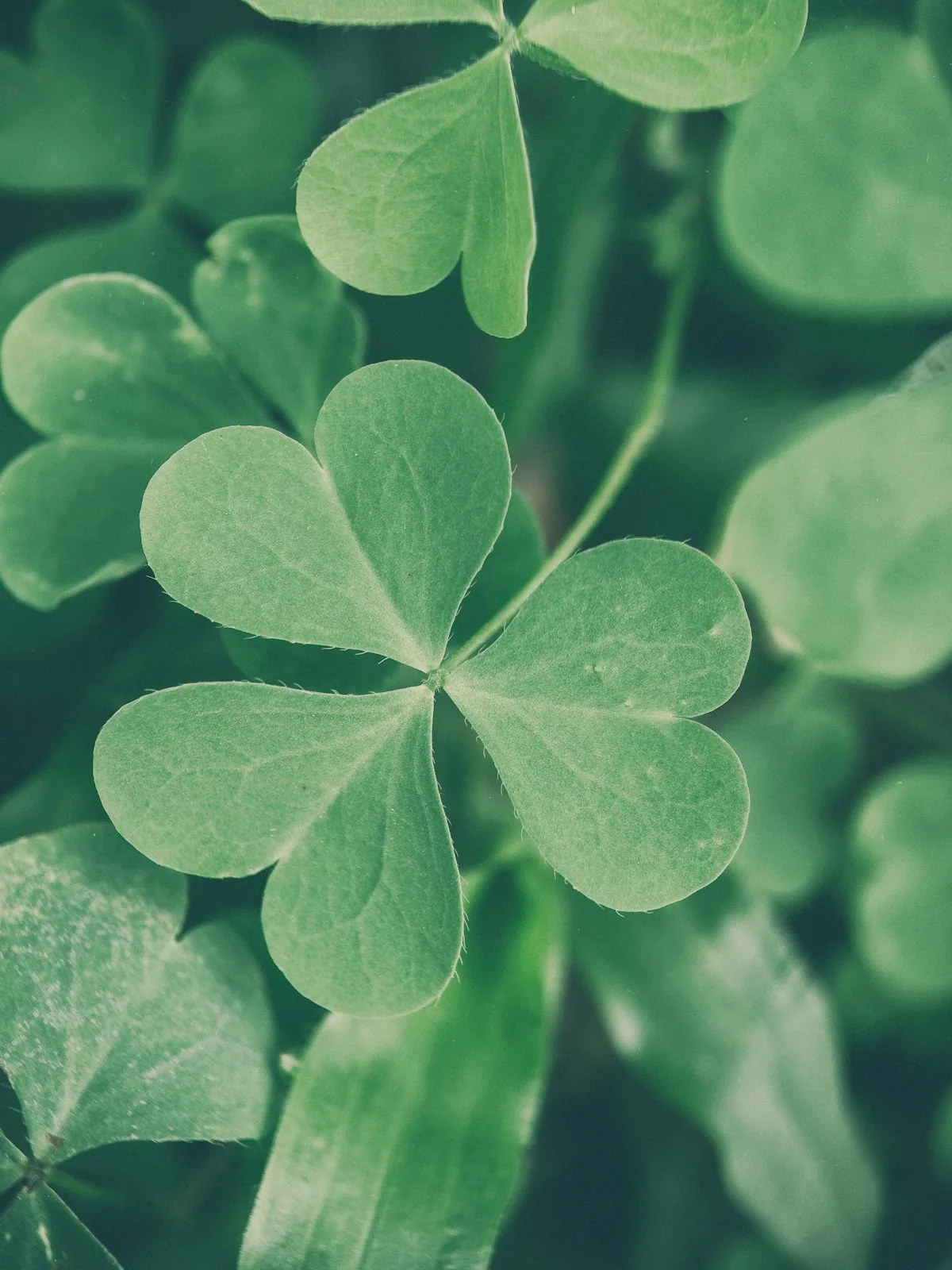

What Is a Shamrock?
The shamrock (seamróg) is a three-leaf clover used by St. Patrick in the 5th century to explain the Holy Trinity to the pagan Irish. It became Ireland's most recognized symbol and is worn on St. Patrick's Day (March 17). The shamrock is not Ireland's official symbol — the harp is — but it is the most widely associated emblem of Irish identity worldwide.
A shamrock is a young sprig of clover with three leaves — the Irish word is seamróg (pronounced SHAM-rohg), a diminutive of seamair, the Irish word for clover. It means "little clover."
The plant itself is ordinary. You have walked past thousands of them. Shamrocks grow across Ireland, Britain, and most of the temperate world. They are not rare, not exotic, and not botanically remarkable.
What makes the shamrock extraordinary is what it came to represent.
In the 5th century, St. Patrick — the missionary who brought Christianity to Ireland — is said to have picked a shamrock from the ground and used its three leaves to explain one of Christianity's most difficult concepts: the Holy Trinity. Three leaves, one stem. Father, Son, Holy Spirit — three persons, one God.
Whether this story is historically accurate or a later legend hardly matters. The Irish took the shamrock as their own. It became Ireland's national emblem — worn on St. Patrick's Day (March 17), embroidered on military regiments, printed on passports, and exported across every ocean by the Irish diaspora.
The shamrock is not Ireland's official national symbol (that is the harp), but it is Ireland's most visible one. When people anywhere in the world think "Ireland," they picture a shamrock.
Shamrock vs Four-Leaf Clover — They Are Not the Same
A shamrock has three leaves and symbolizes the Holy Trinity — it is Ireland's national emblem, used by St. Patrick to teach Christianity. A four-leaf clover has four leaves and symbolizes luck — it is a separate tradition from European folklore. They are different plants with different meanings. The shamrock is the correct Irish symbol.
This is the most common confusion. A shamrock has three leaves. A four-leaf clover has four leaves. They are different plants, different symbols, and different traditions.
| Shamrock (3 leaves) | Four-Leaf Clover (4 leaves) | |
|---|---|---|
| Meaning | Holy Trinity, Irish identity, faith | Luck |
| Origin | Irish — St. Patrick, 5th century | European folklore — not specifically Irish |
| Rarity | Common — grows everywhere | Rare — approximately 1 in 5,000 clovers |
| National symbol | Yes — Ireland's emblem | No — just a lucky charm |
| St. Patrick's Day | Worn on March 17 | Sometimes confused with shamrock |
| Religious significance | Christian Trinity teaching | None |
The shamrock is about faith and identity. The four-leaf clover is about luck. They grow from the same genus of plant (Trifolium), but the fourth leaf is a genetic mutation — a fluke, not a symbol.
When Americans celebrate St. Patrick's Day, they often display four-leaf clovers thinking they are shamrocks. They are not. If it has four leaves, it is not a shamrock. If you want to honor the Irish tradition correctly, look for three.
St. Patrick & the Shamrock — How a Leaf Changed a Country
St. Patrick arrived in Ireland around 432 AD. He was not Irish — he was a Romano-British Christian who had been kidnapped by Irish raiders as a teenager, enslaved for six years in Ireland, escaped, and returned years later as a missionary.
Patrick faced a specific challenge: explaining the concept of the Trinity — three divine persons in one God — to people who had no framework for it. The Irish Celts were polytheistic. They understood many gods, but the idea of one God who was simultaneously three was abstract to the point of absurdity.
According to tradition, Patrick reached down, picked a shamrock from the ground, and held it up. Three leaves. One plant. Three persons. One God. The physical object made the abstract idea tangible.
The Irish were already a people who found meaning in nature — trees, rivers, stones, animals all carried symbolic weight in Celtic culture. A teaching tool drawn from the earth itself landed differently than an imported theological argument. Patrick spoke their language — literally (he had learned Irish during his enslavement) and symbolically.
Within two centuries, Ireland was not just Christian — it was a Christian intellectual powerhouse, producing monks who would preserve Western learning through the Dark Ages. And the shamrock, the little teaching device that started it all, became the permanent emblem of the transformation.
The Shamrock Through Irish History
Medieval Ireland
The shamrock appears in Irish manuscripts and heraldry from the medieval period onward. It became associated with Irish identity — wearing a shamrock on your clothing identified you as Irish, Roman Catholic, and proud of both. During periods of English rule, this identification was not always safe.
The Penal Laws (1695-1829)
When the English Penal Laws suppressed Irish Catholic culture — banning Catholic worship, education, and property rights — the shamrock became an act of quiet resistance. Wearing it said: I am Irish. I am Catholic. I have not forgotten. The symbol became more powerful precisely because it was suppressed.
The Irish Volunteers and 1798 Rebellion
Irish nationalist movements adopted the shamrock as a symbol of resistance and identity. Wearing green and shamrocks became a political statement — one that could get you arrested.
Modern Ireland
Today, the shamrock is Ireland's global calling card. The Irish government uses a shamrock logo. The Taoiseach (Irish Prime Minister) presents a bowl of shamrocks to the US President every St. Patrick's Day at the White House — a tradition since 1952.
Shamrock Jewelry — Wearing Ireland's Symbol
The shamrock translates naturally into jewelry — its three-leaf shape fits cleanly into pendants, earrings, rings, and brooches.
Common shamrock jewelry styles:
- Shamrock pendants — the most popular style. Sterling silver or gold, sometimes set with green stones (emerald, green onyx, Connemara Marble)
- Shamrock earrings — simple studs or drop earrings. Popular for St. Patrick's Day and everyday Irish heritage wear
- Shamrock rings — the trefoil shape on a band, sometimes combined with Celtic knotwork
- Shamrock brooches — traditional style, often in Connemara Marble (Ireland's 900-million-year-old green stone)
- Shamrock and Claddagh combinations — the shamrock incorporated into the Claddagh design, merging two Irish symbols
Green gemstones connect the shamrock to its roots: emerald (May birthstone, Mohs 7.5-8), Connemara Marble (exclusively Irish, Mohs 3-4, pendants/brooches only), and peridot (August birthstone, vivid yellow-green).
All Irish-made precious metal shamrock jewelry carries the Dublin Castle hallmark — the same certification applied to Claddagh rings.
Shamrock Jewelry & Symbols for Men
Men wear shamrock symbols as a declaration of Irish identity — on jewelry, on clothing, and as tattoos:
Most popular shamrock styles for men:
- Shamrock cufflinks — sterling silver or gold. The most understated way to wear the symbol in professional settings.
- Shamrock tie pins — Celtic knotwork versions connect Irish heritage to formal wear.
- Celtic cross with shamrock — a combined design popular in pendants and rings. Faith and identity together.
- Shamrock tattoos — often integrated into Celtic sleeve designs. The shamrock adds an explicitly Irish element to a broader Celtic artwork.
- Shamrock in Ogham — the word "seamróg" spelled in Ireland's ancient tree alphabet, worn as a bracelet or ring engraving.
The shamrock is one of the few Irish symbols that is immediately recognized worldwide — wearing it eliminates any ambiguity about Irish heritage.
Shamrock Jewelry for Women — Ireland's Green Heritage
Women's shamrock jewelry ranges from delicate everyday pieces to statement heritage items:
Most popular shamrock styles for women:
- Shamrock pendant necklaces — the most gifted style. A sterling silver or gold shamrock on a fine chain sits elegantly for daily wear.
- Shamrock stud earrings — small, simple, and perfect for everyday Irish heritage connection.
- Shamrock and Trinity Knot combinations — merging two Irish symbols in one piece. Trinity Knot leaves on the shamrock add a layer of Celtic meaning.
- Connemara Marble shamrock brooches — Ireland's own stone, carved into Ireland's own symbol. A uniquely Irish gift.
- Shamrock birthstone pieces — a green gemstone (emerald or peridot) set into the shamrock for a personalized touch.
The shamrock is especially popular around St. Patrick's Day (March 17) and Irish-American Heritage Month (March) — but many women wear it year-round as a permanent connection to Ireland.
Explore Irish Symbols
- Celtic Symbols and Meanings — Every symbol explained
- Irish Harp — Ireland's official symbol
- Trinity Knot Meaning — The three-pointed Celtic knot
- Celtic Cross Meaning — Faith meets tradition
- Connemara Marble — Ireland's 900-million-year-old stone
- Claddagh Ring Meaning — Love, loyalty & friendship
- ← Back to all symbols — The complete heritage hub