
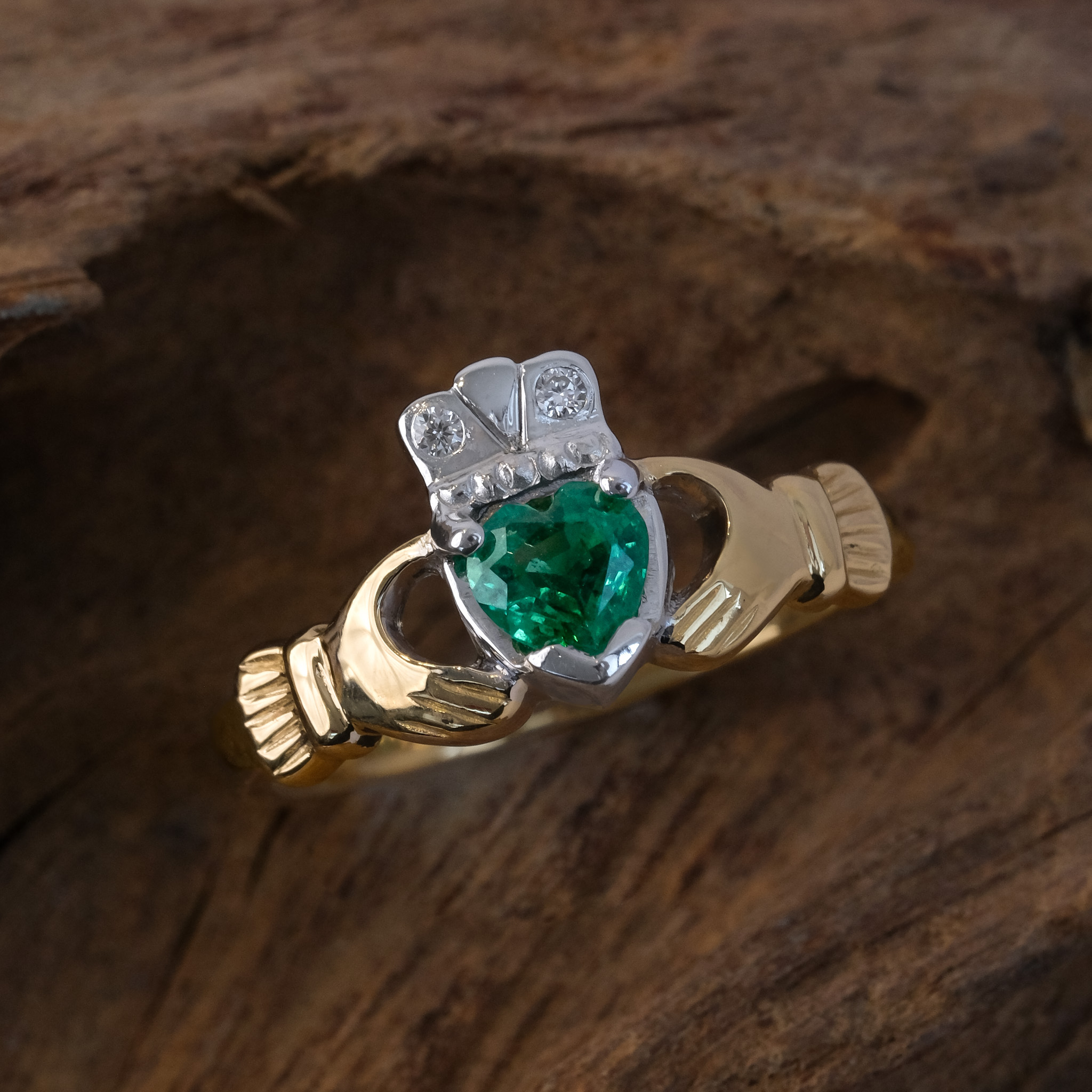

The Claddagh Ring Was a Promise Ring Before Promise Rings Existed
Modern promise rings became popular in the 1990s and 2000s — a pre-engagement commitment, a declaration of intention before the formal proposal. The Claddagh ring has been doing this since the 1600s.
The Claddagh ring's entire design is a promise. The heart promises love. The hands promise friendship. The crown promises loyalty. When Richard Joyce created the first Claddagh ring in Galway, he was making a promise to the woman he loved — a physical expression of commitment created during 14 years of captivity in Algiers.
The four-position wearing system was designed for exactly this progression:
- Right hand, heart out — single, no promise made
- Right hand, heart in — promise made, heart belongs to someone ← This is the promise ring position
- Left hand, heart out — engaged
- Left hand, heart in — married
Position 2 — right hand, heart inward — is the promise ring position. It has been the promise ring position for over 300 years. The modern promise ring trend simply gave a name to something the Claddagh already had built in.
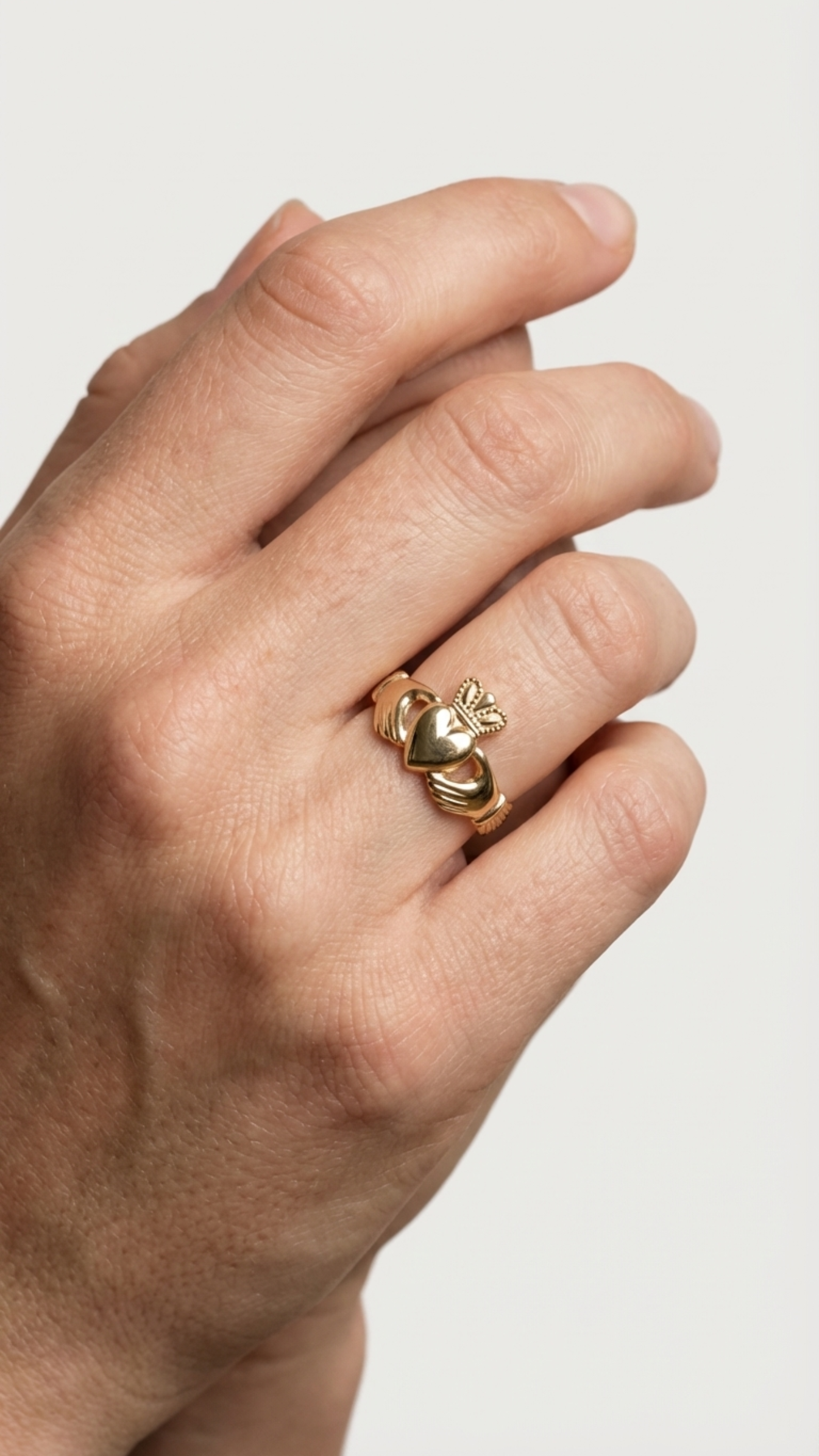
How to Give a Claddagh Promise Ring
The Gesture
Giving a Claddagh ring as a promise ring does not require a formal proposal or a public event. The Claddagh promise is quieter than an engagement — it says "I am committed to you" without saying "we are getting married tomorrow."
Most people give a Claddagh promise ring privately. The meaning of the gift depends on the words that accompany it. Some common ways:
- "I want you to know my heart is yours." — Direct, personal, no ambiguity.
- Explain the three symbols. "The heart is love. The hands are friendship. The crown is loyalty. This ring carries all three, and I am giving all three to you."
- Turn the ring together. Give the ring with the heart facing outward (position 1 — open). Ask your partner to turn the heart inward with you — moving it from "open" to "taken" in a shared moment.
What to Know Before You Buy
- This is not an engagement ring. A promise ring says "I am committed" — not "I am proposing." The Claddagh system handles this cleanly: right hand = promise, left hand = engaged/married. If someone asks "is that an engagement ring?" — the answer is "no, it's a Claddagh promise ring. The engagement ring goes on the left hand."
- Budget. A promise ring does not need to match the budget of an engagement ring. Sterling silver Claddagh rings with the Dublin Castle hallmark are genuine, authentic, and affordable. Gold is an option for a more significant commitment, but silver is perfectly appropriate.
- Matching sets. Couples often exchange matching Claddagh promise rings — both wearing the same ring on the right hand, both with hearts facing inward. Two people, same promise.
Claddagh Promise Rings for Him
Promise rings are not gendered. Men receive and wear Claddagh promise rings the same way women do — right hand, heart inward. The tradition in Galway never distinguished between men and women wearing the ring.
For men, consider:
- Band width: 4-5mm sits comfortably on a man's hand without being bulky. A promise ring does not need to be as wide as a wedding band — the commitment is real, but the ring is lighter in scale.
- Sterling silver is the most popular metal for men's promise rings. It is genuine, hallmarked, and priced appropriately for a pre-engagement commitment.
- Matte or brushed finish — less flashy than polished, more masculine, and hides daily wear marks better.
- Minimal design — some men prefer a simpler Claddagh with less ornate crown and hand details. Clean lines, clear symbol.
The promise ring is temporary in one sense — it eventually moves to the right hand or is replaced by a wedding band on the left. But many men keep their promise ring permanently, wearing it on the right hand after the engagement ring appears on the left.
Claddagh Promise Rings for Her
Women's Claddagh promise rings are among the most meaningful gifts in the Claddagh tradition — a commitment that carries three promises and a 300-year heritage.
For women, consider:
- Sterling silver with a gemstone heart — the most popular choice. A birthstone in the heart personalizes the promise. An emerald (Ireland's green) or a diamond (classic commitment stone) adds significance.
- Delicate band (2-3mm) — a promise ring sits comfortably alongside other rings and does not overpower the eventual engagement ring.
- 14K gold — for a promise ring that feels more substantial. Gold does not tarnish and does not need maintenance — the ring stays bright from the moment you give it.
- Engraving inside — "Grá" (love) or "Mo Ghrá" (my love) engraved in Irish inside the band. A hidden message only the wearer sees.
What happens when the engagement comes?
The Claddagh promise ring stays on the right hand — heart inward — while the engagement ring goes to the left hand. Some women move the promise ring to a necklace chain after the engagement. Others keep it on the right hand permanently. The promise ring does not go away — it is the foundation that was laid before the rest.
Matching Claddagh Promise Rings for Couples
Matching Claddagh promise rings are worn by couples on the right hand with the heart facing inward — the "taken" position. Both rings carry the same three promises: love, loyalty, and friendship. Popular matching options include same-design rings in different widths, complementary birthstones, and matching Irish inscriptions like "Mo Ghrá" (my love).
Matching Claddagh promise rings are the most visible commitment a couple can make before engagement. Both rings carry the same symbol, the same three promises, worn on the same hand in the same position.
How couples match:
- Same design, same metal — the simplest approach. Both wear sterling silver or both wear gold. Same ring, same commitment.
- Same design, different width — her ring at 2-3mm, his at 4-5mm. Same Claddagh, proportioned for each hand.
- Same design, different stones — she has her birthstone in the heart, he has his. Personal within the shared commitment.
- Inscription matching — "Mo Ghrá" (my love) inside both bands. Same Irish words, private to each wearer.
Explore Claddagh Rings
- Claddagh Ring Meaning — Love, loyalty & friendship
- How to Wear a Claddagh Ring — Four positions, four meanings
- Claddagh Engagement Ring — The next step after the promise
- Claddagh Wedding Band — The final position
- Silver Claddagh Ring — Sterling silver styles & care
- Gold Claddagh Ring — 10K, 14K & 18K gold styles
- Claddagh Ring History — The legend of Richard Joyce
- ← Back to all symbols — The complete guide