

What Are the Aran Islands?
The Aran Islands (Inis Mór, Inis Meáin, Inis Oírr) are three limestone islands in Galway Bay, Ireland, with a combined population of approximately 1,200. Irish (Gaeilge) is the primary language. The islands are home to Dún Aonghasa, a prehistoric stone fort over 2,500 years old. They are the birthplace of the Aran sweater and part of Ireland's official Gaeltacht (Irish-speaking region).
The Aran Islands are three slabs of limestone sitting in Galway Bay on Ireland's Atlantic coast. They are among the most remote inhabited communities in Europe — connected to the mainland by ferry and small aircraft, but separated by ocean, weather, and a way of life that has changed less here than anywhere else in Ireland.
The three islands:
- Inis Mór (Inishmore) — the largest, home to about 845 people. This is where the prehistoric fort Dún Aonghasa sits on the cliff edge.
- Inis Meáin (Inishmaan) — the middle island. The quietest of the three. Playwright J.M. Synge lived here and wrote about island life. Population: ~160.
- Inis Oírr (Inisheer) — the smallest and closest to the Clare coast. Known for its wrecked cargo ship, MV Plassey, which ran aground in 1960 and sits rusting on the shore.
Irish is the first language on all three islands. People raise children in Irish, run businesses in Irish, argue in Irish. This is not performative heritage — it is daily life. The Aran Islands are part of the official Gaeltacht — Ireland's Irish-speaking regions.
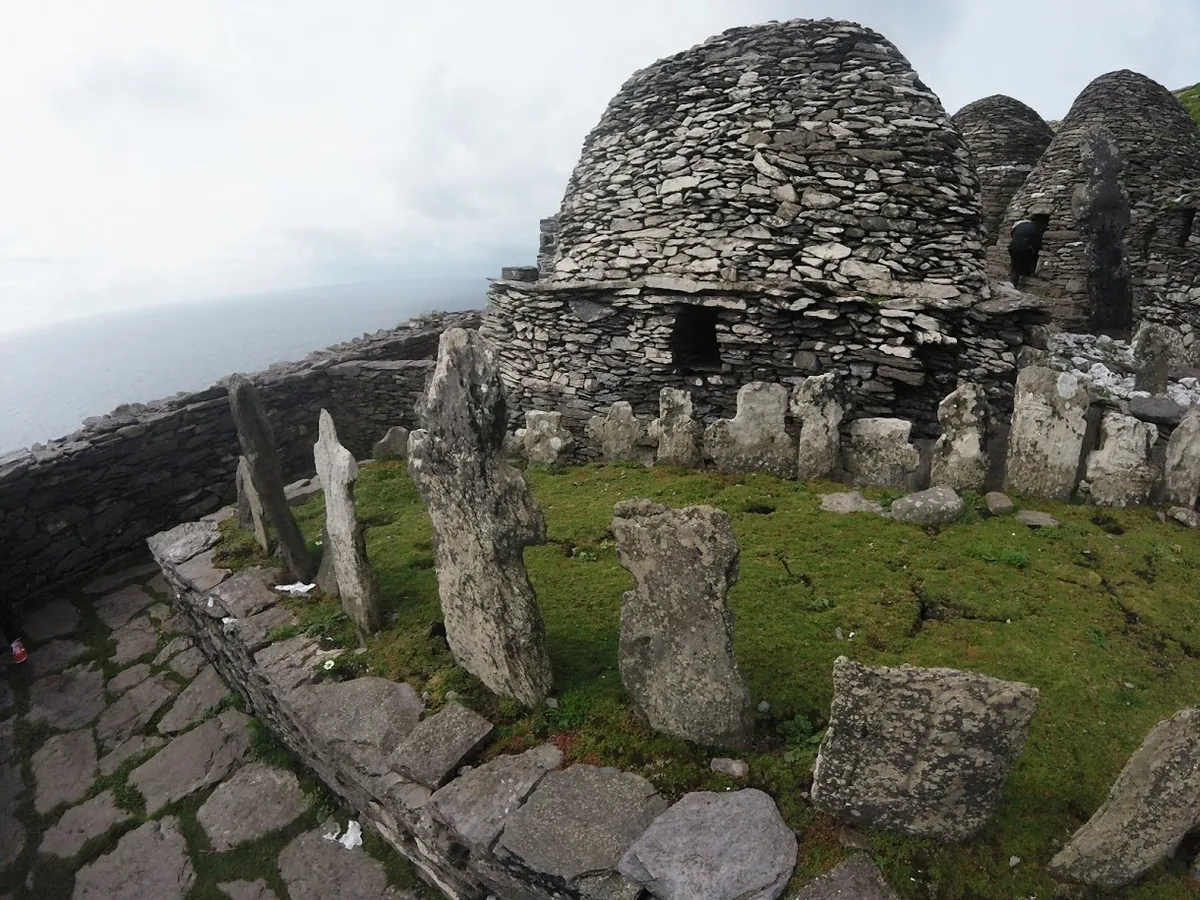
The islands feel like Ireland before the modern world arrived. Stone walls divide every field. Currach boats (traditional canvas-over-frame vessels) are still used. The landscape is bare limestone — almost no trees, almost no soil — with wildflowers growing in every crack.
Dún Aonghasa — The Fort at the Edge of the World
Dún Aonghasa is a semi-circular stone fort on the cliff edge of Inis Mór. It is over 2,500 years old — dating to the late Bronze Age or early Iron Age — and it is one of the most dramatic archaeological sites in Europe.
The fort consists of four concentric walls of dry stone (no mortar), the innermost sitting directly on the edge of a 90-meter (300-foot) vertical cliff dropping straight into the Atlantic. Half the fort has already fallen into the sea. What remains is a three-sided enclosure open to the ocean.
Nobody knows exactly why it was built so close to the edge. Some archaeologists believe the cliff has retreated since construction — the fort may initially have been a full circle. Others argue it was always a cliff-edge structure, designed for ceremonial purposes or defense from seaward attack.
Between the outer and inner walls lies a field of chevaux-de-frise — thousands of jagged limestone pillars driven into the ground at angles, designed to slow attackers crossing open ground. It is one of the earliest defensive obstacle systems in European military history.
Walking up to Dún Aonghasa takes about 30 minutes from the visitor centre. The final approach requires crawling to the cliff edge on your stomach — there is no railing, no barrier, nothing between you and the Atlantic. The view is exactly what you would expect from the edge of a continent.
The Aran Sweater — Born on These Islands
The Aran sweater originated on Ireland's Aran Islands, knitted by island women from undyed sheep's wool. Each family historically had distinctive stitch patterns — cable (safety), diamond (prosperity), honeycomb (labor), moss (growth). The wool's natural lanolin provided water resistance for fishermen. The Aran sweater remains one of the most recognized garments in Irish heritage.
The Aran sweater — heavy, cable-knit, cream-colored — is one of the most recognized pieces of clothing in the world. It was born on these islands, knitted by island women from undyed wool.
Each family historically had its own pattern — a specific combination of cable, diamond, honeycomb, and moss stitches that identified which family the wearer belonged to. The popular story says that drowned fishermen could be identified by their sweater pattern. Whether this is historical fact or later folklore, the tradition of family patterns is real.
The main stitch patterns and their meanings:
- Cable stitch — represents the fisherman's rope and the wish for a good catch (safety and livelihood)
- Diamond stitch — represents the small fields of the islands (prosperity and wealth)
- Honeycomb stitch — represents the hardworking bee (reward for labor)
- Moss stitch — represents the seaweed used as fertilizer (growth, abundance)
- Blackberry stitch — represents the Trinity Knot pattern (faith)
- Tree of Life — represents the family and its branches (unity and heritage)
The earliest Aran sweaters were knitted from báinín — unwashed, undyed sheep's wool that retained its natural lanolin (oil). Lanolin makes wool water-resistant, and Aran fishermen relied on this quality when working in rain and sea spray.
Today, Aran sweaters are produced across Ireland and exported worldwide. Inis Meáin Knitting Company — based on the middle island — produces luxury versions that have appeared in fashion collections globally. But the authentic stitch patterns, the cream wool, and the connection to island life remain unchanged from the first designs.
How to Get to the Aran Islands
By Ferry
- From Rossaveal (Ros an Mhíl): The main ferry terminal, 40 minutes west of Galway city. Aran Island Ferries runs daily services to Inis Mór (~40 minutes), Inis Meáin (~50 minutes), and Inis Oírr (~55 minutes).
- From Doolin, County Clare: Doolin Ferry runs services to all three islands, with Inis Oírr being the closest (~15 minutes). This is the best option if you are visiting the Cliffs of Moher on the same trip.
By Air
Aer Arann Islands operates small aircraft (8-10 seats) from Connemara Airport (Aerfort na Minna) to all three islands. Flight time: 8-10 minutes. The flights give a bird's-eye view of Galway Bay and the Burren.
On the Islands
Inis Mór: bike rental, minibus tours, horse-and-trap, or walking. Inis Meáin and Inis Oírr are small enough to walk everywhere. There are no taxis, no ride-shares, and very few cars.
Aran-Inspired Jewelry & Heritage for Men
The Aran Islands represent the oldest, most rugged expression of Irish heritage — and that translates into men's Irish jewelry:
- Celtic cable-pattern bands — wedding bands and daily rings featuring the cable stitch pattern from Aran sweaters, translated into metalwork. The rope motif carries the same meaning in metal as in wool: safety and livelihood.
- Currach boat motifs — the traditional island boats appear on men's cufflinks and pendants.
- Aran limestone texture — some men's Celtic rings have a deliberately rough, stone-like surface inspired by the raw limestone of the islands.
- Ogham inscriptions — island names (Inis Mór, Árainn) or Irish words like "Neart" (strength) engraved in Ireland's ancient script.
The Aran Islands are the most uncompromising expression of Irish heritage — stone, sea, wind, survival. Men's jewelry inspired by the islands carries that weight.
Aran-Inspired Jewelry for Women — Knit Patterns in Metal
The stitch patterns that define the Aran sweater translate beautifully into women's Celtic jewelry:
- Cable-knit Celtic bands — rings and bangles with the cable stitch pattern rendered in sterling silver or gold. The texture catches light differently from smooth metal — it looks woven, alive.
- Honeycomb stitch pendants — the honeycomb pattern from Aran sweaters, cast in metal. Delicate, geometric, connected to island heritage.
- Connemara Marble pieces — the green stone from the mainland coast visible from the Aran shoreline.
- Celtic knot earrings — the continuous interlace that connects to every element of island tradition — sweaters, stone walls, and the unbroken line of heritage.
The connection between Aran Island knitting patterns and Celtic jewelry design is direct — both use interlace, both are built from repeating units, and both carry symbolic meaning in their structure.
Explore Ireland's West
- Galway — The city across the bay, birthplace of the Claddagh
- Cliffs of Moher — Ireland's Atlantic edge, visible from the islands
- Irish Language — The Aran Islands are part of the Gaeltacht
- Celtic Symbols and Meanings — Every symbol explained
- Celtic Knot Meaning — The interlace patterns of Aran
- Claddagh Ring Meaning — Born in Galway, across the bay
- ← Back to all guides — The complete Irish heritage hub