

Who Was Saint Patrick?
Saint Patrick (late 4th/early 5th century, died c. 461 AD) was a Romano-British Christian missionary who converted Ireland to Christianity. He was not Irish by birth. He was kidnapped from Britain at age 16 and brought to Ireland as a slave. After escaping and becoming a priest, he returned to Ireland as a missionary around 432 AD and spent 30 years establishing churches across the island. He was not the first Christian in Ireland; Palladius preceded him in 431 AD.
Saint Patrick was not Irish. He was born in Roman Britain, likely in modern-day Wales, western England, or near Hadrian's Wall, sometime in the late 4th or early 5th century. The exact dates are debated; scholars have proposed birth years ranging from 385 to 422 AD. At age 16, he was kidnapped by Irish raiders and taken to Ireland as a slave.
For six years, Patrick herded sheep on a mountainside, traditionally identified as Slemish Mountain in County Antrim based on early hagiographic sources like Muirchú's 7th-century account. During this isolation, he found deep Christian faith. He eventually escaped, returned to Britain, entered the priesthood, and then made a decision that changed Irish history: he went back.
Patrick was not the first Christian in Ireland. In 431 AD, a year before Patrick's traditional arrival date, the Pope sent a deacon named Palladius to minister to "the Irish believing in Christ." Christianity had already reached Ireland through trade with Roman Britain. But Patrick became the figure who transformed the island.
He returned around 432 AD as a missionary. Over the next 30 years, he traveled the length of the island, establishing churches, converting local chieftains, and creating an Irish Christian tradition that would light up the European Dark Ages.
Patrick worked within existing Irish culture rather than against it. He adopted local customs, incorporated Celtic symbols, and built churches at sites already sacred to the Celts. The Celtic cross, a Christian cross with a circle drawn from Celtic sun worship, may be his most lasting contribution to Irish visual culture.
Patrick died around 461 AD, though some Irish annals record a second death date around 492 or 493 AD. Many scholars now believe the figure remembered as "Saint Patrick" may be an amalgam of two men: Palladius and Patrick the Briton. The annals preserving two death dates support this "Two Patricks" theory. March 17 became his feast day, and eventually the national holiday of Ireland.
H3: The Shamrock — Why Patrick Picked a Three-Leaf Clover
According to tradition, Saint Patrick used the shamrock (Irish: seamróg, a three-leaf clover) to explain the concept of the Holy Trinity to Irish Celts. Three leaves, one stem: Father, Son, and Holy Spirit in one God.
This story may be embellished, but it captured the Irish imagination so completely that the shamrock became the symbol of Ireland itself. The plant was already considered sacred in pre-Christian Celtic tradition; the Druids treated it as a sign of spring and rebirth.
One of the most sacred items in medieval Ireland was the Bachal Ísú (Staff of Jesus), a gold-and-gem-encrusted crozier that Patrick reportedly received from a hermit on behalf of Christ. It was kept at Armagh for centuries, and oaths sworn on it carried more weight than those sworn on the Bible. The staff was publicly burned during the Reformation in 1538.
The shamrock is not the four-leaf clover. The four-leaf clover is a mutation and a symbol of luck. The shamrock has exactly three leaves and is a symbol of Ireland and the Holy Trinity.
| Symbol | Leaves | Meaning | Connection |
|---|---|---|---|
| Shamrock | 3 | Holy Trinity / Ireland | St. Patrick, Irish identity |
| Four-leaf clover | 4 | Luck | General folklore, not specifically Irish |
How Did St. Patrick's Day Become a Worldwide Celebration?
The first St. Patrick's Day parade was held in Boston in 1737, not in Ireland. The celebration grew dramatically after the Great Famine (1845–1852), when over 2 million Irish emigrants brought their traditions to America. Today, St. Patrick's Day is celebrated in over 100 countries, making it one of the most widely observed cultural holidays in the world.
St. Patrick's Day was a modest religious feast day in Ireland for centuries. The transformation into a global celebration happened not in Ireland, but in America.
Timeline:
| Year | Event | Significance |
|---|---|---|
| 461 AD | Death of Saint Patrick | March 17 becomes his feast day |
| 1631 | Church establishes March 17 officially | Feast day added to the Catholic liturgical calendar |
| 1737 | First St. Patrick's Day parade in Boston | Irish immigrants organized the first recorded parade |
| 1762 | First New York City parade | Irish soldiers in the British Army marched through Manhattan |
| 1848–1860s | Great Famine emigration | Over 2 million Irish arrive in America; celebrations grow enormously |
| 1903 | St. Patrick's Day becomes a public holiday in Ireland | Officially added to the Irish calendar by the Bank Holiday Act |
| 1962 | Chicago River dyed green for the first time | Now an annual tradition using vegetable-based dye |
| 1995 | Irish government launches St. Patrick's Festival | Multi-day event to promote Irish culture worldwide |
| Today | Celebrated in 100+ countries | Parades in New York, Chicago, Boston, Sydney, Tokyo, and more |
The Lenten restrictions on eating and drinking were traditionally lifted for St. Patrick's Day, even when it fell during Lent. This is the historical root of the day's association with feasting and drinking. It was literally the one day when fasting rules did not apply.
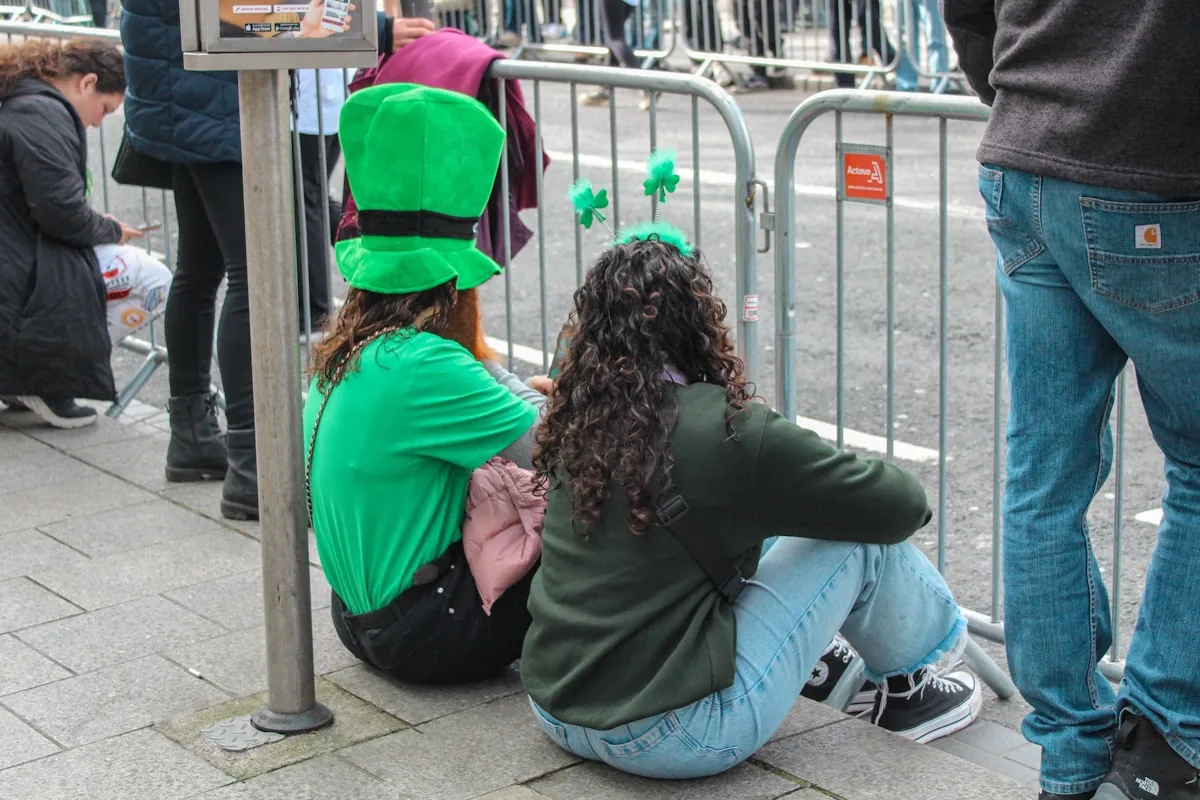
Why Do We Wear Green on St. Patrick's Day?
Wearing green on St. Patrick's Day is actually a modern tradition. Saint Patrick himself was associated with the color blue, specifically a shade called "St. Patrick's Blue." This shade remains the official color of the Irish Presidential flag and the choir robes at Saint Patrick's Cathedral in Dublin. The shift to green happened gradually, driven by three forces:
- The shamrock: Ireland's national symbol is green
- The Irish landscape: Ireland is called "the Emerald Isle" for its vivid green countryside
- Irish nationalism: Green became the color of the independence movement in the 18th and 19th centuries, adopted by the United Irishmen in 1798
By the time Irish-American communities were organizing parades in the 19th century, green was an unshakeable symbol of Irish identity. The tradition of "wearing the green" became a public declaration of Irish heritage, and eventually a way for everyone to join in.
The American tradition of pinching anyone not wearing green? It comes from Irish-American folklore: the idea that leprechauns would pinch anyone they could see, and they cannot see the color green. It has no basis in Irish tradition.
Traditional St. Patrick's Day Food
Corned beef and cabbage is not a traditional Irish dish. It was created by Irish immigrants in 19th-century New York who bought salt-cured beef from Jewish neighbors. In Ireland, the traditional St. Patrick's Day meal is roast lamb or bacon and cabbage, eaten after morning Mass.
St. Patrick's Day food traditions tell a story of both Ireland and the Irish diaspora.
In Ireland, the day was traditionally marked with a simple roast meal, often lamb or bacon and cabbage, following morning Mass. Lenten fasting restrictions were lifted for the day, making it a rare opportunity for feasting during the penitential season.
In America, Irish immigrants created their own traditions:
| Dish | Origin | Story |
|---|---|---|
| Corned beef and cabbage | Irish-American | Irish immigrants in New York's Lower East Side bought cheap corned (salt-cured) beef from Jewish delis. This dish barely exists in Ireland. It is entirely an Irish-American creation |
| Irish soda bread | Ireland | Dense, crusty bread leavened with baking soda instead of yeast. A staple of Irish kitchens for over 150 years |
| Colcannon | Ireland | Mashed potatoes with butter, cream, and kale or cabbage. Traditional comfort food |
| Boxty | Ireland (north-west) | A potato pancake from the northwest counties: "Boxty on the griddle, boxty in the pan" |
| Irish stew | Ireland | Lamb or mutton with potatoes, onions, and carrots. The original one-pot meal |
| Shepherd's pie | Ireland/Britain | Minced lamb under a mashed potato crust |
Irish Jewelry for St. Patrick's Day
St. Patrick's Day is the moment when Irish heritage is most visible and most felt. For the 30+ million Irish Americans who celebrate, wearing Irish jewelry on March 17 is a way to carry that identity close.
The most meaningful pieces for St. Patrick's Day:
- The Claddagh ring: Love, loyalty, and friendship. The quintessential Irish ring, worn across Ireland and the diaspora. Hallmarked at Dublin Castle
- Shamrock pendants and brooches: The symbol of St. Patrick himself, worn over the heart
- Green stone Claddagh rings: Emerald or green stone hearts that connect to Ireland's green identity
- Celtic cross pendants: Faith and heritage combined in one symbol
- Trinity knot jewelry: Patrick used the three-leaf shamrock to explain the Trinity; the Trinity knot carries the same meaning in knotwork form
These are not costume jewelry for one day. They are pieces that connect the wearer to a heritage that stretches back 1,500 years.
Explore St. Patrick's Day Jewelry →
Explore More Irish Heritage
- Shamrock Meaning: The symbol of St. Patrick
- Celtic Cross Meaning: Faith and Irish tradition
- Claddagh Ring Meaning: Love, loyalty & friendship
- Irish History: The full story of Ireland
- ← Back to all guides: Irish heritage hub