
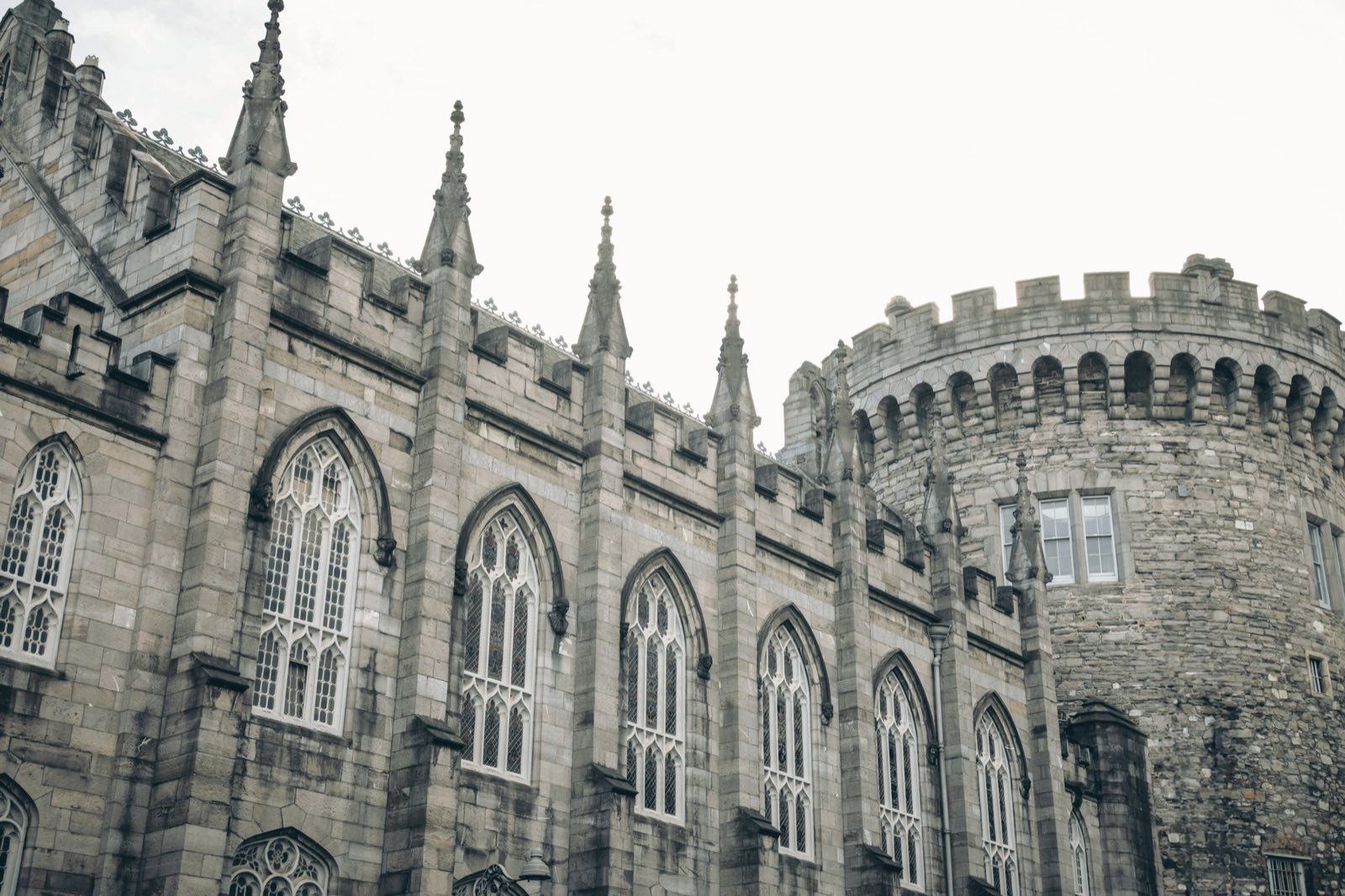

What Is Dublin Castle?
Dublin Castle is not one building. It is a walled compound of towers, courtyards, gardens, and state rooms that has been rebuilt, burned, rebuilt again, and repurposed more times than anyone can count.
It sits on Dame Street in the center of Dublin. The name comes from the Irish Dubh Linn — "black pool" — the tidal pool at the confluence of the River Poddle and the Liffey where the Vikings first settled in the 9th century. That pool is long gone, buried under the castle grounds. But the name survives.
What stands today is mostly Georgian and Victorian — the medieval fortress was largely destroyed by fire in 1684. But beneath the 18th-century façade, the bones of a Norman castle are still there. The Undercroft preserves sections of the original 13th-century walls, the base of the Powder Tower, and the remains of the Viking-age defenses.
The castle is a working government complex. State ceremonies happen here. Presidents are inaugurated here. EU summits are hosted here. And between those events, it is open to the public.
Dublin Castle is a historic government complex on Dame Street in Dublin, Ireland. Originally ordered built by King John in 1204, it served as the seat of British administration in Ireland for over 700 years. Today it hosts presidential inaugurations, state funerals, and EU Presidency events.
Who Built Dublin Castle?
King John of England ordered the construction of Dublin Castle in 1204. His instructions were specific: build a castle "with good and strong walls and good ditches for the defence of the city, the administration of justice, and the protection of the King's treasure."
The original Norman design was a classic quadrangular fortress: four massive corner towers connected by curtain walls enclosing a central courtyard — what is now the Upper Castle Yard. The towers were the Record Tower, the Bermingham Tower, the Cork Tower, and the Powder Tower. Of these, only the Record Tower survives above ground in its medieval form. It is the oldest standing structure in the castle complex.
The castle served as the administrative headquarters of English (and later British) rule in Ireland for over 700 years. The Lord Lieutenant of Ireland — the Crown's representative — governed from here. The expression "beyond the Pale" comes from this period: the Pale was the area around Dublin under direct English control, and everything beyond it was Gaelic Ireland — ungoverned, unpredictable, and alien to the Crown administration sitting inside these walls.
In April 1684, a fire swept through the castle and destroyed most of the medieval buildings. What rose from the ashes was an 18th-century Georgian palace — the elegant State Apartments that visitors see today.
Dublin Castle was ordered built by King John of England in 1204 as a Norman fortress with four corner towers. It served as the seat of British rule in Ireland for over 700 years. A fire in 1684 destroyed the medieval buildings; the current State Apartments date to the 18th-century Georgian rebuilding.
What Happened at Dublin Castle in 1916 and 1922?
Dublin Castle's place in Irish history pivots on two dates.
Easter Monday, 1916. A small unit of the Irish Citizen Army led by Captain Seán Connolly attacked the castle's Cork Hill Gate. They killed an unarmed policeman — Constable James O'Brien, the first casualty of the Easter Rising — and seized the guardroom. But they failed to take the main complex, which was largely undefended at the time. Had they pushed further, the Rising might have unfolded differently. The castle remained in British hands throughout the week.
January 16, 1922. The last Viceroy of Ireland, Lord FitzAlan, formally surrendered Dublin Castle to Michael Collins and the Provisional Government of Ireland. It was the most symbolic handover of the independence movement — the building that had represented British power in Ireland for 700 years, passed to Irish hands.
When the British Under Secretary said, "We're glad to see you, Mr. Collins," Collins reportedly replied in his thick Cork accent: "Ye are like hell, boy!"
The official version is more restrained. Collins stated: "It is now in the hands of the Irish nation."
Either way, the transfer was complete. The castle had changed hands for the last time.
What Can You See Inside Dublin Castle?
The State Apartments are the heart of the visit. Built in the 18th century after the 1684 fire, they include:
- St. Patrick's Hall — the grandest room in the castle. Originally the ballroom of the Viceregal court, it now hosts presidential inaugurations (every Irish president since 1938 has been inaugurated here), state funerals, and EU Presidency banquets. The painted ceiling panels depict scenes from Irish mythology.
- The Throne Room — where the monarch's representative received guests. The throne was removed after independence, but the room retains its ornate plasterwork and gilt furnishings.
- The State Drawing Room — used for state receptions and dinners for visiting heads of state.
The Chapel Royal (Church of the Most Holy Trinity) was built in 1814 in Gothic Revival style. The exterior is covered with over 90 carved heads of historic figures. The interior features fan-vaulted ceilings, stained glass, and carved oak galleries. The Revenue Museum — covering the history of taxation and smuggling in Ireland — is housed in the chapel's crypt.
The Viking Undercroft sits beneath the modern ground level, under the 13th-century Powder Tower. Here you can see the remains of Viking Dublin's original defenses, a section of the medieval curtain wall, a postern gate (a secret secondary exit), and the bed of the moat — the diverted River Poddle.
The Chester Beatty Library, housed in the 1820 Clock Tower building, contains one of the finest collections of manuscripts, rare books, and decorative arts in the world. Admission is free.
The Bedford Tower was built in the 1750s on the site of the medieval gatehouse. It is famous for the 1907 theft of the Irish Crown Jewels — a jeweled star and badge stolen from the Office of Arms just days before a royal visit. The jewels were never recovered.
Dublin Castle's State Apartments include St. Patrick's Hall (used for presidential inaugurations since 1938), the Throne Room, and the State Drawing Room. The Chapel Royal (1814) houses the Revenue Museum in its crypt. The Viking Undercroft preserves 13th-century walls and Viking-age defenses. The Chester Beatty Library offers free admission.
What Is the Dublin Castle Hallmark?
The Irish Assay Office was established by royal charter in 1637 and has been based at Dublin Castle since its founding. It is still a working office today — every piece of gold and silver jewelry sold in Ireland must be hallmarked here.
The "Dublin Castle Hallmark" refers to the marks stamped into precious metals to certify their purity. Three marks matter:
- The Hibernia Mark — introduced in 1730, a seated figure of Hibernia (the female personification of Ireland). This is the unique, distinguishing mark of the Dublin Assay Office.
- The Harp Crowned — the standard mark for Irish gold and silver.
- The Maker's Mark — identifies the company responsible for the piece.
If you own Irish jewelry and want to know if it is genuine, look for the Hibernia stamp. If it is there, the metal passed through Dublin Castle.
For a deeper look at what these marks mean, read our [Dublin Castle Hallmark guide](dublin-castle-hallmark.html).
What Are the Dubh Linn Gardens?
The Dubh Linn Gardens sit on the site of the original "black pool" that gave Dublin its name. They were landscaped in 1994 for the 1996 Irish Presidency of the European Union.
The circular lawn at the center is not just decorative — it doubles as a VIP helicopter landing pad, complete with integrated navigation lights. The serpentine path that winds through the gardens follows a Celtic sea-serpent design.
The gardens are free to enter and open year-round. They offer a quiet green space in the middle of the busiest part of Dublin.
How Do You Visit Dublin Castle?
| Detail | Info |
|---|---|
| Location | Dame Street, Dublin 2, Ireland |
| Built | 1204 (Norman fortress); 18th c. (State Apartments) |
| Ordered by | King John of England |
| Guided tour | ~1 hour, €12 adult (State Apartments + Undercroft + Chapel Royal) |
| Self-guided | ~30 min, €8 adult (State Apartments + exhibitions) |
| Hours | Mon–Sun, 09:45–17:45 (last admission 17:15) |
| Chester Beatty | Free admission |
| Website | dublincastle.ie |
Getting there:
- The castle is in the center of Dublin, a 5-minute walk from Temple Bar and a 10-minute walk from Trinity College
- Luas (Red Line): Jervis stop, then walk south
- Dublin Bus: multiple routes stop on Dame Street
Important — 2026 closure: Dublin Castle will be completely closed to the public from May 5 to December 31, 2026, to accommodate the Irish Presidency of the European Union. Plan accordingly.
Tips:
- The guided tour is worth the extra €4 — the Undercroft and Chapel Royal are not included in the self-guided option
- State Apartment access can be restricted at short notice for government events
- The Chester Beatty Library is free and could easily fill two hours on its own
- The Dubh Linn Gardens are always open, even when the castle buildings are closed
Dublin Castle is located on Dame Street in Dublin 2, Ireland. Guided tours cost €12 and include the State Apartments, Viking Undercroft, and Chapel Royal. The Chester Beatty Library has free admission. Dublin Castle will be closed to the public from May 5 to December 31, 2026, for the Irish EU Presidency.
Explore Ireland's Castles
- Irish Castles Guide — Ireland's 3,000 castles from tower houses to cliff ruins
- Blarney Castle & the Blarney Stone — 135,000 visitors kiss the stone each year
- Bunratty Castle & Folk Park — Medieval banquets and a 19th-century village
- Kilkenny Castle — Norman stronghold turned public park
- Dublin Castle Hallmark — What the Hibernia stamp means
- Dublin Guide — The complete Dublin heritage guide
- Temple Bar Guide — 5 minutes from the castle
- ← Back to all guides — The complete Irish heritage hub