
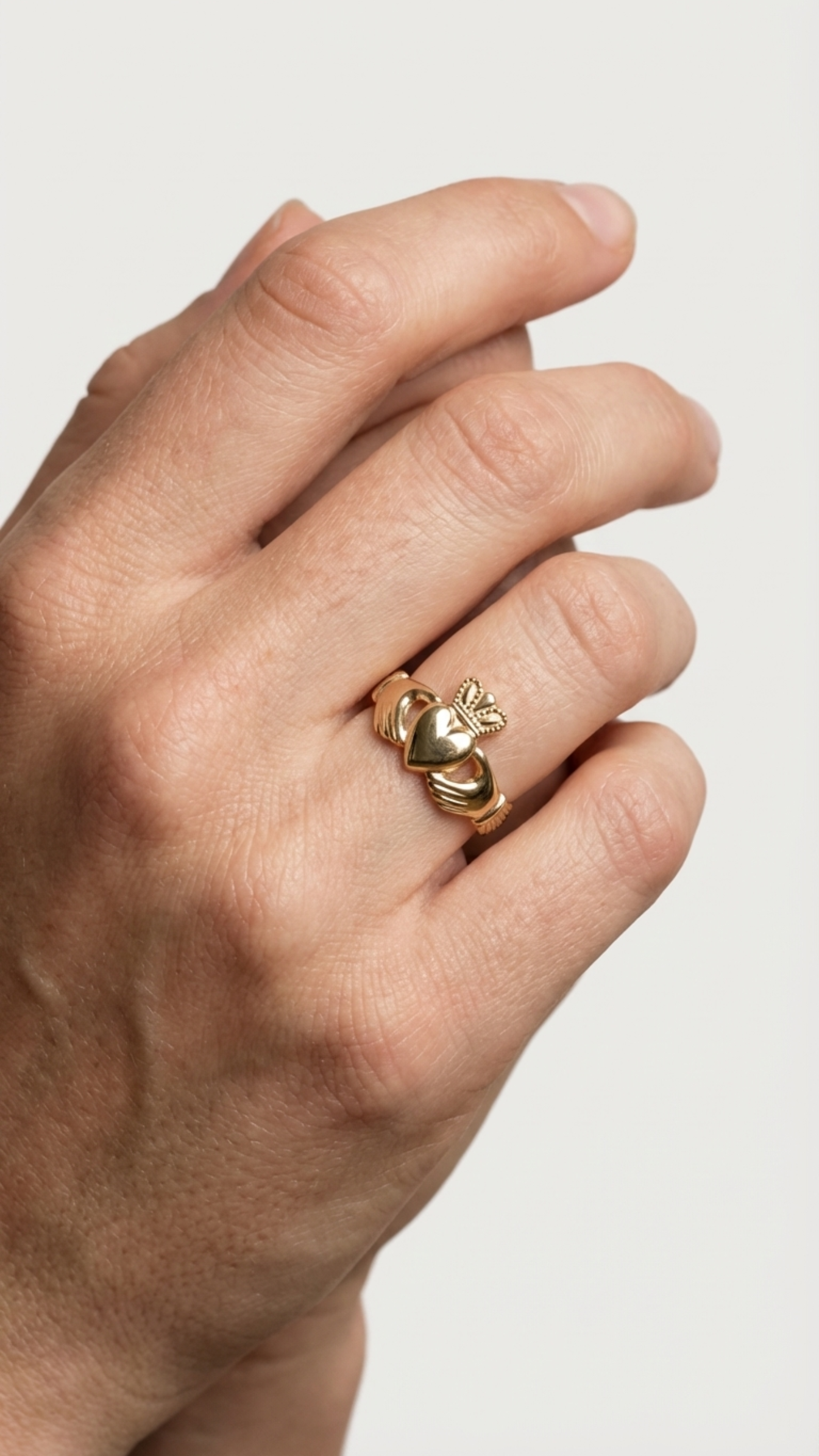

How Do You Wear a Claddagh Ring?
A Claddagh ring has four wearing positions: (1) right hand, heart out = single, (2) right hand, heart in = in a relationship, (3) left hand, heart out = engaged, (4) left hand, heart in = married. The heart direction and hand placement signal the wearer's relationship status. This tradition originates from the Claddagh village in Galway, Ireland.
The Claddagh is one of the few rings in the world that talks. Not literally — but depending on which hand you put it on and which direction the heart faces, you are telling everyone who looks at your hand exactly where you stand. No other ring does this.
The system is simple. Four positions. Four meanings. Here is how it works.
H3: Right Hand, Heart Facing Outward — Single
Place the ring on your right ring finger with the heart pointing away from your body — toward your fingertips.
This position says: my heart is open. You are single, available, or simply wearing the ring as a connection to your Irish heritage without any relationship signal attached. Nobody is going to mistake this for an engagement ring or a wedding band. The heart faces the world because it has not been claimed yet.
This is the most common position. Most people who wear a Claddagh ring start here — and many stay here permanently, wearing it purely as a heritage piece.
H3: Right Hand, Heart Facing Inward — In a Relationship
Same hand, but rotate the ring so the heart now points toward your wrist — toward you.
This says: my heart belongs to someone. The relationship is real and committed, but you are not engaged or married. The heart has turned inward because someone now holds it.
The moment of switching the ring from heart-out to heart-in is a quiet, personal one. Some people do it in front of their partner. Others do it privately and wait for someone to notice. There is no ceremony — just a rotation of the ring and everything it implies.
H3: Left Hand, Heart Facing Outward — Engaged
Move the ring to your left ring finger — the traditional engagement and wedding ring finger. Keep the heart pointing outward.
This says: a promise has been made, but the wedding has not happened yet. You are engaged. The ring has moved to the left hand to claim the same finger that a conventional engagement ring would, but the heart still points outward because the final commitment — marriage — is still ahead.
This position is most associated with Claddagh diamond and emerald engagement rings. The stone sits inside the heart, held between two hands, crowned — love, declared and protected.
H3: Left Hand, Heart Facing Inward — Married
Turn the heart inward. It now points toward your wrist on your left hand.
This is the final position. The heart faces you because love has been fully given and fully received. Loyalty, friendship, love — all three promises of the Claddagh are sealed.
Some married people wear a separate wedding band alongside the Claddagh. Others use the Claddagh as the wedding ring itself — this was the earliest tradition in the Claddagh village, where one ring served for life and was often passed from mother to daughter.
Claddagh Ring Positions — Quick Reference Chart
| Position | Hand | Heart Direction | Meaning |
|---|---|---|---|
| Single | Right | Outward (toward fingertips) | Heart is open and available |
| In a Relationship | Right | Inward (toward wrist) | Heart belongs to someone |
| Engaged | Left | Outward (toward fingertips) | Committed, wedding ahead |
| Married | Left | Inward (toward wrist) | Love fully given and received |
Print this. Screenshot it. Save it. You will forget which direction means what — everyone does the first few times.
Claddagh Ring Rules — What People Actually Ask
Common Claddagh ring rules: the ring is traditionally worn on the ring finger. Right hand for single or in a relationship, left hand for engaged or married. Heart direction signals status — outward means open, inward means taken. Men and women follow the same system. No Irish ancestry is required to wear a Claddagh ring.
Can I wear a Claddagh ring if I am not Irish?
Yes. The Claddagh ring's three symbols — love, loyalty, friendship — are universal. You do not need Irish ancestry to wear one. Millions of people with no Irish connection wear Claddagh rings because the meaning resonates with them. The ring comes from Ireland, but its values belong to everyone.
Does the Claddagh ring have to go on the ring finger?
Traditionally, yes — the ring finger on either hand. But there are no Claddagh police. Some people wear it on the middle finger, the index finger, or on a chain around the neck. The four-position system only works on the ring finger, so if the relationship signaling matters to you, stick with the traditional placement.
What if I am widowed?
There is no single "official" position. Some widowed people keep the ring in the married position — left hand, heart inward — to honor the marriage. Others move it to the right hand, heart inward, to signal that their heart is held but not available. Both are seen and both are understood in Irish tradition.
Can men wear a Claddagh ring?
Absolutely. The Claddagh ring is not gendered. Men have worn Claddagh rings in Galway for as long as women have. The same four positions apply. Men's Claddagh rings are typically wider (5-7mm band) with a bolder design, but the meaning and wearing system are identical. See our Men's Irish Rings guide.
Which way should the crown point?
The crown always faces away from the heart. When the heart points toward your fingertips (outward), the crown faces your wrist. When the heart points toward your wrist (inward), the crown faces your fingertips. The crown follows the heart — it does not have its own independent meaning. Focus on the heart direction.
Where Does the Wearing Tradition Come From?
The four-position system comes from the Claddagh village — a fishing settlement at the mouth of Galway Bay where the ring was first created in the late 1600s.
In the early Claddagh community, Claddagh rings were precious — gold in a fishing village was rare. Rings were passed from mother to daughter, and the way the daughter wore the ring told the village everything it needed to know about her situation. In a tight-knit community where everyone knew everyone, the ring served as a quiet, visible declaration.
The tradition traveled with the Irish diaspora when over a million people left Ireland during the Great Famine of the 1840s. Irish immigrants in Boston, New York, Chicago, and Philadelphia kept the wearing tradition alive. By the 20th century, it had spread beyond Irish communities entirely.
Today, the Claddagh is one of the most recognized rings in the world — and the wearing positions remain unchanged from Galway three hundred years ago.
For the full history, see our Claddagh Ring History guide.
How Men Wear a Claddagh Ring
The wearing system is identical for men. Same four positions, same meanings, same hands. The only difference is the ring itself — men's Claddagh rings tend to be wider (5-7mm), heavier, and finished with brushed or matte metal rather than polished surfaces.
What men should know:
- The four positions apply exactly the same way. Right hand = single/relationship. Left hand = engaged/married. Heart direction signals status.
- Band width matters for comfort. A 5mm band sits comfortably for daily wear. 7mm or wider makes a stronger visual statement but takes a few days to get used to.
- Materials for men: 14ct yellow gold is traditional and tough. Sterling silver is the most accessible entry point. Platinum is the most durable — it will outlast everything else.
- Pairing with a wedding band: Some men wear a separate Celtic knot wedding band alongside the Claddagh. Others use the Claddagh as their only ring.
Men's Claddagh rings carry the same Dublin Castle hallmark as women's — certified by the Irish Assay Office.
How Women Wear a Claddagh Ring
Women have historically been the primary wearers of the Claddagh ring — the mother-to-daughter tradition that kept the ring alive for three centuries.
What women should know:
- The four positions apply exactly as described. No variation for women versus men.
- Stacking with other rings: Many women wear the Claddagh on one hand and a different ring (wedding band, eternity ring, or fashion ring) on the other. If you wear the Claddagh as your engagement ring, the wedding band typically goes underneath it — closer to your palm — on the same finger.
- Gemstone Claddagh rings: A Claddagh with a diamond, emerald, or birthstone in the heart follows the same position system. The gemstone does not change the rules — it just personalizes the heart.
- Necklace option: If you prefer not to wear a ring on your finger, Claddagh pendants and necklaces carry the same symbolism. The heart direction on the pendant does not signal relationship status — only the ring on a finger does.
The most common position for women is right hand, heart outward — worn as a heritage piece and a connection to Ireland.
Explore the Claddagh
- Claddagh Ring Meaning — Love, loyalty & friendship — the full symbol guide
- Claddagh Ring History — Richard Joyce and the village behind the ring
- Women's Claddagh Ring — Styles, metals & gemstones
- Men's Irish Rings — Men's Claddagh styles & fit
- Claddagh Engagement Ring — Diamond, emerald & birthstone
- Irish Wedding Traditions — Customs, rings & Celtic blessings
- ← Back to all symbols — The complete guide