

Why Galway Matters — More Than a City
Galway is where the Claddagh ring was born.
The fishing village of Claddagh — at the mouth of Galway Bay — is where Richard Joyce created the first Claddagh ring in the late 1600s. The ring's three symbols (love, loyalty, friendship) come from this community. The tradition of wearing the ring in four positions to signal relationship status started in these streets. When people ask where the Claddagh ring comes from, the answer is a specific place: a stone-walled fishing village on the western edge of Galway city.
But Galway is more than the ring's birthplace. It is Ireland's most culturally alive city — a place where Irish is spoken on the streets, where traditional music pours out of nearly every pub, where the arts festival draws 250,000 people every July, and where the Atlantic is always in view.
Galway sits at the meeting point of Ireland's past and present. The medieval city center — built by Anglo-Norman merchant families — stands next to the remains of the Claddagh village. Spanish Arch, where wine ships from Spain once docked, overlooks the spot where Joyce's first ring was created. Everything in Galway connects.
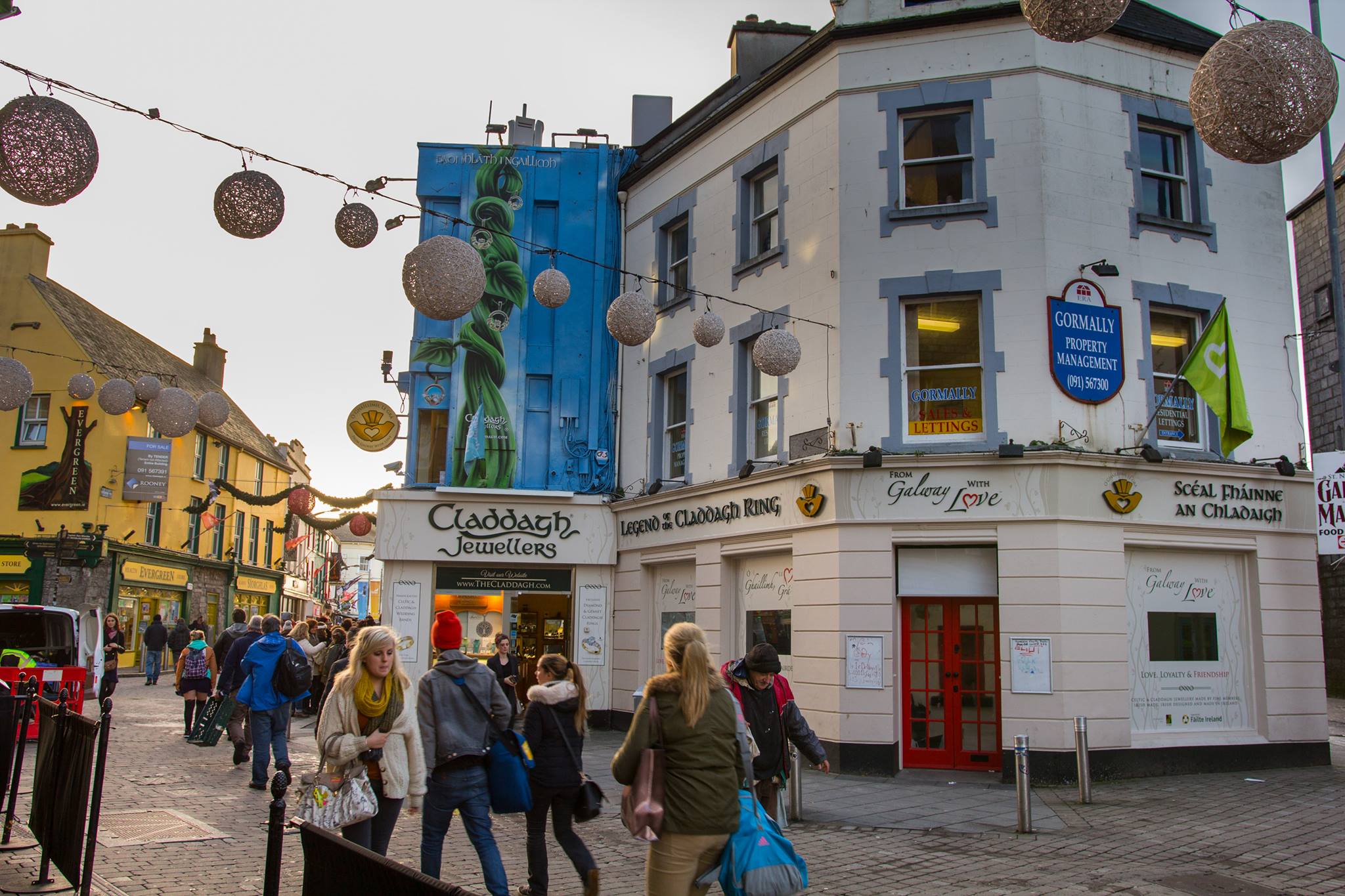
The History of Galway — City of the Tribes
Galway's Claddagh village was a separate fishing community at the mouth of Galway Bay, distinct from the medieval city governed by the 14 Tribes. The Claddagh had its own elected king and fleet of traditional Galway hookers. Richard Joyce, a member of the Joyce family (one of the 14 Tribes), created the Claddagh ring here in the late 17th century.
The 14 Tribes of Galway
Galway was governed for centuries by 14 merchant families known as the Tribes of Galway. These Anglo-Norman and Welsh-Norman families controlled the city's trade, politics, and culture from the 13th to 19th centuries.
The 14 Tribes: Athy, Blake, Bodkin, Browne, D'Arcy, Deane, Font, French, Joyce, Kirwan, Lynch, Martin, Morris, Skerrett.
The Joyce family — one of the 14 Tribes — produced Richard Joyce, the goldsmith who created the Claddagh ring. The family name is still one of the most common surnames in Galway.
The Tribes made Galway a prosperous trading port, connected to Spain, France, and the Mediterranean. Spanish wine, French silks, and Mediterranean goods flowed through Galway's docks. The Spanish Arch — still standing — marks the old quay where Spanish ships unloaded cargo.
The Claddagh Village
The Claddagh was a separate community from Galway city — a fishing village with its own customs, its own leader (the "King of the Claddagh"), and its own traditions. The Claddagh fishermen were Gaelic Irish, distinct from the Anglo-Norman Tribes inside the city walls.
The village had its own governance structure for centuries. The King of the Claddagh was elected by the community and wore a specific white-brimmed hat. The Claddagh fleet of Galway hookers (traditional sailing boats) fished Galway Bay.
The historic village was demolished in the 1930s for public health reasons — the thatched cottages were replaced with modern housing. The streets and the community remain, but the physical village of Joyce's era is gone. What survives is the ring.
What to See in Galway
The Claddagh
Walk from Galway's city center south across the Wolfe Tone Bridge and you are in the Claddagh. The historic village is gone, but the location remains. The Claddagh Basin — the small harbor where the hooker fleet once anchored — is still there. A walk along the Claddagh Quay at sunset, looking out across Galway Bay to the Burren, is one of the best moments in the city.
The Spanish Arch & Long Walk
The Spanish Arch (1584) — one of the last surviving gates of the old city walls — stands where Spanish trading ships once unloaded wine and spices. The Long Walk — a row of colorful houses along the waterfront — is the most photographed street in Galway.
Eyre Square
The city's central square, renamed John F. Kennedy Memorial Park after Kennedy's 1963 visit (his ancestors came from County Wexford). Eyre Square has been Galway's gathering place since medieval market days.
Galway Cathedral
The Cathedral of Our Lady Assumed into Heaven and St. Nicholas — completed in 1965, one of the last great stone cathedrals built in Europe. Sits on the bank of the River Corrib.
The Latin Quarter
Galway's cultural core — shop Street, Quay Street, and the cobbled lanes between them. This is where the music lives. On any evening, you will hear traditional Irish music playing in Tig Cóilí, The Crane Bar, and Taaffes — not staged performances, but sessions where musicians simply sit down and play.
Galway Bay
The bay is the city's horizon. On the far side, the Aran Islands rise from the water. The Burren's gray limestone meets the sea to the south. The Clare hills hold the Cliffs of Moher beyond the visible horizon. Everything to the west of Galway is Atlantic.
Galway's Living Culture — Music, Language & Festival
Traditional Music
Galway is the traditional music capital of Ireland. Not because someone declared it so — but because the Connemara Gaeltacht (the largest Irish-speaking region) is 30 minutes west, and this community of Irish speakers, musicians, and artists has kept traditional culture alive in a way no other Irish city can match.
Music sessions happen every night. They are not performances — they are conversations in melody. Musicians show up, join the circle, and play. If you sit in The Crane Bar on a Tuesday night, you are hearing a tradition that predates the city's medieval walls.
The Irish Language
Galway is the gateway to the Connemara Gaeltacht — the largest Irish-speaking region in the country. You will hear Irish spoken in Galway city itself — in shops, at the university (NUI Galway teaches through Irish), and on the streets of Salthill. The national Irish-language television station, TG4, broadcasts from the Connemara Gaeltacht just west of the city.
Galway International Arts Festival
Held every July, the Arts Festival transforms the city for two weeks — theater, music, visual art, street performance, and spectacle. Over 250,000 people attend annually, making it Ireland's largest arts event.
Food
Galway's food scene reflects its position between the Atlantic and the farms of the West. The Galway International Oyster Festival (September) has been running for over 70 years — making it the world's longest-running oyster festival. Galway Bay oysters are famous beyond Ireland. The city's restaurants source seafood directly from the Atlantic and lamb from the limestone-fed Burren pastures.
Men's Irish Jewelry from Galway — Heritage at the Source
Galway is where the Claddagh ring tradition began. Men's Irish jewelry from this city carries the weight of a 300-year heritage:
- Claddagh rings — the quintessential men's Irish ring. Wide band (5-7mm), bold Claddagh design, Dublin Castle hallmarked. The ring was born here — wearing one from Galway means wearing the source.
- Galway hooker boat motifs — the traditional sailing boats of Galway Bay appear on men's cufflinks, pendants, and ring engravings. A symbol of the maritime heritage that defined the Claddagh community.
- Celtic warrior shields — inspired by the artifacts of Galway's medieval period, when the 14 Tribes defended the city.
- Ogham inscriptions — "Gaillimh" (Galway) or personal names spelled in Ireland's ancient script.
Women's Irish Jewelry from Galway — Where the Ring Was Born
Women's Claddagh rings carry a direct connection to Galway — the city and the village that created them:
- Claddagh rings — the defining Irish ring. When a woman wears a Claddagh from Galway, she wears the source of the tradition. The ring's four positions were first practiced by women of the Claddagh village.
- Galway-inspired Celtic pendants — wave patterns, Galway Bay motifs, and Atlantic-inspired designs.
- Connemara Marble jewelry — green stone from the coastline just west of Galway city. Available in pendants, brooches, and earrings.
- Trinity Knot pieces — Galway's NUI university and its deep connection to Irish-language culture have made the Trinity Knot a symbol of the city's intellectual heritage.
Explore Ireland's West
- Claddagh Ring Meaning — Born in Galway's Claddagh village
- Claddagh Ring History — The legend of Richard Joyce
- Aran Islands — Ancient Irish life across Galway Bay
- Cliffs of Moher — Ireland's Atlantic edge, 1.5 hours south
- Irish Language — Galway is the gateway to the Gaeltacht
- Connemara Marble — Ireland's green stone, from Galway's west
- ← Back to all guides — The complete Irish heritage hub