
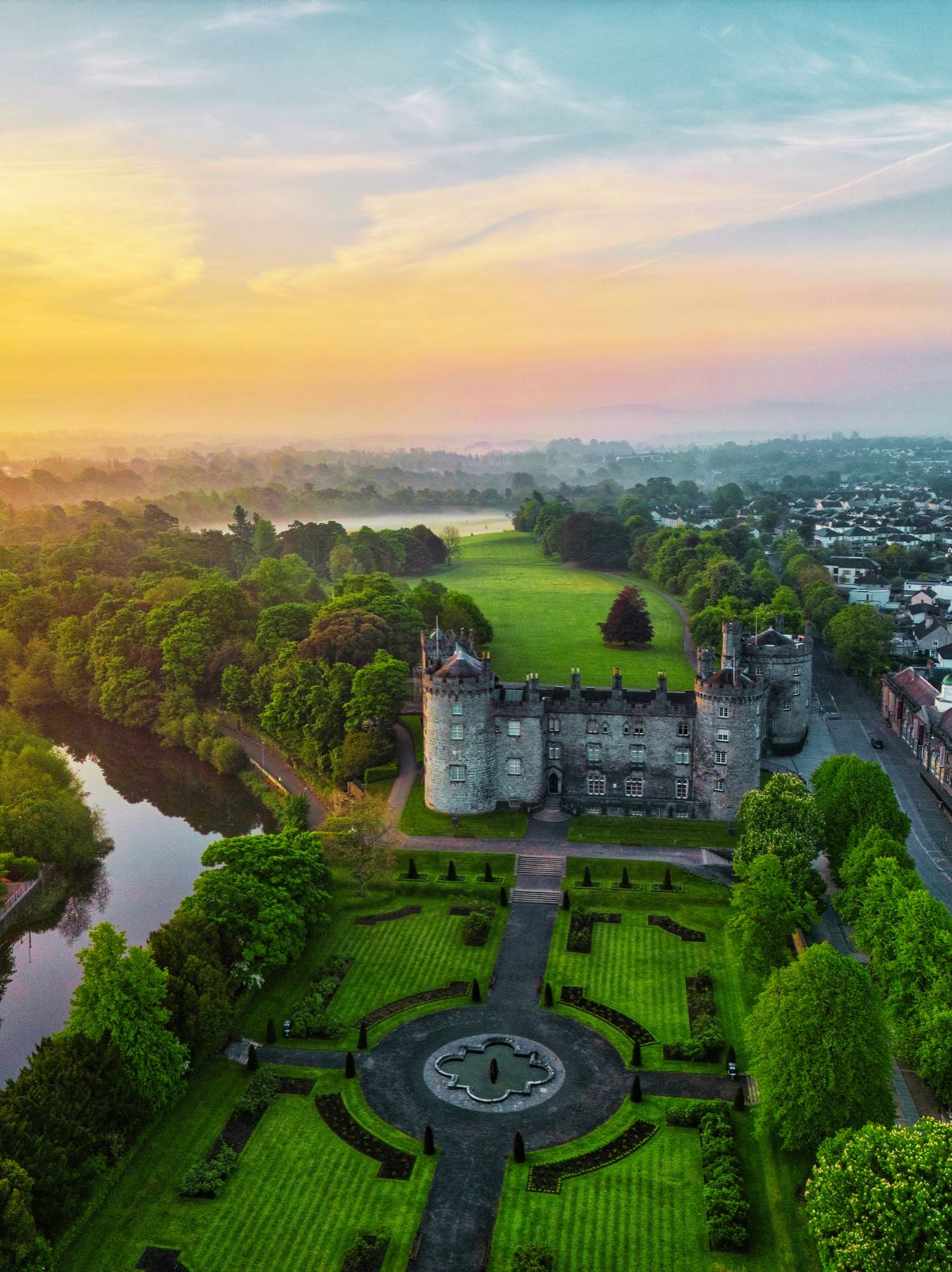

How Many Castles Are in Ireland?
Three thousand. That is a conservative count.
Every county in Ireland — all 32 of them — has castle sites. Some are luxury hotels where you sleep in a four-poster bed. Some are stone towers standing in the middle of a field with sheep grazing against the walls. Some are nothing more than a footprint in the earth, a mound where a Norman bailey once stood.
The sheer density is the thing that surprises people. Drive any road in rural Ireland for twenty minutes and you will pass one. A ruin on a hilltop. A tower behind a petrol station. A wall running through someone's backyard. Ireland has more castles per square mile than almost anywhere in Europe.
Most of them are tower houses — the dominant castle type of the 15th and 16th centuries. Tower houses were built by powerful families as defensible primary residences. Not grand palaces. Practical fortresses. Thick walls, narrow stairs, a single entrance you could defend with three men. The MacNamaras built them in Clare. The O'Briens built them along the Shannon. The MacCarthys built them across Munster. Every clan that mattered had at least one.
The older castles — the ones built by the Normans after the 1169 invasion — are a different architecture entirely. Motte-and-bailey earthworks. Stone keeps. Curtain walls. These are the large, imposing structures that look like what people imagine when they hear the word "castle."
Ireland has over 3,000 recorded castle sites across all 32 counties. The majority are tower houses from the 15th and 16th centuries, built as defensible clan residences. The most visited include Blarney Castle (1446), the Rock of Cashel (4th century), Bunratty Castle (c. 1425), Ashford Castle, and Dunluce Castle.
Blarney Castle and the Blarney Stone
Blarney Castle sits four miles northwest of Cork city. The stone tower you see today was built in 1446 by Cormac Láidir MacCarthy, Lord of Muskerry — though an earlier stone structure stood on the same site from 1210.
The castle is not what people come for. They come for the stone.
The Blarney Stone — the Stone of Eloquence — is set into the battlements near the top of the castle. Kissing it is supposed to grant you the gift of eloquent speech. The catch: you have to lean backwards over the edge of the wall, holding onto iron railings, with nothing below you but a long drop. An attendant holds your waist. You tip your head back. You kiss cold limestone. Then you stand up, and supposedly you can talk your way out of anything.
Nobody knows for certain how the tradition started. One theory claims the stone is the Lia Fáil — the sacred stone upon which Irish kings were crowned. Another story credits Queen Elizabeth I's frustration with the MacCarthy lords — she wanted Cormac MacDermot MacCarthy to surrender his lands, and he kept stalling with elaborate, flattering, never-quite-agreeing language. Her exasperation supposedly gave birth to the word "blarney" — meaning persuasive, charming nonsense.
The castle grounds are worth the visit even without the stone. The Poison Garden grows wolfsbane, mandrake, and opium poppies behind a locked gate. The Rock Close trails through ancient trees and druidic rock formations. The castle itself — even as a ruin — commands the landscape.
| Detail | Info |
|---|---|
| Location | Blarney, County Cork |
| Built | 1446 (current keep); 1210 (original stone) |
| Builder | Cormac Láidir MacCarthy |
| The Stone | Stone of Eloquence, set into the battlements |
| Open to visitors | Year-round |
| Website | blarneycastle.ie |
Rock of Cashel — Why Is It Called "Cashel of the Kings"?
The Rock of Cashel rises from the flat Tipperary plain like a fist of limestone pushed through the earth. You can see it for miles in every direction. That visibility is the point — it was chosen as a seat of power because anyone approaching could be seen long before they arrived.
This was the throne of the Kings of Munster from as early as the 4th century. The name "Cashel" comes from the Irish caiseal, meaning "stone fort." Legend says the rock itself landed here after St. Patrick banished Satan from a mountain cave 20 miles to the north — the Devil bit a chunk from the mountain (now called the Devil's Bit, in the Slieve Bloom foothills) and spat it out onto the Golden Vale below.
Brian Boru was crowned King of Munster at Cashel in 977. He would go on to become High King of Ireland. The rock was his capital.
What stands today is a collection of medieval ecclesiastical buildings, not a secular fortress. The Munster kings donated the Rock to the Church in 1101. After that came the construction that visitors see now:
- Cormac's Chapel (consecrated 1134) — a Romanesque church with the only surviving Romanesque frescoes in Ireland. Twin towers. Germanic architectural influence. Stone carvings of animals and human figures on the exterior. The chapel alone justifies the visit.
- A 28-meter-high Round Tower — one of the tallest and best-preserved in the country. These towers served as bell towers, lookout posts, and places of refuge during raids.
- A 13th-century Gothic cathedral — roofless now, but the walls and transepts still stand at full height.
- The Hall of the Vicars Choral — restored, and now the entrance to the site. Displays the original St. Patrick's Cross (a 12th-century high cross).
The Rock of Cashel is managed by the Office of Public Works (OPW) and is one of the most visited heritage sites in Ireland.
| Detail | Info |
|---|---|
| Location | Cashel, County Tipperary |
| In use since | 4th century (seat of Munster kings) |
| Key event | Brian Boru crowned King of Munster, 977 |
| Cormac's Chapel | Consecrated 1134, Romanesque frescoes |
| Managed by | Office of Public Works (OPW) |
| Website | heritageireland.ie |
Bunratty Castle — Medieval Banquets in a 15th-Century Tower House
Bunratty is the castle that feeds you.
The current structure — the fourth on this site — was built c. 1425 in County Clare. It is a large tower house, the kind of building that powerful Clare families put up when they needed a home that could double as a fortress. The first castle here was a Norman motte-and-bailey built c. 1250 by Robert De Muscegros. The MacNamaras later built on the site, followed by the O'Briens, Earls of Thomond, who made it their principal seat.
By the 20th century, Bunratty was a ruin. Then the 7th Viscount Gort stepped in. He bought the castle in 1956, restored it with period-appropriate furniture, tapestries, and art from the 1600s, and opened it to the public in 1960. The restoration is one of the most complete of any tower house in Ireland.
The medieval banquets are what made Bunratty famous beyond heritage circles. Guests sit in the great hall, eat with their hands, drink mead, and watch performers in period costume. It is theatre, tourism, and a surprisingly good night out. The banquets have been running since the 1960s and have hosted heads of state.
A footnote to Bunratty's military history: during the Confederate Wars of the 1640s, the castle was defended by Rear-Admiral Penn — the father of William Penn, who went on to found Pennsylvania. Irish castle history has a habit of connecting to places you do not expect.
Outside the castle walls, the Bunratty Folk Park recreates a 19th-century Irish village — thatched cottages, a working forge, a village street. It is the best place in Ireland to see what rural life looked like before the 20th century.
| Detail | Info |
|---|---|
| Location | Bunratty, County Clare |
| Built | c. 1425 (4th castle on this site) |
| Restored | 1956 by the 7th Viscount Gort |
| Open since | 1960 |
| Known for | Medieval banquets, period furnishings |
| Managed by | Shannon Heritage |
Dunluce Castle — The Fortress on the Cliff
Dunluce is the most dramatic castle ruin in Ireland. Maybe in Europe.
It sits on a basalt headland on the north Antrim coast — separated from the mainland by a deep chasm, connected only by a narrow bridge. The Atlantic crashes against the rock below. Parts of the castle are missing because in 1639, the kitchen — along with several servants — fell into the sea during a storm. The Countess of Antrim reportedly refused to live there after that.
Before the kitchen incident, Dunluce was the principal seat of the MacDonnell clan — Scottish-Irish lords who took the castle from the MacQuillans in the 16th century. The MacDonnells were opportunists in the best sense. When the Spanish Armada ship *Girona* wrecked on the nearby coast in 1588, the MacDonnell chief salvaged its cannons to fortify the castle and sold the cargo to fund renovations. Spanish gold paid for Irish walls.
The castle ruins include a 16th-century manor house, earlier medieval towers, and what remains of a 17th-century town that once surrounded the castle — discovered by archaeologists in the 1980s. The town was the closest thing to an urban settlement in that part of Ulster at the time.
From the castle ruins, you can see the Giant's Causeway. The two sites are about three miles apart — the same Antrim basalt that formed the causeway columns formed the headland that Dunluce sits on.
| Detail | Info |
|---|---|
| Location | County Antrim, Northern Ireland |
| Clan | MacDonnell (took it in 16th century) |
| Spanish Armada connection | Girona wreck, 1588 — cannons and gold salvaged |
| Kitchen collapse | 1639, fell into the sea |
| Managed by | Department for Communities (NI) |
Ashford Castle and Ireland's Castle Hotels
Some Irish castles have a second life. Instead of crumbling, they take bookings.
Ashford Castle in County Mayo is the most famous. It sits on the shores of Lough Corrib, surrounded by 350 acres of grounds. The original Norman structure dates to 1228, but what stands today is largely a 19th-century Victorian expansion. It operates as a five-star hotel and has consistently ranked among the best in the world. Former guests include royalty, presidents, and the cast of *The Quiet Man* (John Ford filmed there in 1951).
Other castle hotels worth knowing:
- Dromoland Castle (County Clare) — a 16th-century tower house expanded into a baronial estate. Now a five-star hotel with a golf course. - Clontarf Castle (Dublin) — originally a 12th-century fortress, now a hotel ten minutes from Dublin city center. - Ballynahinch Castle (Connemara, County Galway) — a more intimate castle hotel on a river in the heart of Connemara's wild landscape. - Cabra Castle (County Cavan) — a Gothic Revival castle from the 1760s, run as a hotel with original period features.
Staying in a castle hotel costs more than a regular hotel. But you sleep in a room with stone walls three feet thick, and breakfast is served in a hall where people have eaten for five centuries. The experience is the point.
Norman Castles vs. Gaelic Tower Houses — What Is the Difference?
Ireland's castles come from two traditions that eventually merged.
Norman castles arrived with the Anglo-Norman invasion of 1169. The invaders needed to hold territory fast. They built motte-and-bailey castles — an earthen mound topped with a wooden tower, surrounded by a fenced enclosure. Quick to build. Effective. Dozens went up within years of the invasion.
The Normans then rebuilt in stone. Carrickfergus Castle (1177, County Antrim) is the finest surviving example — a massive stone keep on Belfast Lough that served as the administrative center of English-controlled Ulster for centuries. Trim Castle (1174, County Meath) is the largest Norman castle in Ireland — it appeared in the film *Braveheart*. Carlow Castle (1209) was built by the great Norman lord William Marshall.
Gaelic castles are rarer. The Irish chieftains did not build stone castles before the Normans arrived — they used ring forts and crannógs. But they learned. By the late medieval period, Gaelic lords were building their own fortifications. Harry Avery's Castle (County Tyrone, c. 1320) is a notable early example, built by the O'Neill clan.
By the 15th century, the distinction collapsed. Both Norman-descended families and Gaelic clans were building the same thing: tower houses. These are the small, rectangular stone towers that dot the Irish countryside by the thousands. Four or five stories. Narrow spiral stairs. A single entrance. Thick walls. Practical, defensible, and everywhere.
For centuries Dublin Castle served as the seat of British administration in Ireland until independence. The complex on the site of the Viking settlement still hosts state receptions, museums, and the Chester Beatty Library. See our Dublin Castle visitor guide for history, tickets, and what to see in the Upper Yard.
Which Irish Castles Can You Visit?
| Castle | County | Built | Managed By | What to See |
|---|---|---|---|---|
| Blarney Castle | Cork | 1446 | Private | Blarney Stone, Poison Garden, Rock Close |
| Rock of Cashel | Tipperary | 4th c. onward | OPW | Cormac's Chapel, Round Tower, cathedral ruins |
| Bunratty Castle | Clare | c. 1425 | Shannon Heritage | Medieval banquets, Folk Park |
| Trim Castle | Meath | 1174 | OPW | Largest Norman castle in Ireland |
| Ross Castle | Kerry | 15th c. | OPW | Lakeside setting, Killarney National Park |
| Cahir Castle | Tipperary | 1142 | OPW | One of Ireland's largest, river island site |
| Kilkenny Castle | Kilkenny | 1195 | OPW | Restored interiors, art gallery, city center |
| Dunluce Castle | Antrim | 13th c. | DoE NI | Cliff ruins, Armada connection, views to Giant's Causeway |
| Ashford Castle | Mayo | 1228 origin | Private (hotel) | Five-star hotel, Lough Corrib grounds |
Tip: The OPW Heritage Card (€40 adult / €10 student) gives unlimited access to all OPW-managed sites for a year — including Cashel, Trim, Ross, Cahir, Kilkenny, and dozens more. If you are visiting more than two, it pays for itself.
Explore Ireland's Heritage
- Irish History — 5,000 years from Newgrange to the Republic
- Dublin Castle Hallmark — The Assay Office inside Dublin Castle
- Ireland's Ancient East — The heritage trail through castle country
- Killarney — Ross Castle sits on Killarney's lakeshore
- Celtic Monastery Trail — Monks and towers across the Irish midlands
- Book of Kells — Medieval Ireland's greatest manuscript
- ← Back to all guides — The complete Irish heritage hub