

What is Newgrange and why is it older than the pyramids?
Neolithic farming communities built Newgrange around 3200 BC using approximately 200,000 tonnes of stone and earth. The mound stretches over 80 meters in diameter and is surrounded by 97 kerb stones, many decorated with megalithic art. The passage inside is low and narrow, leading to a central chamber that has remained waterproof for thousands of years. This enduring construction highlights the technical skill of the people who inhabited the Boyne Valley long before the rise of the Egyptian pharaohs. It stands as a premier location for exploring traditional Irish heritage.
What happens at Newgrange during the winter solstice?
During the winter solstice, Newgrange reveals its astronomical purpose through a precise alignment with the rising sun. A small opening called the roof box allows a beam of light to travel down the passage, illuminating the inner chamber for approximately 17 minutes. This event occurs annually between December 19 and 23.
The winter solstice alignment is a marvel of Neolithic engineering. As the sun rises over Red Mountain in Donore, the light shines directly into the roof box located above the main entrance. This beam slowly crawls along the 19-meter passage until it reaches the floor of the rear chamber. For a brief period, the darkness of the tomb is completely replaced by a golden glow, signaling the turning of the year.
Because the chamber can only hold a small number of people, access during these mornings is highly restricted. Visitors typically enter a lottery system for the chance to be inside the chamber during the illumination, though many gather outside the mound to witness the sunrise. The accuracy of this 5,000-year-old solar clock demonstrates the profound understanding of celestial cycles held by ancient Irish communities. Travelers planning a visit during this time should note that the opening of the site is weather-dependent to ensure safety.
What are the triple spiral carvings at Newgrange?
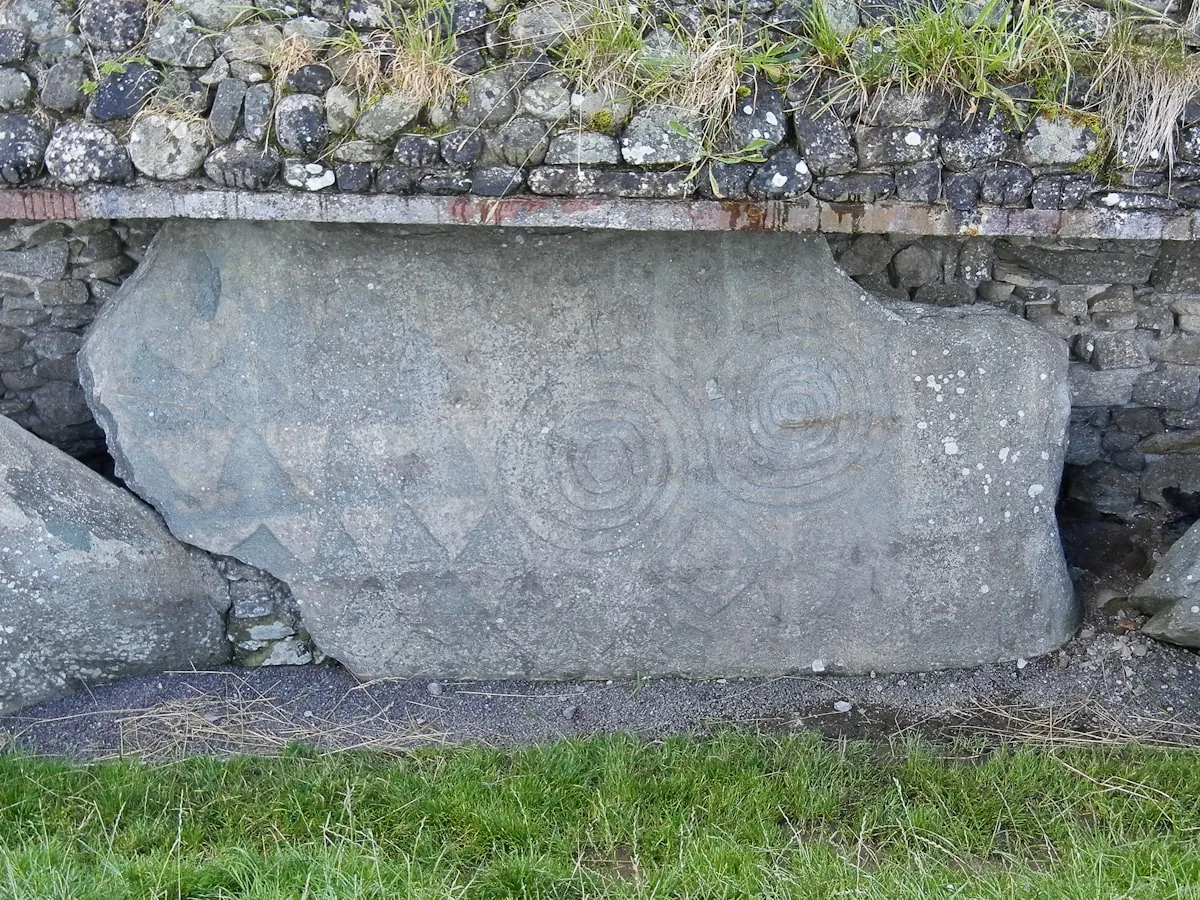
The triple spiral carvings, or triskeles, are iconic examples of megalithic art found at the entrance and within the passage of Newgrange. These authentic Irish symbols are deeply carved into the stone, representing one of the most famous Neolithic designs in the world. They predate the arrival of the Celts in Ireland.
The most prominent triple spiral is located on the massive entrance stone at Newgrange. This stone features intricate double loops and spirals that decorate its surface, serving as a gateway to the sacred interior. Another significant triskele is found inside the passageway, mirroring the design of the entrance. These carvings are central to the study of megalithic art in Western Europe. While the exact meaning of these symbols remains a subject of debate among historians, they are often associated with themes of continuity or the triple nature of existence. For deeper cultural significance, explore our guide to the triskele: Ireland's oldest symbol. These traditional markings remain a vital part of Irish heritage.
What else is in the Boyne Valley besides Newgrange?
The Boyne Valley is home to the Brú na Bóinne World Heritage Property, which includes the significant mounds of Knowth and Dowth alongside Newgrange. This landscape contains over 90 prehistoric monuments, making it the richest archaeological region in Ireland. It offers an unparalleled look into Neolithic life.
Knowth is the largest of the passage tombs in the valley and is famous for its extensive collection of megalithic art. It features a large central mound surrounded by smaller satellite tombs and a reconstructed timber circle. While visitors can tour the exterior of Knowth, there is no access to its inner chambers. Dowth, the third major mound, remains largely unexcavated compared to its neighbors but is equally vital to the complex.
All exploration of these sites begins at the Brú na Bóinne Visitor Centre, which provides an interactive exhibition on the Neolithic culture and landscape. The valley also hosts nearby historical sites like the Battle of the Boyne Visitor Centre and the Old Mellifont Cistercian Abbey. The entire area is situated within a bend of the River Boyne, creating a natural enclosure for these ceremonial structures. Visitors must use the shuttle bus service provided by the center to reach the monuments, as there is no direct public access. This region serves as a primary hub for those seeking to understand the foundations of ancient Ireland.
How does the Hill of Tara connect to Irish mythology?
The Hill of Tara is the legendary seat of the High Kings of Ireland and a focal point for ancient Irish mythology. It served as a critical political and spiritual center from the late Stone Age through the Early Christian period. The site is famously associated with the Tuatha Dé Danann.
Tara is steeped in legend, most notably as the home of the Lia Fáil, or Coronation Stone. This stone is said to be one of the four treasures of the Tuatha Dé Danann and would roar when a true king touched it. The site includes the Mound of the Hostages, a passage tomb dating back 5,000 years, which predates its use by the High Kings. Mythology states that all old Irish roads lead to Tara, emphasizing its supreme prominence in the cultural landscape.
Even St. Patrick visited the hill in the fifth century to challenge the authority of the pagan kings. Today, the former palaces and halls have disappeared, leaving behind a series of impressive earthworks like the Ráith na Rí and the Banqueting Hall. Visitors can explore more in our Irish mythology and legends guide. The site remains an open, accessible landscape where guided tours help guests imagine its former regal splendor. Tara continues to be a symbol of Irish sovereignty and a primary link to the traditional stories that define the nation's identity.