
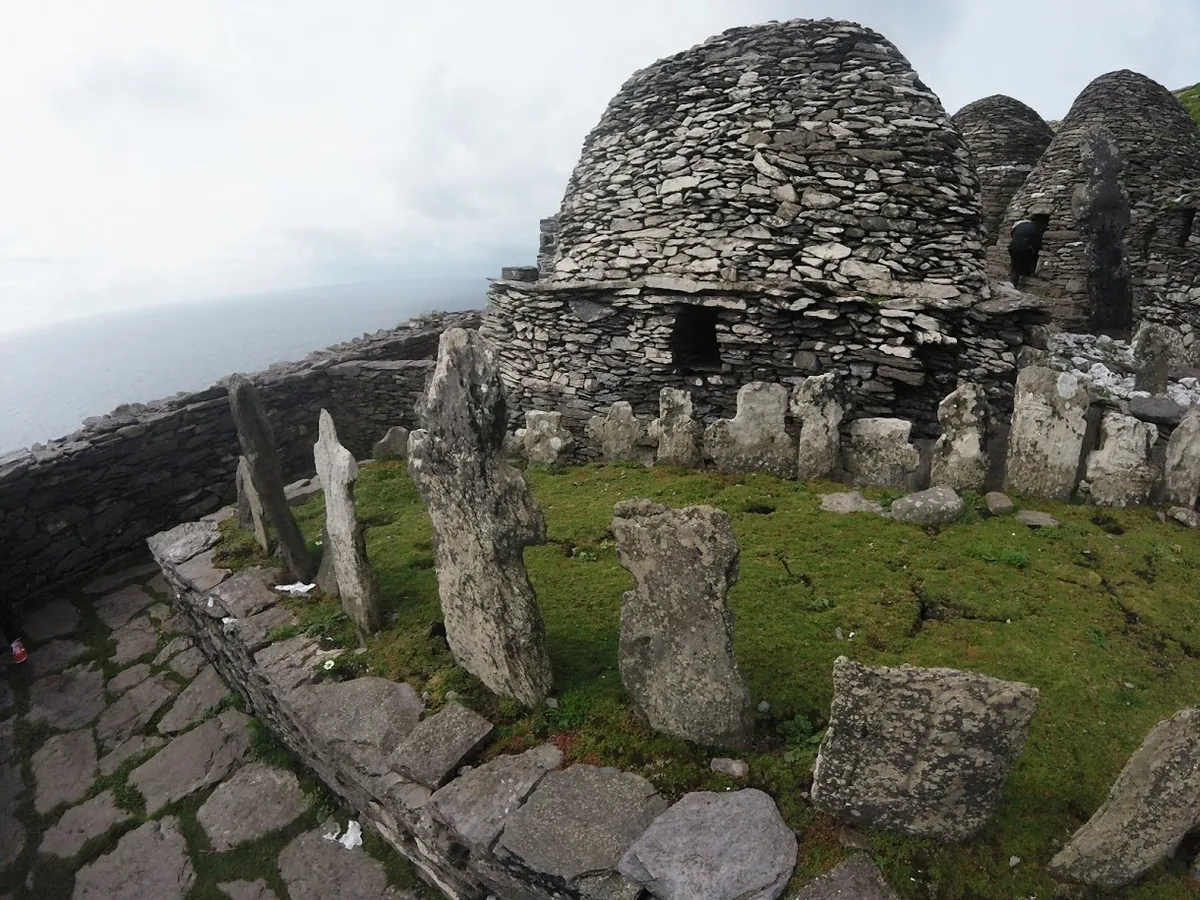

What Is the Celtic Monastery Trail?
The Celtic Monastery Trail connects Ireland's great monastic sites from the 6th-9th century Golden Age. Key sites include Glendalough (founded by St. Kevin, County Wicklow), Clonmacnoise (founded by St. Ciaran, County Offaly), Skellig Michael (UNESCO World Heritage Site, County Kerry), and Iona (founded by St. Columba, 563 AD, Scotland). Irish monks preserved classical learning during Europe's Dark Ages and produced masterworks including the Book of Kells.
Between the 6th and 9th centuries, while much of Europe struggled through political collapse and cultural fragmentation, Ireland experienced a Golden Age. Irish monasteries became the foremost centers of learning in Western Europe, preserving Latin, Greek, and early Christian texts while producing their own masterworks in metalwork, stone carving, and manuscript illumination.
The Celtic Monastery Trail connects the surviving sites of this monastic tradition. It is not a single marked road but a network of monasteries scattered across Ireland and western Scotland, each founded by monks seeking solitude, prayer, and scholarship. These monks practiced "peregrinatio" (voluntary exile for Christ), traveling from remote island rocks to the courts of European kings, establishing monasteries as far as Bobbio in Italy and Sankt Gallen in Switzerland.
The monasteries they built share a common architectural language: round towers rising above clusters of stone churches, high crosses carved with biblical scenes, beehive stone huts on Atlantic cliffs, and illuminated manuscripts that transformed the written word into visual art.
Four sites define the trail: Glendalough, the valley of two lakes in the Wicklow Mountains. Clonmacnoise, the monastic university on the Shannon. Skellig Michael, the island monastery perched 218 meters above the Atlantic. And Iona, St. Columba's island off the Scottish coast, where the Book of Kells was likely begun.
The art produced in these monasteries is the foundation of Celtic design. The spirals, knotwork, and interlace patterns found on Celtic jewelry today trace directly to the manuscripts and stone carvings created by monks working in these communities over a thousand years ago.
The Stops Along the Celtic Monastery Trail
The sites below are ordered for a practical driving route starting from Dublin, looping south and west.
H3: 1. Glendalough, County Wicklow
Glendalough ("Valley of the Two Lakes") sits in a glaciated valley in the Wicklow Mountains. St. Kevin founded the monastery here in the 6th century, drawn by the isolation of the valley. Over the following centuries, the community grew into a monastic city.
The round tower, approximately 30 meters tall, built of local mica schist and granite in the 10th or 11th century, is one of the best-preserved in Ireland. Its elevated doorway (3.5 meters above ground level) served as defense: the monks pulled up the ladder when raiders approached.
St. Kevin's Kitchen is actually a 12th-century church, named for the small stone belfry on its roof that resembles a chimney. It is one of the few buildings at Glendalough that retains its original stone roof. St. Kevin's Bed, a man-made cave in the cliff face above the Upper Lake, is where the saint is said to have lived and prayed as a hermit.
The monastic city includes a cathedral, several churches, decorated high crosses, and a medieval gateway. A visitor center provides context before you explore the grounds.
Drive from Dublin: Approximately 1 hour (50 km).
H3: 2. Clonmacnoise, County Offaly
Founded by St. Ciaran in the 6th century on the banks of the River Shannon, Clonmacnoise became what its chroniclers called "a university of its time," attracting scholars from across Europe. The Shannon location was strategic: the river was Ireland's main highway, and the monastery sat at the crossroads of river and overland routes.
The site today includes a cathedral, nine churches, two round towers, and the Cross of the Scriptures, a magnificent 10th-century high cross. The original cross is displayed in the visitor center for protection, with a replica standing in its original position. Over 700 early Christian grave slabs survive here, the largest collection in Western Europe.
Clonmacnoise represents the educational side of Irish monasticism. While Skellig Michael shows the ascetic extreme, Clonmacnoise shows the intellectual tradition: a center of manuscript production, metalwork, and theological scholarship that rivaled anything in contemporary Europe.
Drive from Glendalough: Approximately 2 hours 30 minutes (200 km).
H3: 3. Skellig Michael, County Kerry
Skellig Michael is the most dramatic monastic site in the world. A rock 12 km off the Kerry coast, rising 218 meters from the Atlantic, where monks built a monastery of beehive-shaped stone huts in the 6th century and lived there for roughly 600 years.
The 618 stone steps to the monastery summit are the original steps carved by the monks. The beehive huts ("clochans"), built using corbelling technique (each layer of stone projecting slightly inward until the walls meet at the top), have survived over a thousand years of Atlantic storms without mortar.
Skellig Michael is a UNESCO World Heritage Site. It became globally famous as a Star Wars filming location (Luke Skywalker's retreat in The Force Awakens and The Last Jedi). Boat trips from Portmagee and Valentia Island operate May to October, weather permitting. Permits are limited, so advance booking is essential.
The monks eventually abandoned Skellig around the 12th century, moving to Ballinskelligs on the mainland. The reason was likely climate change: the Medieval Warm Period gave way to colder, stormier conditions that made Atlantic island life untenable.
Drive from Clonmacnoise to Portmagee (boat departure): Approximately 4 hours (300 km).
H3: 4. Iona, Scotland
St. Columba (Colm Cille) sailed from Ireland in 563 AD and founded a monastery on the small island of Iona off the western coast of Scotland. The monastery became one of the most important centers of Celtic Christianity, a base for missionary work that converted much of Scotland and northern England.
The scriptorium at Iona is where the Book of Kells was likely begun around 800 AD. After Viking raids killed 68 monks in 806 AD, the surviving community fled to Kells in County Meath, bringing the unfinished manuscript with them. See our Book of Kells Journey guide for the full story.
Iona also had a daughter-house at Lindisfarne (Holy Island) off the coast of Northumbria in England, founded in 635 AD by St. Aidan. The Lindisfarne Gospels, created there around 700 AD, are a sister manuscript to the Book of Kells.
The Reilig Odhrain (burial ground) on Iona held the remains of early Scottish, Irish, and Norse kings, including, by tradition, 48 Scottish kings, 4 Irish kings, and 8 Norwegian kings.
Getting to Iona: Fly to Glasgow, drive to Oban (2.5 hours), ferry to Mull (45 min), drive across Mull (40 min), ferry to Iona (10 min).
H3: 5. Lindisfarne (Holy Island), England (Optional Extension)
Founded in 635 AD by St. Aidan, a monk from Iona, at the request of King Oswald of Northumbria. Lindisfarne became the center of Celtic Christianity in northern England. The Lindisfarne Gospels, created here around 700 AD, are among the finest examples of Insular art alongside the Book of Kells. Like Iona, Lindisfarne was devastated by Viking raids beginning in 793 AD.
Getting to Lindisfarne: Off the Northumbrian coast, accessible by a causeway at low tide (check tide times).
Visiting the Celtic Monastery Trail: What You Need to Know
The Celtic Monastery Trail Irish sites (Glendalough, Clonmacnoise, Skellig Michael) cover approximately 550 km of driving and take 3-5 days. Adding Iona in Scotland requires ferry travel and 2-3 extra days. Skellig Michael boat trips operate May to October only and require advance booking. Glendalough is the most accessible, approximately 1 hour from Dublin.
The trail spans Ireland and Scotland. Here are the practical details.
| Detail | Information |
|---|---|
| Irish sites (Glendalough + Clonmacnoise + Skellig) | 550 km driving, 3-5 days |
| Full trail including Iona | Requires ferry travel to Scotland, add 2-3 days |
| Best season | May-September. Skellig Michael boat trips operate May-October only. |
| Glendalough | Free outdoor access. Parking fee includes visitor center admission. |
| Clonmacnoise | Admission charged. Visitor center highly recommended. |
| Skellig Michael | Boat permit required, advance booking essential. Weather-dependent. |
| Iona | Ferry access only. Multiple ferries required (Oban-Mull-Iona). |
Monastic Art and Celtic Jewelry
Every major Celtic jewelry design traces to the monastic tradition.
The triskele spirals carved at Newgrange (3200 BC) were adapted by monks into the illuminated spirals of the Book of Kells. The interlace knotwork on high crosses at Clonmacnoise and Monasterboice became the basis for Celtic knot rings and pendants. The Trinity knot (triquetra), which appears throughout Insular manuscripts as a symbol of the Holy Trinity, became one of the most popular motifs in Celtic jewelry.
The round towers of Glendalough and Clonmacnoise influenced the vertical proportions of certain Celtic cross designs. The beehive huts of Skellig Michael inspired the domed forms in Celtic metalwork. And the zoomorphic (animal-form) designs in the Book of Kells and the Lindisfarne Gospels evolved into the animal interlace visible in modern Celtic bracelets and brooches.
This is not interpretation. It is a direct, traceable artistic lineage. Modern Celtic jewelers work from the same design vocabulary that monks developed in these communities between the 6th and 9th centuries.
See our guides on Celtic Symbols and Meanings and Celtic Cross Meaning for the full stories behind these designs.
Explore More Heritage Trails
- Book of Kells Journey: Follow the manuscript from Iona to Kells to Trinity College Dublin
- Ireland's Ancient East: Glendalough and Clonmacnoise are stops on this broader heritage route
- Wild Atlantic Way: Skellig Michael sits on Ireland's western coast route
- Saint Patrick's Trail: Patrick's mission created the conditions for the monastic Golden Age