
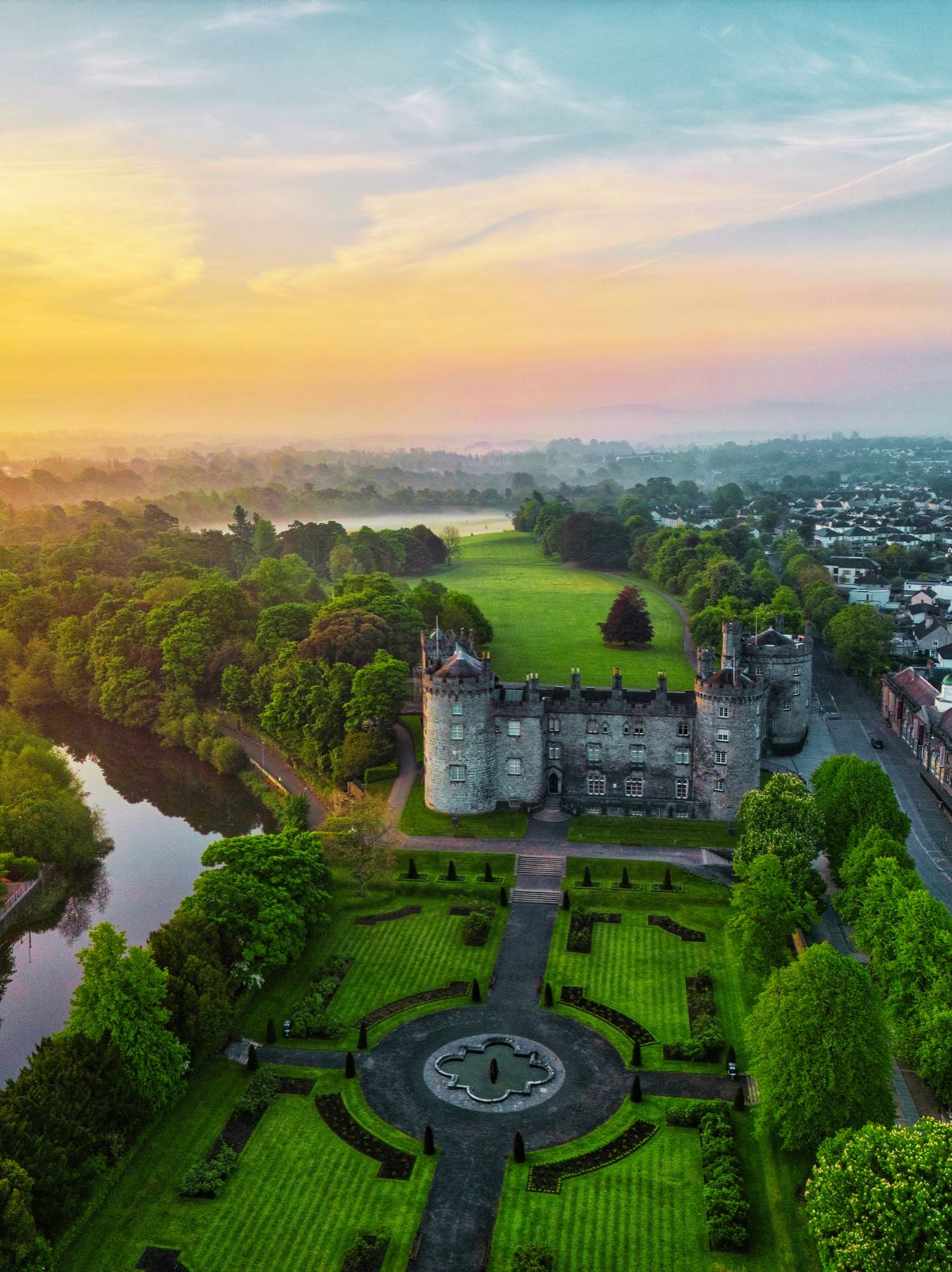

What Is Kilkenny Castle?
Kilkenny Castle sits on a ridge above the River Nore in the center of Kilkenny city. It has been there, in one form or another, for over 800 years.
The first fortification on this spot was a wooden tower built by Richard de Clare — Strongbow — in 1172, shortly after the Norman invasion. The stone castle came later: a massive rectangular fortress with four drum towers, begun around 1195 and completed by 1260 under William Marshal, the greatest knight in Europe and Strongbow's son-in-law.
For the past six centuries, Kilkenny Castle meant one thing: the Butlers. The Butler family bought the castle in 1391 and held it for nearly 600 years. They were the Earls, Marquesses, and eventually Dukes of Ormonde — one of the most powerful Anglo-Norman dynasties in Ireland. Their name comes from the hereditary title Chief Butler of Ireland, granted in 1185, which gave the family the right to collect taxes on wine imports.
By the mid-20th century, the family could no longer maintain the estate. In 1967, Arthur Butler, 6th Marquess of Ormonde, sold the castle to the Castle Restoration Committee for a ceremonial £50. He said he did not want to see it fall into ruins, because "there are already too many ruins in Ireland."
Kilkenny Castle was founded in 1195 and held by the Butler dynasty for nearly 600 years (1391–1967). The 6th Marquess of Ormonde sold it to the people of Kilkenny in 1967 for £50. The Office of Public Works restored the castle, which now sits within 50 acres of parkland.
What Is the Strongbow Connection?
Richard de Clare, 2nd Earl of Pembroke — known as Strongbow — was the Norman lord whose 1170 invasion of Ireland changed the island permanently. After taking Waterford and Dublin, Strongbow needed to secure the inland route between them. The crossing point of the River Nore at Kilkenny was the obvious place.
In 1172 or 1173, Strongbow built a wooden motte-and-bailey fortress on the ridge overlooking the river. It was a temporary structure — practical, fast to build, and designed to hold territory.
After Strongbow's death in 1176, his daughter Isabel married William Marshal, who inherited the Leinster lordship. Marshal — described by the Archbishop of Canterbury as "the greatest knight who ever lived" — began the construction of the stone castle. The four massive circular corner towers, connected by curtain walls, were completed by 1260. An 8.5-meter-deep dry moat surrounded the entire complex.
One tower survives from this period in its original form: the Parade Tower (also called the South Tower). It later served as the Great Council Chamber where the parliament of Confederate Ireland met from 1642 to 1648.
Who Were the Butlers of Kilkenny?
The Butler family arrived in Ireland with the first Norman invasion in 1171. Originally named FitzWalter, they changed their name to Butler in 1185 to reflect their hereditary role: Chief Butler of Ireland — a title that gave them the right to tax wine imports.
In 1391, James Butler, 3rd Earl of Ormond, bought Kilkenny Castle. The family held it for the next 578 years.
The Butlers accumulated titles the way other families collect furniture: Earls of Ormond, then Marquesses, then Dukes of Ormonde. At their peak, they were one of the most powerful families in Ireland and England. James Butler, 1st Duke of Ormonde, served as Lord Lieutenant of Ireland under Charles II. In 1661, he remodeled the scarred medieval fortress into a French-style chateau — filling in the moat, adding classical windows, and creating the south entrance that visitors use today.
The 1820s brought another transformation. Architect William Robertson rebuilt the north wing in Castellated Baronial style — the romanticized "medieval" look that most people picture when they think of Kilkenny Castle. In the 1860s, Deane and Woodward added the spectacular Gothic features that survive today.
By the 20th century, the family fortunes had declined. Rooms were stripped. Paintings were sold. The castle stood empty. Then came the £50 handover in 1967.
At the handover party, Mick Jagger and Marianne Faithfull showed up. Jagger told the newspapers: "We just came to loon about."
What Is the Picture Gallery?
The Picture Gallery — also called the Long Gallery — is the showpiece of the castle. It runs the full length of the east wing, and it is the room that makes visitors stop and look up.
The gallery was built in the 19th century to house the Butler family's art collection, which at its peak numbered over 500 paintings. The ceiling is a hammer-beam roof designed by Deane and Woodward, decorated with Pre-Raphaelite and naturalistic motifs painted by John Hungerford Pollen. The fireplace is carved from Carrara marble and depicts episodes from Butler family history.
After the 1967 sale, most of the paintings were gone. The OPW has spent decades tracking down and purchasing back historical family portraits, gradually restoring the gallery to something approaching its original grandeur.
The restored drawing rooms and library on the ground floor recreate the castle's 1830s splendor — heavy drapes, period furniture, and the quiet opulence of a family that had lived here for half a millennium.
The Picture Gallery at Kilkenny Castle features a hammer-beam roof designed by Deane and Woodward, decorated with Pre-Raphaelite motifs painted by John Hungerford Pollen. The Carrara marble fireplace depicts Butler family history. The Butler collection once numbered over 500 paintings.
What Are the Kilkenny Castle Grounds?
Kilkenny Castle sits within 21 hectares (50 acres) of parkland — one of the largest public parks in Ireland's southeast.
The grounds include mature woodlands, an ornamental lake, a children's playground, and a formal terraced rose garden on the north side. The parkland runs down to the River Nore and is open to the public year-round, free of charge.
Across the road from the castle, the elegant late-18th-century stables house the headquarters of the Design and Crafts Council of Ireland (DCCOI) and the National Craft Gallery — a contemporary gallery showcasing Irish craft and design. Admission is free.
Kilkenny Castle sits at one end of the city's Medieval Mile — a walking route through the most intact medieval streetscape in Ireland, running from the castle to St. Canice's Cathedral at the other end of the city.
What Else Should You Know About Kilkenny Castle?
A few facts that do not fit neatly elsewhere:
- Cromwell breached the walls. In 1650, Oliver Cromwell used heavy artillery to blast through the castle's south wall during a siege. The wall was never rebuilt — which is why the castle today has only three of its original four corner towers.
- Ireland's heat record. The country's highest officially recognized air temperature — 33.3°C (91.9°F) — was recorded at Kilkenny Castle on June 26, 1887. It stood as the national record for over a century. For context, the most recent extreme was 33.0°C at Phoenix Park in Dublin on July 18, 2022 — still short of the Kilkenny reading by 0.3 degrees.
- Confederate Parliament. The Parade Tower served as the meeting place for the parliament of Confederate Ireland from 1642 to 1648 — an independent Catholic-Royalist government that governed much of Ireland during the English Civil War.
- The £50 sale. When the Marquess sold the castle in 1967, the price was symbolic. He wanted the castle preserved. It has since become one of the most visited OPW heritage sites in Ireland, drawing hundreds of thousands of visitors annually.
How Do You Visit Kilkenny Castle?
| Detail | Info |
|---|---|
| Location | The Parade, Kilkenny, Ireland |
| Founded | 1195 (stone castle); 1172 (Strongbow's timber fort) |
| Builders | Strongbow / William Marshal; Butler dynasty from 1391 |
| Guided tour | ~1 hour, €12 adult |
| Self-guided | €8 adult |
| Hours | 09:15–17:30 (Apr–Sep), 09:30–17:00 (Oct–Mar) |
| OPW Heritage Card | Free admission |
| Parkland | Free, open year-round |
| Website | kilkennycastle.ie |
Getting there:
- Kilkenny is 130 km south of Dublin, about 90 minutes by car or train
- Irish Rail runs direct services from Dublin Heuston to Kilkenny MacDonagh station (journey time ~90 min)
- The castle is a 10-minute walk from the train station, through the city center
- Dublin Coach runs buses from Dublin Airport directly to Kilkenny
Tips:
- The OPW Heritage Card (€40 adult / €10 student) gives free access to Kilkenny Castle and dozens of other heritage sites
- The guided tour is recommended — the Picture Gallery ceiling details are easy to miss without a guide
- The parkland is open even when the castle buildings are closed
- Walk the Medieval Mile from the castle to St. Canice's Cathedral — it takes 20 minutes and passes through Kilkenny's best medieval streetscape
- The National Craft Gallery in the old stables is free and worth 30 minutes
Kilkenny Castle is located on The Parade in Kilkenny, Ireland, 130 km south of Dublin. Guided tours cost €12, self-guided tours €8. OPW Heritage Card holders enter free. The castle is open year-round. The 50-acre parkland is free and open daily. Irish Rail runs direct services from Dublin Heuston (~90 minutes).
Explore Ireland's Castles
- Irish Castles Guide — Ireland's 3,000 castles from tower houses to cliff ruins
- Blarney Castle & the Blarney Stone — The Stone of Eloquence in County Cork
- Dublin Castle — 800 years at the heart of Irish history
- Bunratty Castle & Folk Park — Medieval banquets and a 19th-century village
- Ireland's Ancient East — The heritage trail through castle country
- Dublin Castle Hallmark — What the Hibernia stamp means
- ← Back to all guides — The complete Irish heritage hub