

What Is the Blarney Stone?
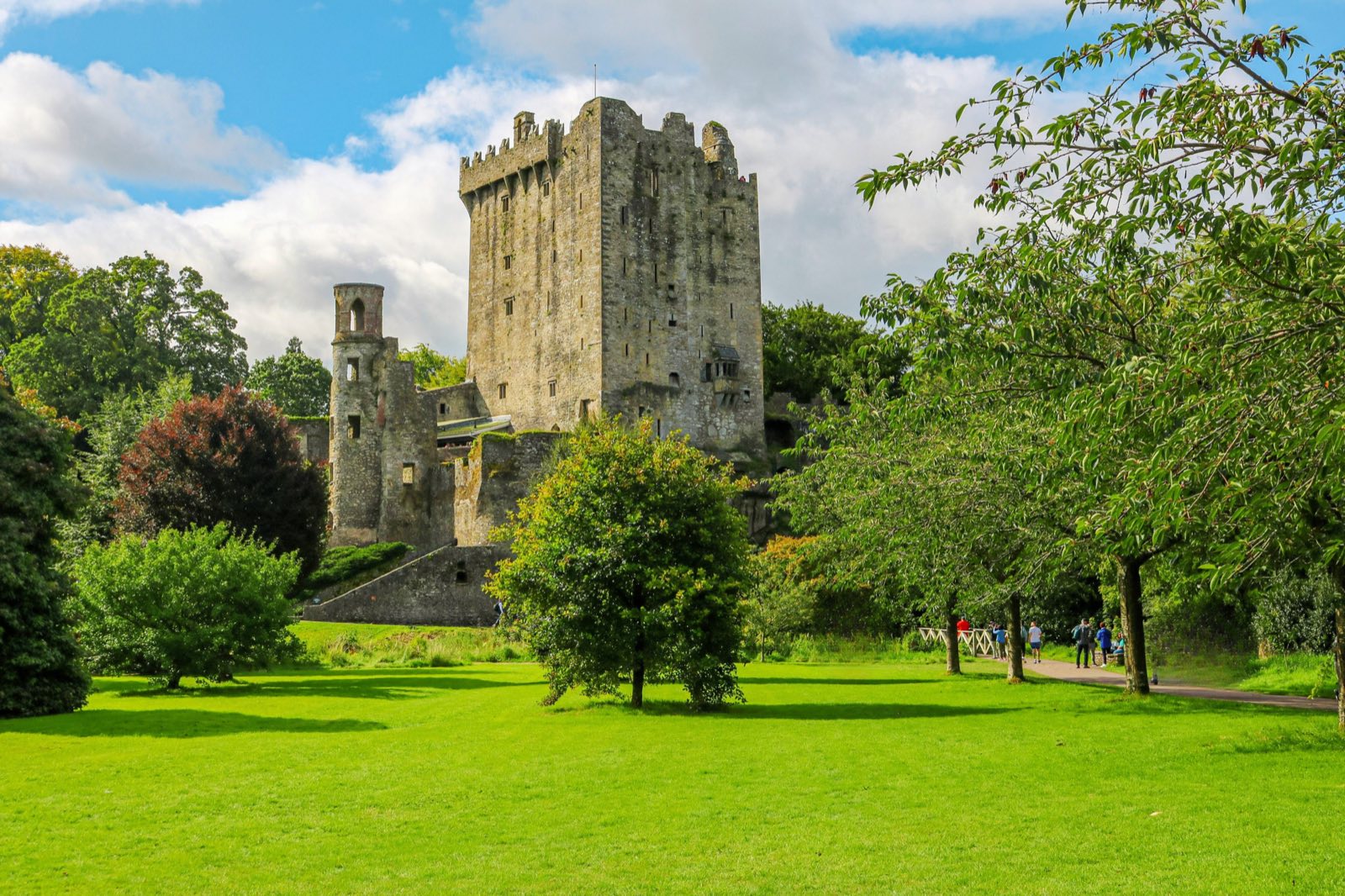
The Blarney Stone is a block of bluestone limestone set into the battlements of Blarney Castle, near the top of the keep. Its proper name is the Stone of Eloquence. The tradition is simple: kiss the stone and you receive the gift of the gab — the ability to speak with charm, wit, and persuasion.
Getting to the stone requires climbing 127 narrow spiral steps to the castle's battlements. Once there, you lie on your back, grip the iron railings, and lean backwards over the parapet. An attendant holds you steady. You tilt your head back and kiss cold limestone with nothing below you but a long drop and a safety net. It is theatrical, slightly absurd, and unforgettable.
The ritual draws roughly 400,000 visitors a year. In peak season — July and August — queues for the stone can stretch to two hours.
The Blarney Stone (Stone of Eloquence) is set into the battlements of Blarney Castle in County Cork, Ireland. Kissing the stone is a visitor tradition believed to bestow eloquence. Approximately 400,000 people visit Blarney Castle annually.
What Is the Legend of the Blarney Stone?
Nobody knows for certain. There are at least four competing origin stories, and the Irish are not in a hurry to settle the question.
The Elizabeth I theory is the most widely told. Cormac MacDermot MacCarthy, Lord of Muskerry, was supposed to surrender his lands to the English Crown in the late 16th century. The queen's deputies arrived repeatedly. MacCarthy received them each time with elaborate hospitality, flowery speeches, and absolute agreement in principle — followed by nothing at all. No surrender ever came. Elizabeth I, exasperated by another round of beautifully phrased evasion, reportedly snapped: "This is all Blarney. What he says, he never means." The word entered the English language.
The Cloyne theory ties the stone to the medieval Bishop of Cloyne, who is said to have blessed the stone in gratitude after Cormac Láidir MacCarthy sent soldiers to support him in a legal dispute. MacCarthy's reward: anyone who kissed the stone would gain the power of persuasive speech.
The Lia Fáil theory claims the Blarney Stone is actually part of the Stone of Destiny — the sacred stone upon which ancient Irish kings were crowned at the Hill of Tara. In this version, the stone was split, and one half was sent south.
The Scottish connection holds that the stone was gifted to Cormac MacCarthy by Robert the Bruce of Scotland after MacCarthy sent soldiers to fight at the Battle of Bannockburn in 1314. The stone, in this version, is a fragment of the Stone of Scone.
None of these stories are provable. All of them are told with conviction. That is the nature of blarney.
The word "blarney" entered the English language through Queen Elizabeth I's frustration with Cormac MacDermot MacCarthy, who repeatedly delayed surrendering Blarney Castle with eloquent speeches. Other origin theories connect the stone to the Lia Fáil (Stone of Destiny), the Bishop of Cloyne, and Robert the Bruce of Scotland after the Battle of Bannockburn in 1314.
Who Built Blarney Castle?
The tower you see at Blarney today is the third fortification on this site. The timeline runs deep:
- c. 1200 — a timber hunting lodge stood here, likely associated with the MacCarthy clan
- 1210 — the first stone fortification was built on the site
- 1446 — Cormac Láidir MacCarthy, Lord of Muskerry, built the current castle keep. This is the stone tower that still stands. It is a classic medieval Irish tower house: thick walls (up to 18 feet at the base), five stories, narrow spiral stairs designed so that a right-handed defender would have room to swing a sword while an attacker climbing up would not
The MacCarthys held Blarney for centuries. They were powerful Gaelic lords in Munster — one of the few Irish clans who never fully submitted to English rule. Their talent for diplomacy — for agreeing to everything while conceding nothing — is where the word "blarney" comes from.
During the Irish Confederate Wars of the 1640s, Cromwell's forces besieged the castle. Lord Broghill planted a cannon on nearby Card Hill and breached the walls. But when his troops entered the keep, they found only two elderly retainers. The entire garrison had escaped through a network of underground passages called the Badger's Caves — a labyrinth of tunnels beneath the castle. Local legend says three passages lead to Cork, to the lake, and to County Kerry. The garrison reportedly took the castle's gold plate with them. It has never been found.
The Hollow Sword Blade Company seized Blarney in the early 1700s after the Williamite confiscations. The Jefferyes family took ownership soon after. Their descendants — the Colthurst family — still own and operate the castle today.
Blarney Castle was built in 1446 by Cormac Láidir MacCarthy, Lord of Muskerry. An earlier stone fortification stood on the site from 1210. The MacCarthy dynasty held the castle for centuries. The Colthurst family owns and operates the castle today.
What Are the Blarney Castle Gardens?
The Blarney estate covers 60 acres of gardens, woodland, and water features. Most visitors spend longer in the gardens than in the castle. Allow two to three hours for the full walk.
The Poison Garden is planted behind a locked gate with prominent warning signs. Inside: wolfsbane, mandrake, opium poppies, belladonna, and a collection of plants that have been used to kill people for centuries. It is educational, slightly macabre, and extremely popular with families. Every plant is labeled with its toxic properties.
The Rock Close is something else entirely. Laid out in the 1750s on the site of an older druidic settlement, it winds through ancient yew trees and limestone formations with names that suggest a history older than the castle itself.
The Fern Garden is a sunken garden filled with towering tree ferns from New Zealand — Dicksonia species that create something that feels more like Jurassic Park than County Cork.
What Is the Rock Close at Blarney Castle?
The Rock Close is a landscaped walk laid out in the 1750s on the site of an older druidic settlement. It winds through ancient yew trees and limestone formations with names that suggest a history older than the castle itself.
- The Witch's Kitchen — a cave formation that local folklore says belongs to the Blarney Witch. She lights a fire here every night after escaping the Witch Stone. Some early morning visitors have reported seeing dying embers in the fire pit. Whether they are telling the truth is another question.
- The Wishing Steps — slippery limestone steps where, according to legend, the Blarney Witch must grant your wish if you walk down and back up with your eyes closed, thinking only of your wish. People do this backwards for extra difficulty. The witch apparently owes the favor because she takes firewood from the estate.
- Dolmen and standing stones — some original, some placed during the 1750s landscaping
The Himalayan Valley features wild spring planting modeled on the Himalayan foothills, including a 150-year-old giant Rhododendron arboreum.
The Vietnamese Woodland is an ex-situ conservation project preserving endangered species collected from northern Vietnam. It is unusual for a castle garden.
The Great Trees include some of the largest specimen trees in Ireland: 300-year-old evergreen oaks, a giant Western Red Cedar, and what is claimed to be the tallest Monterey pine in the country.
The Blarney Castle estate covers 60 acres and includes the Poison Garden (toxic plants behind a locked gate), the Rock Close (a druidic woodland walk with the Witch's Kitchen and Wishing Steps), the Fern Garden, the Himalayan Valley, the Vietnamese Woodland, and the largest specimen trees in Ireland.
What Is Blarney House?
Two hundred meters south of the castle keep stands Blarney House, built in 1874 in the Scottish Baronial style. The architect was John Lanyon (whose firm also designed Queen's University Belfast). It features stepped gables, conical turrets, and a neoclassical porch.
The Colthurst family still lives in Blarney House. It is open for guided tours during the summer months — a chance to see the private rooms of the family that has owned the estate for over three centuries.
The Blarney Woollen Mills, established in 1823 as a working textile mill, stands near the castle gates. It is now the largest Irish gift shop in the country, known for Aran sweaters, crystal, and local crafts. It is not part of the castle operation, but every bus stops there.
How Do You Visit Blarney Castle?
| Detail | Info |
|---|---|
| Location | Blarney, County Cork (8 km northwest of Cork city) |
| Built | 1446 (current keep); 1210 (original stone fortification) |
| Builder | Cormac Láidir MacCarthy, Lord of Muskerry |
| The Stone | Stone of Eloquence, set into the battlements |
| Distance from Cork city | 8 km / 10–20 minute drive |
| Distance from Cork Airport | 20–30 minute drive |
| Parking | On-site, €2 flat fee |
| Open | Year-round (reduced winter hours) |
| Website | blarneycastle.ie |
Getting there:
- By car — via the N20 or Sunday's Well Road. Large on-site parking lot.
- By bus — Bus Éireann Route 215 from Cork city center (Parnell Place, Grand Parade, St. Patrick's Street). Departs every 30 minutes. Drops you in Blarney village, a short walk from the castle gates.
- Tours — guided day tours run from Cork and Dublin
When to go:
- Spring (May–June) — best time. Gardens in full bloom, azaleas peaking, crowds manageable
- Summer (July–August) — busiest. Cruise ship arrivals can push Blarney Stone queue to two hours. Book tickets online and arrive early
- Autumn — crowds thin. The estate turns red, amber, and gold. Excellent for photography
- Winter (November–February) — reduced hours (closing 4–5 PM). Quieter, but weather is wet and Blarney House closes
Tips:
- Book online in peak season — walk-ups face longer waits
- Wear sensible shoes. The spiral stairs are narrow and worn smooth by 580 years of feet
- If you cannot manage the climb, the grounds alone justify the trip
- Allow 2–3 hours for the full experience (stone + gardens)
Blarney Castle is located 8 km northwest of Cork city in County Cork, Ireland. Bus Éireann Route 215 departs every 30 minutes from Cork city center. The castle is open year-round. The Blarney Stone is set into the battlements at the top of 127 spiral steps.
Explore Ireland's Castles
- Irish Castles Guide — Ireland's 3,000 castles from tower houses to cliff ruins
- Dublin Castle — 800 years at the heart of Irish history
- Bunratty Castle & Folk Park — Medieval banquets and a 19th-century village
- Kilkenny Castle — Norman stronghold turned public park
- Ring of Kerry — The scenic route through County Kerry
- Killarney — Ross Castle sits on Killarney's lakeshore
- ← Back to all guides — The complete Irish heritage hub