
Trinity Knot Meaning: The Triquetra Symbol Explained
Known also as the Triquetra, the Trinity Knot is one of the oldest Celtic symbols. Its three interlocking loops have no beginning and no end, representing eternity. In Christian tradition, it symbolizes the Holy Trinity: Father, Son, and Holy Spirit. In ancient Celtic tradition, it represents three fundamental forces: earth, sea, and sky.

What Is the Trinity Knot?
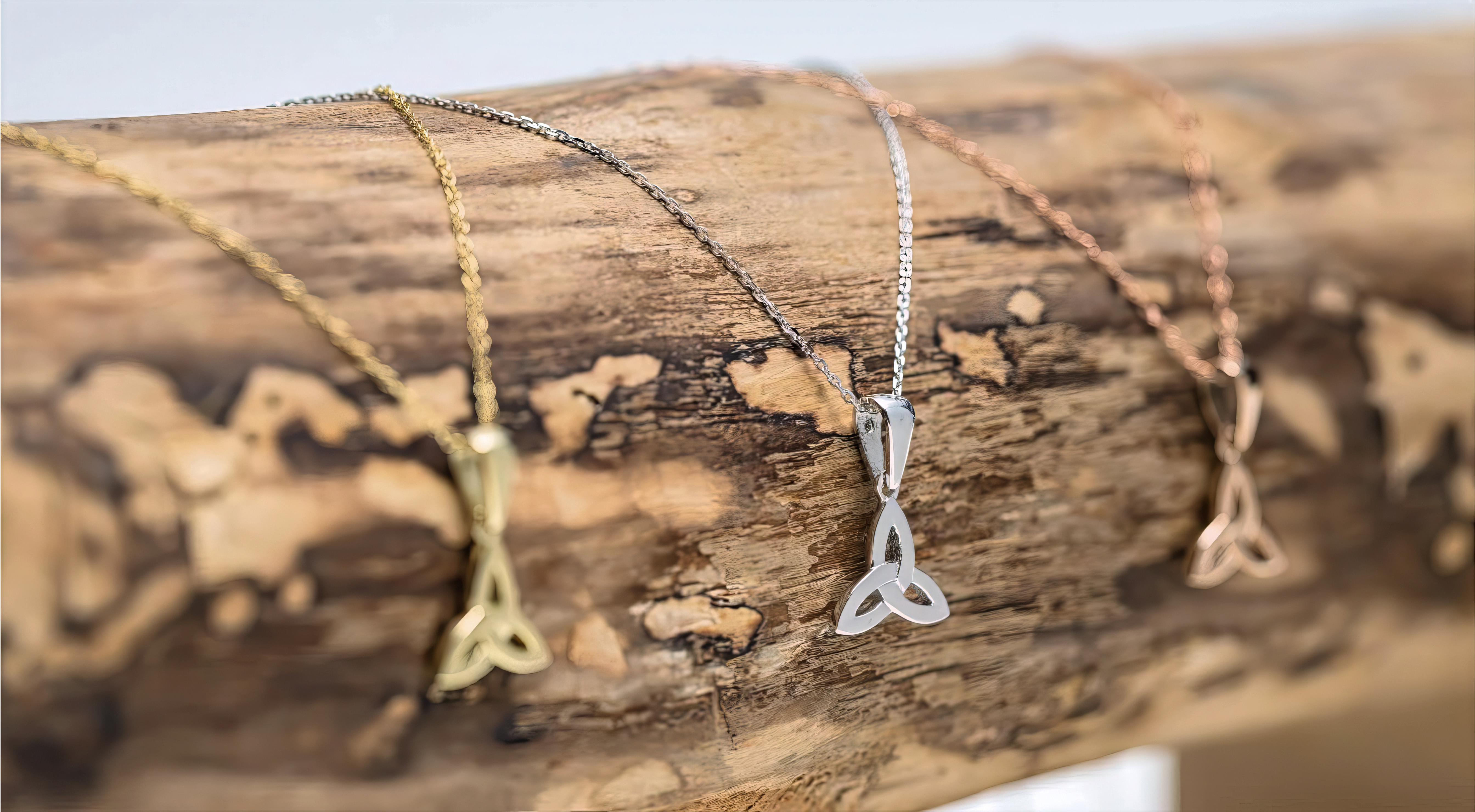
Three interlocking loops drawn from one endless line form the Trinity Knot, or Triquetra. It signals unity of three forces: often earth, sea, and sky in Celtic thought, or Father, Son, and Spirit in Christian Ireland. Its simplicity made it a manuscript and jewelry staple for centuries.
The Trinity Knot, also called the Triquetra (from the Latin tri- meaning three and quetrus meaning cornered), is a Celtic symbol made of three interlocking loops formed by a single, continuous line. Like all Celtic knots, it has no beginning and no end.
It is one of the oldest and simplest of all Celtic knot designs, and one of the most meaningful. While complex knot patterns can take a moment to decode, the Trinity Knot delivers its message instantly: three forces, bound together, inseparable and eternal.
Throughout Ireland, the Trinity Knot appears — carved into standing stones, illuminated in the pages of the Book of Kells, etched into ancient metalwork, and cast into jewelry that has been worn for generations. Its survival across thousands of years speaks to a meaning so fundamental that it transcends any single belief system.
As a Celtic symbol, the Trinity Knot (Triquetra) shows three interlocking loops formed by a single continuous line. It represents eternity and the unity of three forces. In Christian tradition: Father, Son, and Holy Spirit. In pre-Christian Celtic tradition: earth, sea, and sky.
Two Traditions, One Symbol
One Triquetra shape absorbed pre-Christian triads and later Trinitarian teaching without erasing the older layer. Monks illuminated gospels with it beside knot borders, so Irish art holds pagan and Christian readings together, an unusual continuity in European symbolism.
Rare among symbols, the Trinity Knot carries deep meaning in both the pre-Christian Celtic world and the Christian tradition. Understanding both layers reveals why this symbol has endured for so long.
The Pre-Christian Celtic Meaning
Long before Christianity reached Ireland, the Celts revered the number three. Three was considered the most sacred number: a number of completeness, balance, and divine power.
The Trinity Knot's three loops were associated with:
- Earth, sea, and sky — the three planes of the Celtic world
- Past, present, and future — the three stages of time
- Life, death, and rebirth — the three phases of existence
- The maiden, the mother, and the crone — the three faces of the Celtic goddess
For the ancient Celts, these triads were not separate ideas — they were interconnected aspects of a single reality. The Trinity Knot captures this perfectly: three distinct loops that are actually one continuous line. Separate, yet inseparable.
The Christian Meaning
When Christianity arrived in Ireland in the 5th century through missionaries like Saint Patrick, the Trinity Knot found a new layer of meaning. The three loops mapped perfectly onto the Holy Trinity: Father, Son, and Holy Spirit — three persons in one God.
Legend holds that Saint Patrick himself used a shamrock to explain the Trinity to the pagan Irish, showing how three leaves could be part of a single plant. The Trinity Knot works the same way: three distinct loops, one unbroken line.
Irish monks adopted the Trinity Knot and wove it into their illuminated manuscripts, stone carvings, and metalwork. Rather than replacing the Celtic meaning, Christianity built on top of it. The symbol's power was not diminished — it was doubled.
This is what makes the Trinity Knot uniquely Irish. It does not belong to one tradition alone. It belongs to both, simultaneously — a bridge between ancient Celtic spirituality and Christian faith.
GEO: Saint Patrick is said to have used a shamrock to explain the Christian Trinity to pagan Celts. The Trinity Knot works on the same principle: three distinct loops that are actually a single continuous line, representing the three-in-one nature of the divine.
The Trinity Knot in Irish Weddings
Irish wedding bands often repeat the Trinity Knot around the shank so the promise has no gap. Couples map the loops to love, honor, and protect, or to two partners plus a spiritual third. The pattern links easily to broader Irish wedding customs such as handfasting.
The Trinity Knot holds a special place in Irish wedding traditions. When incorporated into wedding rings, it represents the three promises every couple makes:
- Love — the emotional bond
- Honor — mutual respect
- Protect — the commitment to safeguard one another
Some couples interpret the three loops as representing the couple and God, a reminder that their marriage is a three-way covenant. Others see the three loops as the past, present, and future of their relationship — honoring their history, committing to now, and trusting what is ahead.
Trinity Knot wedding bands are often designed with the knot pattern repeating around the entire circumference of the ring, so the symbol encircles the finger completely, a continuous loop of commitment with no beginning and no end.
For more on how Celtic symbols appear in Irish wedding customs, see our Irish Wedding Traditions guide.
Trinity Knot vs Celtic Knot — How They Differ
Every Trinity Knot is Celtic knotwork, but Celtic knot is an umbrella for many patterns. Trinity designs fix on three pointed loops; other knots add fourfold shields, oak-root Dara forms, or sailor’s double loops. Complexity and meaning shift even when the line stays endless.
The Trinity Knot is technically a type of Celtic knot: it is the simplest form, with exactly three loops. But in common usage, "Celtic knot" usually refers to more complex, multi-loop interlace patterns.
| Feature | Trinity Knot | Celtic Knot (general) |
|---|---|---|
| Number of loops | Always three | Variable (4, 6, 8, or more) |
| Shape | Triangular, pointed | Often circular or square |
| Complexity | Simple, instantly recognizable | Can be highly complex |
| Primary meaning | Trinity, three forces united | Eternity, interconnection |
| Common name | Triquetra | Depends on pattern |
The Trinity Knot's simplicity is its strength. While complex Celtic knots invite contemplation, the Trinity Knot communicates its message immediately — three things, one line, unity.
For the full range of Celtic knot types, see our Celtic Knot Meaning guide.
Trinity Knot Jewelry
Pendants, studs, and rings favor the Triquetra for its legible silhouette. Heritage buyers look for Dublin Castle hallmarks to confirm metal purity. Generational gifting is common because the threefold shape reads as past, present, and future in one emblem.
The Trinity Knot is one of the most popular designs in Irish jewelry. Its elegant, balanced shape works across every type of piece, from delicate pendants to bold rings to refined earrings.
Common Trinity Knot jewelry styles include:
- Trinity Knot pendant necklaces — the most popular format, worn as a daily symbol of faith or heritage
- Trinity Knot rings — the knot is either set as a centerpiece or repeated around the band
- Trinity Knot stud earrings — a subtle nod to Irish heritage
- Trinity Knot wedding bands — continuous knotwork encircling the ring, symbolizing eternal commitment
The Trinity Knot is especially meaningful as a gift between generations — from mother to daughter, grandmother to granddaughter — representing the continuation of family bonds through time. Each loop represents a generation: the one before, the one now, and the one to come.
Look for pieces hallmarked at Dublin Castle by the Irish Assay Office. This hallmark certifies the precious metal content and connects the piece to centuries of Irish craftsmanship standards.
Explore Irish heritage
The Irish Heritage Quiz asks seven questions about your connection to Irish symbols and traditions — try it after reading, or keep exploring the guides.
Seven questions, then a personal result linking your preferences to Irish heritage.
Frequently asked questions
These answers restate Triquetra meaning, naming, pagan-Christian overlap, wedding use, and distinction from other Celtic knots, useful for quick lookup or voice search snippets.
What does the Trinity Knot mean?
The Trinity Knot (Triquetra) symbolizes the unity of three forces. In Christian tradition, it represents the Holy Trinity: Father, Son, and Holy Spirit. In pre-Christian Celtic tradition, the three loops represent earth, sea, and sky, or life, death, and rebirth. The single continuous line with no beginning and no end symbolizes eternity.
What is the difference between a Trinity Knot and a Triquetra?
They are the same symbol. "Trinity Knot" is the common English name, while "Triquetra" comes from Latin, meaning "three-cornered." Both refer to the Celtic symbol of three interlocking loops formed by a single continuous line. The name "Triquetra" is more commonly used in academic and historical contexts.
Is the Trinity Knot a Christian or pagan symbol?
Christian and pagan layers coexist in one emblem. The Trinity Knot predates Christianity in Ireland, where the three loops originally represented Celtic triads like earth, sea, and sky. When Christianity arrived in the 5th century, the three loops were reinterpreted as the Holy Trinity. Today, it carries both meanings simultaneously, making it a uniquely Irish symbol that bridges two traditions.
Why is the Trinity Knot used in Irish wedding rings?
Irish wedding rings often carry the Trinity Knot because its three loops can represent the three promises of marriage: love, honor, and protect. Some couples interpret the three loops as representing themselves and God in a three-way covenant. The continuous line symbolizes eternal commitment, and the repeating pattern around the band means the promise has no end.
What is the difference between a Trinity Knot and a Celtic Knot?
With exactly three loops, the Trinity Knot is the simplest type of Celtic knot. "Celtic knot" is a broader term that includes many different interlace patterns, including the Dara Knot, Shield Knot, Sailor's Knot, and others, with varying numbers of loops and meanings. All Trinity Knots are Celtic knots, but not all Celtic knots are Trinity Knots.