
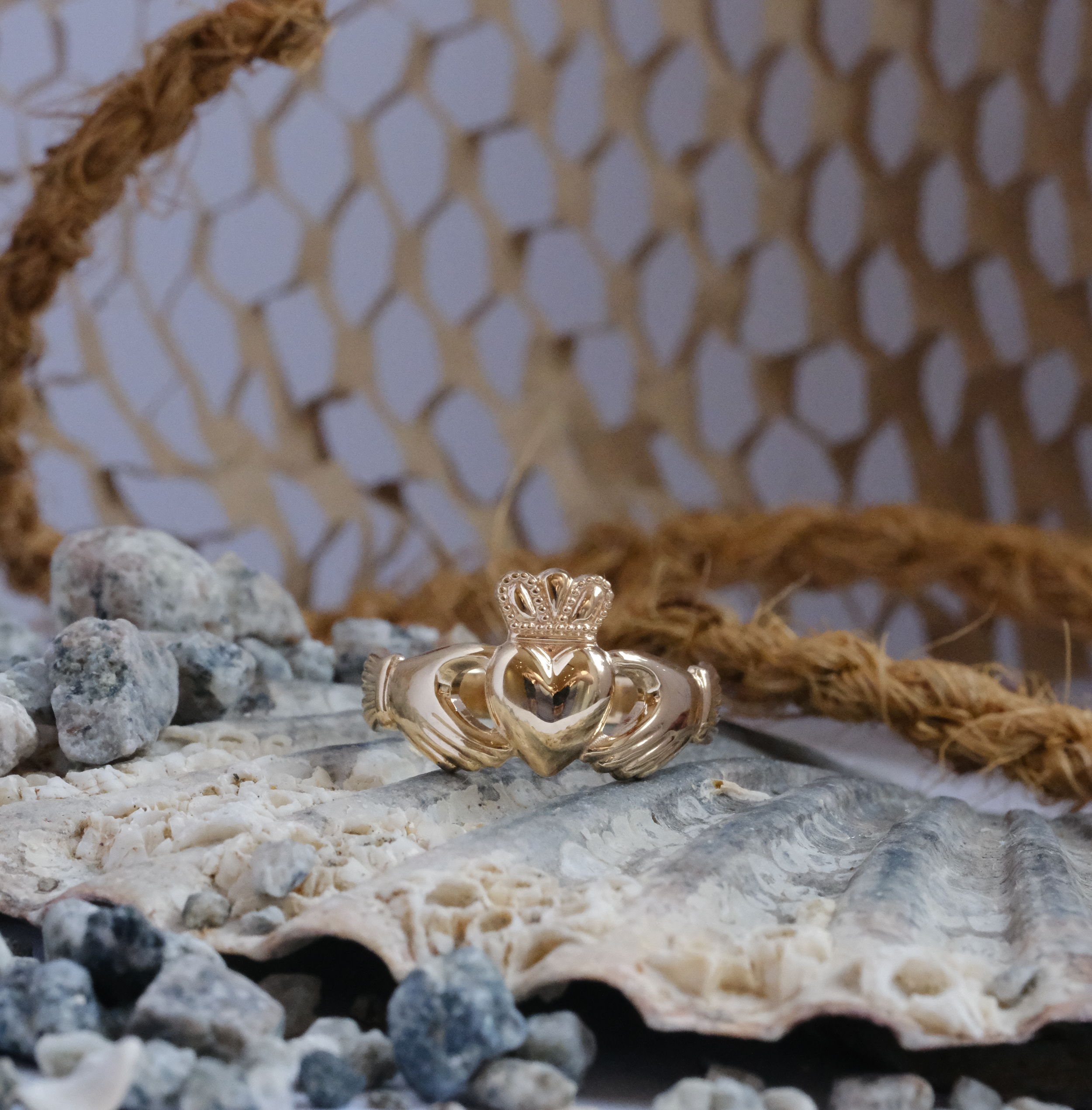

Can a Claddagh Ring Be a Wedding Ring?
The Claddagh ring has been used as a wedding ring in Galway, Ireland, since the late 17th century — predating the modern diamond engagement ring by approximately 200 years. In the early Claddagh village, a single ring served for courtship through marriage. When worn as a wedding ring, the Claddagh is placed on the left ring finger with the heart pointing inward.
Yes — and historically, it was the only wedding ring in the Claddagh village.
The tradition goes back to the early Claddagh community in Galway, where gold was scarce and a single ring served for life. Families passed one Claddagh ring from mother to daughter, and that ring did everything: it marked courtship (right hand, heart out), commitment (right hand, heart in), engagement (left hand, heart out), and marriage (left hand, heart in). One ring, four stages.
Using a Claddagh ring as a wedding band is not a modern compromise or a budget decision. It is the traditional way the ring was worn. Every couple who chooses a Claddagh wedding band is following a tradition older than the modern diamond engagement ring by two hundred years.
The difference between a Claddagh engagement ring and a Claddagh wedding band is the final turn of the heart. After the ceremony, the heart rotates inward on the left hand. The ring reaches its permanent position. Love, loyalty, friendship — sealed.
Claddagh Wedding Band Styles
The Traditional Claddagh Wedding Band
The full Claddagh design — heart, hands, and crown — on a wedding-weight band. This is the style that mirrors the rings worn in Galway for centuries. The Claddagh motif sits prominently on the top of the ring, and the band tapers to a comfortable width around the rest of the finger.
Available in 10K, 14K, and 18K gold, as well as sterling silver and platinum.
Claddagh Band with Celtic Knotwork
The Claddagh design on top, with continuous Celtic knotwork wrapping around the rest of the band. This combines two of Ireland's most powerful symbols — the Claddagh's three promises and the Celtic knot's representation of eternity. No beginning, no end — an infinite loop around a declaration of love.
This is the most requested Claddagh wedding band style for couples who want both symbols on one ring.
Fitted Claddagh Wedding Band
A Claddagh wedding band designed to nest alongside a Claddagh engagement ring on the same finger. The band has a shaped curve that fits around the Claddagh's crown and heart, so both rings sit flush against each other without a gap.
If you are planning to wear a Claddagh engagement ring and a separate wedding band together, make sure the bands are made to fit each other. A fitted set from the same source ensures they sit cleanly.
Plain Band with Claddagh Engraving
A minimal approach — a smooth, classic wedding band with the Claddagh design engraved inside the ring. The symbolism is hidden, visible only to the wearer. Private. Between the ring and the person who wears it.
This style appeals to people who want the Claddagh meaning without the external design — a quiet marker of the three promises, invisible to everyone else.
Matching Claddagh Wedding Bands for Couples
Matching Claddagh wedding bands typically feature the same design in different widths — women's at 2-4mm and men's at 5-7mm. Popular inscriptions include "Grá Go Deo" (love forever) and "Mo Anam Cara" (my soul friend) in Irish. Both rings carry the Dublin Castle hallmark when certified at Dublin Castle.
Matching Claddagh wedding bands carry the same design on both rings — the same knotwork pattern, the same Claddagh style, the same metal — in different widths for his and hers.
How couples typically match:
- Same design, different width — the most common approach. Women's rings: 2-4mm. Men's rings: 5-7mm. Same Claddagh, same knot pattern, scaled to fit each hand.
- Same metal — most couples choose the same gold karat and color (both 14K yellow, for example). Some mix metals intentionally — she wears white gold, he wears yellow gold — with matching knotwork tying them together.
- Complementary designs — not identical, but clearly a pair. She has a Claddagh with a Trinity Knot band; he has a Claddagh with a Celtic Knot band. Different symbols, same heritage.
- Matching inscriptions — "Grá Go Deo" (Love Forever) or "Mo Anam Cara" (My Soul Friend) engraved inside both bands in Irish.
The tradition of matching wedding bands is universal, but matching Claddagh bands are distinctly Irish — two people wearing the same three promises, confirmed on the same day.
Best Metals for a Claddagh Wedding Band
A wedding ring is worn every day for life. The metal matters more than it does for any other piece of jewelry.
14K Yellow Gold — the most popular choice. Hard enough for daily wear, warm enough to look like real gold. Richard Joyce made the first Claddagh in gold, and gold remains the traditional wedding metal.
14K White Gold — cooler tone, contemporary feel. Pairs cleanly with diamond settings. Needs rhodium re-plating every 2-3 years.
Platinum — the most durable wedding metal. It does not tarnish, barely scratches, and holds gemstone settings more securely than gold. Significantly heavier — you feel it. Platinum Claddagh wedding bands are the premium choice for people who want a ring that will look the same in 50 years.
Sterling Silver — accessible and genuine. Carries the Dublin Castle hallmark. Does tarnish and requires maintenance over decades, so silver is better suited to daily-wear rings for people who accept the upkeep.
10K Gold — the hardest gold option and the most affordable. Growing fast — +823% YoY for Claddagh ring searches.
All Irish-made Claddagh wedding bands in precious metals carry the Dublin Castle hallmark from the Irish Assay Office.
Using the Claddagh in Your Wedding Ceremony
The Claddagh adds a layer to the ring exchange that a plain wedding band cannot match. Here is how couples incorporate it:
The Heart Turn. During the ceremony, after vows are spoken, the couple rotates the Claddagh ring so the heart faces inward. This is the moment the ring reaches its final position — love, fully given. Some officiants narrate the symbolism as the turn happens: "The heart now faces your heart. Love is given and received."
Reading the Three Promises. The officiant or a family member reads the three symbols aloud during the ring exchange: "With this ring, I give you my love — the heart. I offer you my friendship — the hands. And I promise you my loyalty — the crown."
Combining with Handfasting. The couple's hands are bound with a cord while they each wear their Claddagh ring — the ring and the cord together represent two layers of the same commitment.
For more ceremony elements, see our Irish Wedding Traditions and Irish Blessings & Toasts guides.
Claddagh Wedding Bands for Men — Heritage Meets Commitment
Men's Claddagh wedding bands are built for a lifetime of daily wear. Wider, heavier, and finished for masculine hands.
What men need to know:
- Width: 5mm is standard. 7mm is bold. Wider bands use more metal and cost more, but the extra presence is worth it — a men's Claddagh wedding band should feel substantial.
- Finish: Polished catches light. Brushed hides daily wear. Matte is the most rugged. Most men go brushed or matte for a wedding band — it ages gracefully.
- Comfort fit: A wedding ring is worn 24/7. Comfort-fit bands are slightly domed on the inside, so the ring slides on and off more easily and feels better during long wear. Ask for comfort fit if it is available.
- Metal: 14K yellow gold is the most popular. 10K is the hardest and most affordable. Platinum is the most durable premium option.
- Sizing: Men's ring sizes often change slightly over years. A jeweler can resize a Claddagh wedding band — gold and platinum resize easily. Sterling silver resizes, but with more limitation.
Claddagh Wedding Bands for Women — Elegant, Meaningful & Timeless
Women's Claddagh wedding bands combine tradition with the finer proportions and optional gemstone settings that suit daily elegance.
What women need to know:
- Fitted sets are essential if pairing with a Claddagh engagement ring. A matching fitted band curves around the engagement ring's design so both sit flush on the finger.
- Width: 2-3mm is delicate and sits well alongside an engagement ring. 4mm stands alone as a solo wedding band.
- Diamond accents: Some women's Claddagh wedding bands have small diamonds set into the crown or along the band shoulders — adding sparkle without overwhelming the Claddagh design.
- Engraving inside: "Grá Go Deo" (love forever) is the most popular Irish wedding band engraving. "Mo Anam Cara" (my soul friend) is the other common choice. Both connect the ring to the Irish language tradition.
- Metal: 14K yellow or white gold for daily wear. Sterling silver for couples who prefer accessibility. Rose gold is growing in popularity among women choosing Claddagh wedding bands.
Explore Irish Wedding Rings
- Irish Wedding Traditions — Customs, vows & Celtic blessings
- Claddagh Engagement Ring — Diamond, emerald & birthstone
- Claddagh Ring Meaning — Love, loyalty & friendship
- How to Wear a Claddagh Ring — Four positions, four meanings
- Gold Claddagh Ring — 10K, 14K & 18K gold styles
- Silver Claddagh Ring — Sterling silver Claddagh rings
- Celtic Love Knot — Bonds that never break
- ← Back to all symbols — The complete guide