
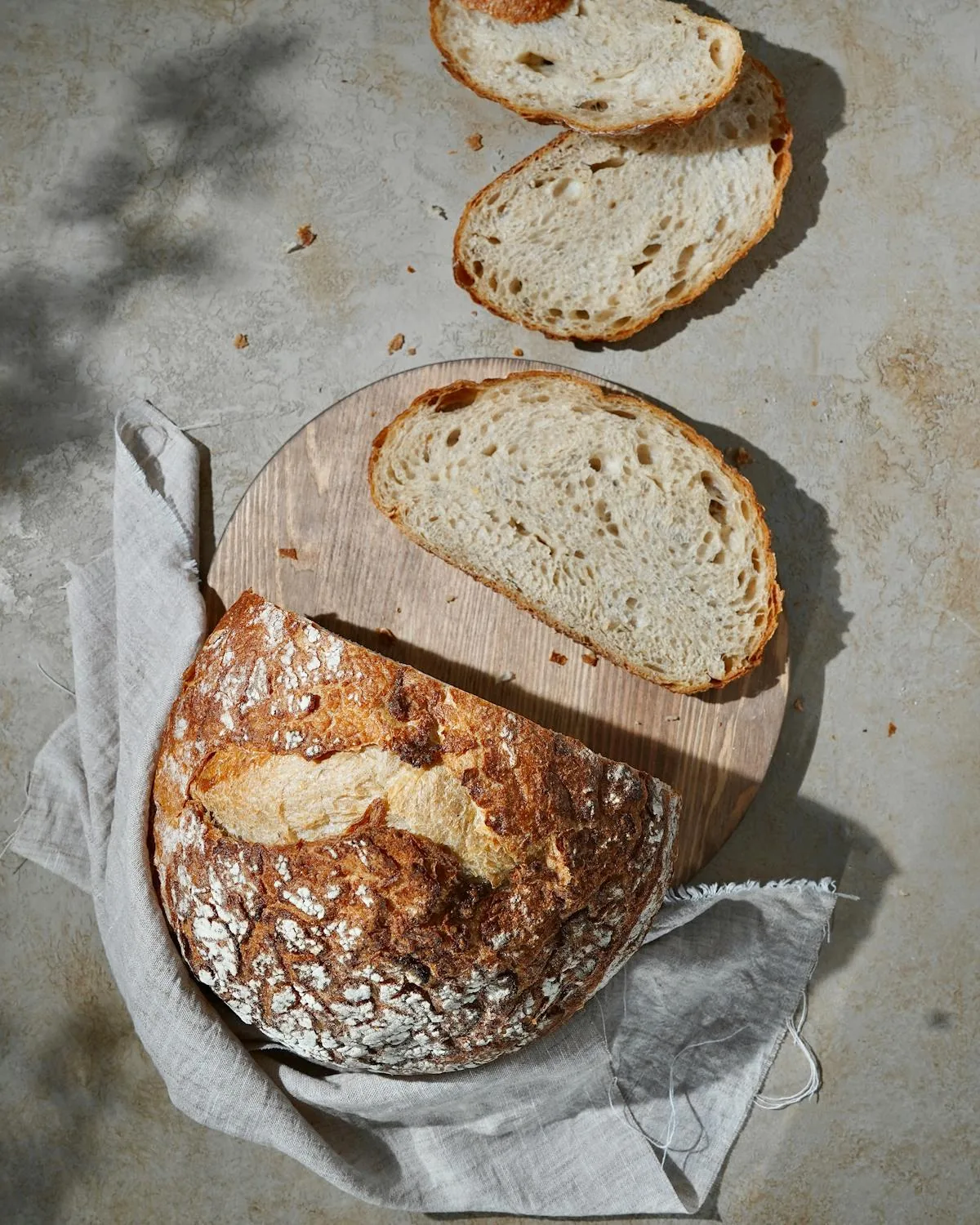

What Is Irish Soda Bread?
Irish soda bread is a quick bread raised with bicarbonate of soda and buttermilk instead of yeast. The acid in the buttermilk reacts with the bread soda to produce carbon dioxide — that's your rise. No kneading, no proving, no waiting. You mix it, shape it, score a cross on top, and it goes straight into the oven.
The bread became a staple in Ireland because domestic Irish flours — soft wheat, low in gluten — didn't cooperate well with yeast. When baking soda reached Ireland in the 1840s, it solved the problem overnight. Suddenly every household could bake a proper loaf with nothing more than flour from the local mill and buttermilk from the churn.
Four ingredients. That's the tradition, and that's the whole point.
Traditional Irish Soda Bread Recipe
This is the white soda bread. No sugar, no eggs, no butter in the dough — just the four.
Ingredients
- 450 g (3½ cups) plain flour — use soft wheat flour if you can find it, or all-purpose at a pinch. Avoid strong bread flour; the extra gluten toughens the crumb.
- 1 level teaspoon bicarbonate of soda (bread soda in Ireland)
- 1 level teaspoon fine salt
- 350–400 ml (1½ cups) buttermilk — real cultured buttermilk, not the thin stuff
Method
- Heat the oven to 200°C (400°F / Gas 6). Dust a baking tray with flour.
- Sift the flour, bread soda, and salt into a large bowl. Make a well in the centre.
- Pour in most of the buttermilk. Mix with one hand or a wooden spoon — quickly, not carefully. The dough should come together in less than a minute. Add the remaining buttermilk if it looks dry. Stop when it's soft and slightly sticky. Do not knead.
- Turn the dough onto a floured surface. Shape it gently into a round about 5 cm (2 inches) high. Place on the tray.
- Cut a deep cross on top — right through to the base. This lets the heat reach the centre and, tradition says, lets the devil out of the bread.
- Bake for 35–40 minutes. The loaf is done when the bottom sounds hollow if you tap it. Cool on a wire rack.
Prep time: 5 minutes | Cook time: 40 minutes | Makes: 1 round loaf (8 slices)
Eat it the day you bake it. Soda bread doesn't keep like yeast bread — by tomorrow it's for toast and crumbs.
Why Buttermilk? The Chemistry in Plain English
Buttermilk is acidic (lactic acid). Bread soda is alkaline (sodium bicarbonate). When they meet, carbon dioxide bubbles form inside the dough. Those bubbles are your leavening — they puff the bread up as it bakes.
This reaction starts the moment the wet hits the dry. That's why you work fast and don't mess about with the dough. Over-mixing pushes the gas out. Under-mixing leaves you with pockets of raw soda, which taste bitter and leave yellow streaks.
If you can't get buttermilk, stir a tablespoon of lemon juice into 350 ml of whole milk and let it sit for ten minutes. It'll curdle slightly — that's the acid developing. Some bakers in the west of Ireland use live yoghurt thinned with a splash of milk. In a pinch, a bottle of stout works too.
Irish Brown Bread (Wheaten Bread)
Brown soda bread uses wholemeal flour — sometimes called wheaten bread, particularly in Ulster, where it's a separate tradition with its own character not to be confused with the white version.
Ingredients
- 280 g (2 cups) coarse wholemeal flour
- 170 g (1¼ cups) plain white flour
- 1 level teaspoon bicarbonate of soda
- 1 teaspoon salt
- 1 tablespoon brown sugar or treacle (optional — traditional in the north)
- 25 g (2 tablespoons) butter, melted (optional)
- 400 ml buttermilk
- 1 egg, beaten (some recipes include this; many don't)
Method
Same approach as white soda bread. Mix dry ingredients, add wet, combine quickly with minimal handling. Shape, score, bake at 200°C for 40–45 minutes. The wholemeal flour absorbs more liquid, so don't skimp on the buttermilk.
Brown bread saw a serious revival on restaurant menus in the 1960s. Before that it was farmhouse food — the bread your granny put out with butter and a cup of tea. Now you'll find it in every good restaurant in Ireland served warm with soup or smoked salmon.
Regional Variations Across Ireland
Irish soda bread isn't one recipe — it changes county by county.
Ulster: The Soda Farl
A soda farl is soda bread flattened into a round about 2 cm thick, then cut into four triangles (farls). It's cooked on a flat griddle or heavy pan rather than baked in the oven. The result is denser, with a floury crust and a soft interior. It's essential to the Ulster Fry — the full breakfast of the north.
Southern Provinces: Brown Bread
In Cork, Kerry, and Galway, the wholemeal version is just called brown bread. It's virtually identical to Ulster's wheaten bread but tends to skip the sugar.
Spotted Dog
Add a handful of raisins or currants and a spoonful of sugar to the white dough, and you've got spotted dog — the everyday sweet version. Some families call it spotted dick, though that name tends to cause confusion on the far side of the Atlantic.
Fermanagh: Fadge
In parts of County Fermanagh, the white flour version cooked on a griddle is called fadge — a dialect word that's survived for centuries.
Soda Bread and Irish Life
Soda bread is not fancy food. It's the bread that fed generations when money was short, when yeast was unavailable, when the nearest shop was miles away. Every household had flour and buttermilk. Every household made bread.
The cross scored on top has practical origins — it helps the heat penetrate a thick, dense loaf — but ask anyone's grandmother and she'll tell you it blesses the bread and lets the fairies out. Both explanations have stuck.
In Irish towns today, soda bread is back on bakery shelves and restaurant menus. Mary's Soda Bread Shop in Louisburgh draws queues. Ballymaloe Cookery School treats it as the foundation of Irish home cooking. The recipe itself hasn't changed — it doesn't need to.
Tips for Getting It Right
- Don't knead the dough. Soda bread is not yeast bread. Kneading develops gluten, which makes the crumb tough. Gently shape and stop.
- Use soft flour. Irish flour is naturally soft wheat. If you're baking in the US, pastry flour or a 50/50 mix of all-purpose and cake flour gets you closest.
- Work fast. The chemical reaction starts immediately. From bowl to oven should take five minutes, no more.
- Score the cross deep. Shallow scoring won't help the heat reach the centre. Go almost to the base.
- Listen for the hollow sound. If you tap the bottom and it thuds rather than rings, give it five more minutes.
Where to Try It in Ireland
- Ballymaloe House, Shanagarry, Cork — Darina Allen's brown bread is the standard
- Mary's Soda Bread Shop, Louisburgh, Mayo — traditional white soda bread, wood-fired
- Any B&B in the west — brown bread with butter and tea is the universal welcome
For wheaten bread, head to Belfast or Derry. It's on every café table and comes with the Ulster Fry at breakfast.
Sources: Wikipedia (Soda bread, Irish cuisine); NotebookLM research; Ballymaloe Cookery School references; Darina Allen's Irish Traditional Cooking.