

What Is the Book of Kells?
The Book of Kells is a 9th-century illuminated manuscript of the four Gospels, created by Celtic monks around 800 AD. It contains 680 pages of decorated vellum (each measuring 330 x 250 mm) and is housed at Trinity College Dublin in four separate volumes. Its intricate Celtic knotwork and spiral motifs contain up to 30 interlacements per square inch, drawn freehand without mechanical aids.
The Book of Kells is a lavishly decorated manuscript of the four Gospels of the New Testament — Matthew, Mark, Luke, and John — written in Latin. It was created by Celtic monks around 800 AD and is widely considered the finest illuminated manuscript in the world.
The book contains 680 pages (340 folios) of vellum, prepared calfskin. Each page measures approximately 330 mm by 250 mm (13 by 9.8 inches), though these are not the original dimensions. The pages were badly cropped during a 19th-century rebinding, and small portions of some illustrations were lost in the process. Every page is a work of art. The text is surrounded by intricate interlaced knotwork, spiral patterns, animal forms, and human figures, all painted by hand using pigments that monks sourced from across the known world.
The detail is almost incomprehensible by modern standards. Under magnification, scholars have counted up to 30 interlacements within a single square inch of knotwork. These patterns were drawn freehand, without rulers or compasses, by artists who worked by candlelight and natural daylight over years or possibly decades.
Despite the extraordinary artistry, the manuscript contains numerous uncorrected textual errors. Aesthetics were given priority over utility. A famous example occurs at Matthew 10:34, where the scribe wrote gaudium ("joy") instead of gladium ("sword"), changing the verse's meaning to "I came not to send peace, but joy."
The Book of Kells is not just a religious text. It is the greatest surviving example of Insular art, the distinctive style that emerged from Celtic and early Christian traditions in Ireland and Britain between the 6th and 9th centuries. The same artistic language (spirals, interlace, animal forms) appears in Celtic jewelry to this day.
Since 1953, the manuscript has been bound in four separate volumes to reduce the strain on the fragile vellum. Two pages are displayed at any time in the Trinity College Library, and they are rotated every 12 weeks for conservation purposes.
Where Was the Book of Kells Created?
The exact origin of the Book of Kells is one of the great debates in medieval scholarship. The most likely theory is that it was begun on the island of Iona — a tiny island off the west coast of Scotland that was home to one of the most important monasteries in the Celtic world.
The Iona-Kells theory:
| Date | Event |
|---|---|
| ~563 AD | Saint Columba (Colm Cille) founds the monastery on Iona |
| ~800 AD | Work begins on the manuscript at Iona |
| 806 AD | Viking raiders attack Iona, killing 68 monks |
| ~807 AD | Surviving monks flee to Kells, County Meath, Ireland, bringing the unfinished manuscript |
| ~815–850 AD | Manuscript completed at the monastery of Kells |
| 1007 | The book is stolen and its gold-encrusted cover stripped — the manuscript itself is recovered |
| 1541 | Catholic Church properties confiscated during the Reformation |
| 1661 | The Book of Kells is given to Trinity College Dublin, where it remains today |
The Viking attacks on Iona were devastating. The 806 raid was one of several that ultimately drove the monastic community to the relative safety of inland Ireland. The monks who carried the manuscript across the Irish Sea were carrying not just a book but the artistic and spiritual legacy of Celtic Christianity.
H3: The Monks Who Created It
The Book of Kells was likely created by a team of at least three scribes, based on analysis of the different handwriting styles found throughout the manuscript. Scholars have designated them as Hand A, Hand B, and Hand C based on their writing characteristics. Hand A typically wrote 18 or 19 lines per page in brownish gall ink. Hand B showed a greater tendency to use minuscule script and colorful inks.
These monks worked with extraordinary materials:
| Material | Source | Use |
|---|---|---|
| Vellum (calfskin) | Local cattle, approximately 185 calves' skins | Pages |
| Iron gall ink | Oak galls + iron salts | Main text |
| Orpiment | Arsenic sulfide mineral — toxic | Yellow pigment |
| Verdigris | Copper corrosion | Green pigment |
| Woad / Indigo | Plant-derived, native to Europe and the British Isles | Deep blue pigment |
| Kermes | Insect dye from Mediterranean | Red/crimson |
| Orcein | Lichen-derived dye | Purple/lilac pigment |
| Lead white | Lead carbonate | White highlights |
Modern spectroscopic analysis conducted by Trinity College Dublin revealed that the vivid blue pigment was derived from woad (or indigo), a plant native to Europe, rather than lapis lazuli as was previously assumed. The purple and lilac shades were created using orcein, a dye derived from lichen species, not the expensive Murex shell dye. This means the monks sourced their materials more locally than once believed, though their trade networks still extended to the Mediterranean for red kermes dye.
In 2000, the volume containing the Gospel of Mark suffered minor pigment damage while in transit to an exhibition in Canberra, Australia. Experts believe the damage was caused by vibrations from the airplane engines during the long-distance flight.
What Makes the Book of Kells So Special?
The Chi Rho page (folio 34r) of the Book of Kells is considered the most elaborately decorated page in any medieval manuscript. It depicts the Greek letters XP (the abbreviation for Christ) surrounded by interlaced spirals, knotwork, angels, and animal figures so detailed that new elements are still being identified.
The Book of Kells is famous for three qualities that set it apart from every other medieval manuscript:
1. The Knotwork
Celtic interlace, lines that weave over and under each other in unbroken patterns, reaches its absolute peak in the Book of Kells. These are not random decorations. The patterns have no beginning and no end, symbolizing eternity and the interconnectedness of all creation. This is the same design philosophy that appears in Celtic knot jewelry today.
2. The Animal Forms
The margins of the manuscript are filled with fantastical animals: serpents, lions, peacocks, cats, mice, otters, and creatures that exist only in the imagination. These animals intertwine with the knotwork, biting each other's tails, forming letters, and serving as guardians of the text. Scholars have identified over 30 species depicted across the manuscript.
3. The Chi Rho Page
The most famous single page in the Book of Kells (folio 34r) is the Chi Rho monogram, a massive, ornate rendering of the Greek letters XP (Chi and Rho), the first two letters of "Christ" in Greek. This page is so densely decorated that new details are still being discovered today, over 1,200 years after it was painted.
From the Book of Kells to Celtic Jewelry
The knotwork patterns in the Book of Kells are not frozen in history. They are a living design tradition that continues in Celtic jewelry today.
When a jeweler creates a Trinity knot pendant or a Claddagh ring with knotwork on the band, they are working in the same artistic language that the monks of Kells used 1,200 years ago. The principles are identical:
| Book of Kells | Celtic Jewelry |
|---|---|
| Interlaced lines with no beginning or end | Knotwork bands on rings and pendants |
| Spiral patterns (triskele, double spiral) | Spiral motifs on brooches and earrings |
| Animal forms woven into designs | Stylized animals on carved jewelry |
| Trinity motifs (three-part designs) | Trinity knot (triquetra) pendants |
The connection is direct and unbroken. The Trinity knot that Celtic monks drew in the margins of the Book of Kells is the same Trinity knot that Irish jewelers set in gold and silver today. The design has traveled 1,200 years from vellum to precious metal.
Visiting the Book of Kells at Trinity College Dublin
The Book of Kells is displayed at the Old Library at Trinity College Dublin, in the heart of the city. Two pages of the manuscript are on display at any time (one showing text, one showing a decorated page) and the pages are turned regularly to preserve the fragile vellum.
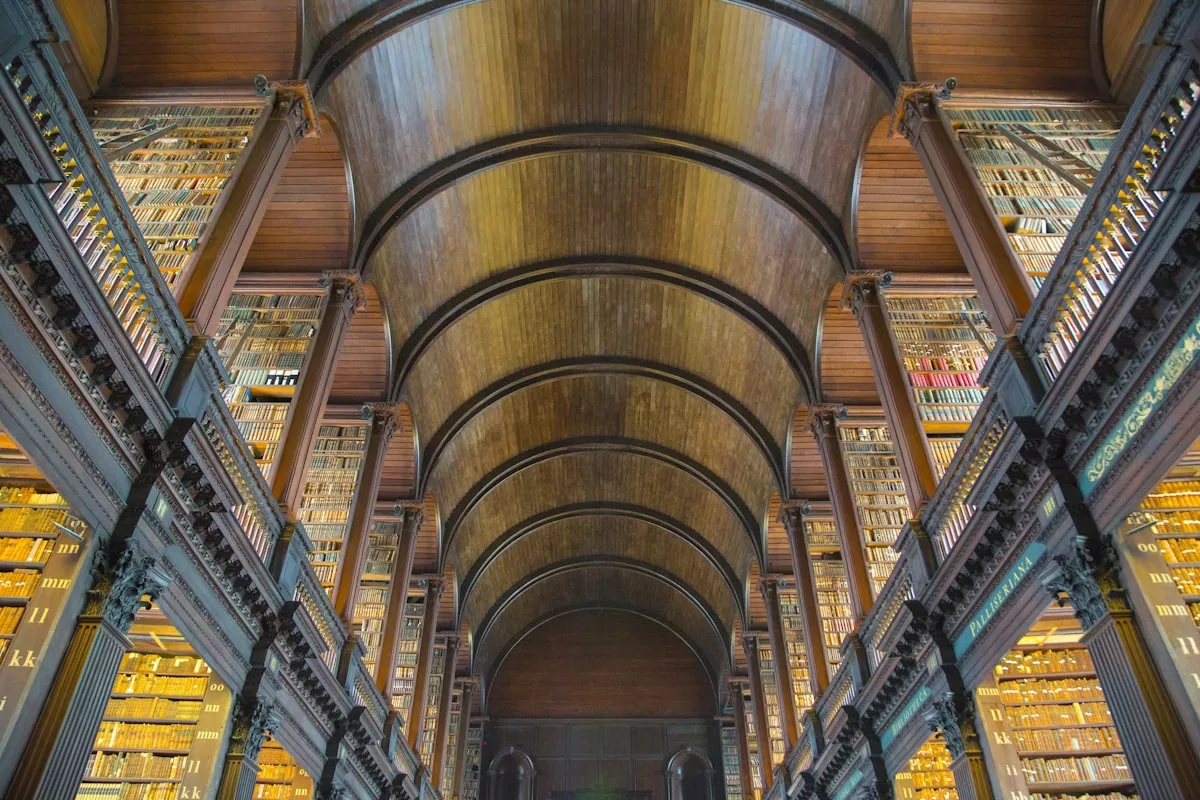
After viewing the manuscript, visitors can walk through the Long Room, a stunning 65-meter-long library housing 200,000 of Trinity's oldest books. The room also contains one of the last surviving copies of the 1916 Proclamation of the Irish Republic and a 15th-century harp that is the model for Ireland's national symbol.
Practical information:
- Location: Trinity College Dublin, College Green, Dublin 2
- Opening hours: Check the Trinity College website for seasonal hours
- Booking: Advance booking is strongly recommended — the exhibition is one of Ireland's most visited attractions
Explore More Irish Heritage
- Celtic Knot Meaning: The art of eternal knotwork
- Trinity Knot Meaning: The Triquetra explained
- Celtic Cross Meaning: Faith and ancient tradition
- Triskele Meaning: Ireland's triple spiral
- ← Back to all guides: Irish heritage hub