

What Is the National Famine Way?
The National Famine Way is a 165 km waymarked trail from Strokestown, County Roscommon, to Custom House Quay in Dublin, following the route 1,490 evicted tenants walked in 1847 during the Great Famine. The trail crosses six counties, mostly along the Royal Canal towpath. More than 30 pairs of bronze children's shoes mark the route. The trail connects the National Famine Museum (Strokestown) and EPIC The Irish Emigration Museum (Dublin).
The National Famine Way is not a scenic trail. It is a memorial walk.
In 1847, at the height of the Great Irish Famine (1845-1852), Major Denis Mahon, the landlord of the Strokestown estate in County Roscommon, organized the "assisted emigration" of 1,490 of his tenants. They were marched 165 km from Strokestown to the Dublin Docks, then shipped to Liverpool, and eventually loaded onto coffin ships bound for Quebec, Canada. Nearly half died during the crossing or in the fever sheds at Grosse Ile quarantine station.
The trail that exists today follows their route. It begins at the National Famine Museum at Strokestown Park House, crosses six counties (Roscommon, Longford, Westmeath, Meath, Kildare, Dublin), and ends at the Famine Memorial sculptures on Custom House Quay in Dublin's Docklands. The first 20 km follows country roads from Strokestown to Clondra, County Longford. The remaining 145 km runs along the towpath of the Royal Canal, flat and walkable.
More than 30 pairs of bronze children's shoes are cast into the path along the route, modeled from an actual pair of 19th-century shoes found in an Irish cottage. Each pair marks a stop, and a free app provides audio and video narratives telling the stories of individual emigrants, including 12-year-old Daniel Tighe, one of the few survivors from his family of six.
The walk typically takes 5-8 days on foot or 3-5 days by bicycle. You can walk individual sections as day walks.
The Great Famine killed approximately one million people and forced another million to emigrate. Ireland's population dropped from roughly 8.2 million in 1841 to 6.6 million in 1851. The demographic impact was permanent: Ireland's population today (approximately 5.1 million in the Republic) has never recovered to pre-famine levels.
For those tracing Irish ancestry, the Famine period is the defining event. See our Irish Ancestry guide.
The Stops Along the National Famine Way
The trail runs east from Roscommon to Dublin. Stops follow the order of the walk.
H3: 1. Strokestown Park House and National Famine Museum, County Roscommon
The starting point. Strokestown Park is the Palladian mansion that was home to the Mahon family, the landlords who organized the 1847 emigration. The National Famine Museum, housed in the estate's original stable yards, holds the personal archive of the Mahon family, including letters, accounts, and eviction records that document what happened to the tenants. It is one of the most important documentary collections relating to the Great Famine.
The museum does not look away from the details. Eviction orders. Lists of the dead. The financial calculations behind "assisted emigration." Major Denis Mahon was assassinated in November 1847, the first Irish landlord killed during the Famine.
Starting point for the trail.
H3: 2. Clondra (Cloondara), County Longford
The first major stop, 20 km from Strokestown. Clondra sits at the junction of the Royal Canal and the River Shannon. From here, the trail joins the canal towpath that carries it the remaining 145 km to Dublin. The village marks the transition from rural roads to the flat, water-edged path that defines most of the walk.
Walk from Strokestown: Approximately 5-6 hours (20 km).
H3: 3. Longford Town
The trail passes through Longford, following the canal towpath. The county was devastated by the Famine: Longford workhouses were overwhelmed, and mass graves in the county hold remains that have never been fully documented. The Longford Museum in the town center provides regional context.
Walk from Clondra: Approximately 4-5 hours (16 km).
H3: 4. Mullingar, County Westmeath
Mullingar is the midpoint of the trail. The town sits on the Royal Canal and provides services (accommodation, food) for walkers. The bronze shoes along this section tell stories of families who traveled together and were separated on arrival in Canada.
Walk from Longford: Approximately 2 days (55 km).
H3: 5. Maynooth, County Kildare
Home to Maynooth University (St. Patrick's College, founded 1795) and Maynooth Castle, a 12th-century Fitzgerald stronghold. The canal passes through the town, and the trail continues east toward Dublin through increasingly suburban landscape.
Walk from Mullingar: Approximately 2 days (50 km).
H3: 6. Custom House Quay and EPIC, Dublin
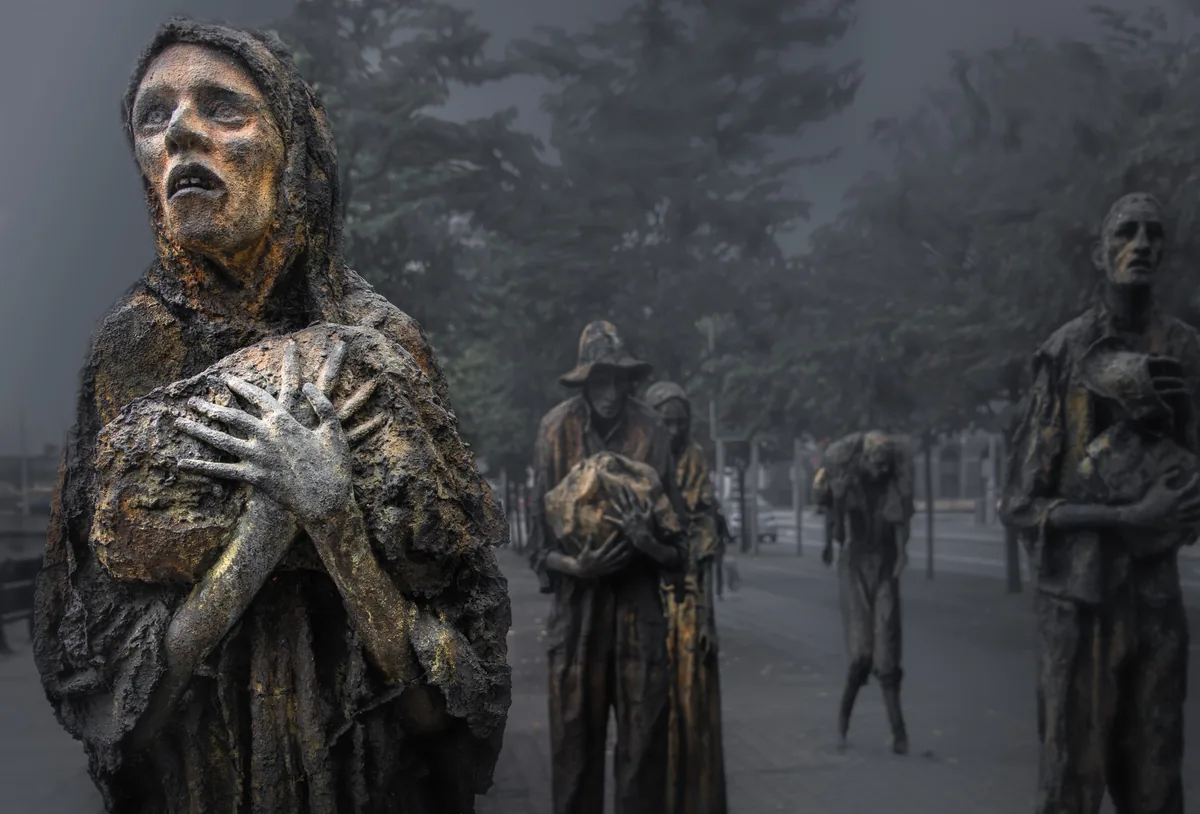
The trail ends at the Famine Memorial on Custom House Quay in the Dublin Docklands. The memorial consists of bronze figures by sculptor Rowan Gillespie, depicting emaciated emigrants walking toward the ships. The figures are life-size and intentionally haunting.
EPIC The Irish Emigration Museum, located nearby in the CHQ Building (a restored 19th-century tobacco warehouse), tells the broader story of Irish emigration from the Famine through the 20th century. Walkers who carry the official National Famine Way passport can present it at EPIC to receive a completion certificate and learn the specific fate of the family group associated with their "ship ticket."
The Jeanie Johnston Tall Ship, a replica of a famine-era emigrant vessel, is moored on the adjacent quay and can be visited.
Walk from Maynooth: Approximately 1 day (25 km).
Walking the National Famine Way: What You Need to Know
The National Famine Way is a 165 km trail taking 5-8 days to walk or 3-5 days to cycle. Most of the route follows the flat towpath of the Royal Canal. A free app provides audio narratives at 30+ bronze shoe sculptures along the route. The official passport can be stamped along the way and presented at EPIC museum in Dublin for a completion certificate.
The trail is well-marked and accessible.
| Detail | Information |
|---|---|
| Total length | 165 km |
| Duration | 5-8 days walking, 3-5 days cycling |
| Terrain | First 20 km on country roads, remaining 145 km on flat canal towpath |
| Difficulty | Easy to moderate. Flat terrain. Suitable for moderate fitness. |
| Waymarking | Yellow walking-figure signs on black background, plus 30+ bronze shoe sculptures |
| App | Free National Famine Way app with audio/video narratives at each bronze shoe |
| Official passport | Available at the National Famine Museum or online at nationalfamineway.ie |
| Best season | April to October for dry weather. The canal towpath can be muddy in winter. |
| Starting point | National Famine Museum, Strokestown Park, County Roscommon |
| End point | Custom House Quay / EPIC Museum, Dublin Docklands |
The Famine, the Diaspora, and Irish Identity
The Great Famine is the single most important event in modern Irish history. It reshaped the country's demographics, culture, and relationship with the rest of the world.
Between 1845 and 1852, the failure of the potato crop, combined with inadequate British government response, killed approximately one million people and drove another million to emigrate. The population of Ireland dropped by approximately 25% in six years. Counties in the west and midlands, including Roscommon, Mayo, and Galway, were hit hardest.
The Famine created the Irish diaspora. The millions who left during and after the Famine established communities across the United States, Canada, Australia, and Britain. Today, approximately 33 million Americans claim Irish ancestry, a community that traces largely to Famine-era and post-Famine emigration.
For those tracing their Irish roots, the Famine period is the critical junction where paper records often end and oral history begins. Parish records, workhouse registers, and ship manifests from this period are the primary tools of genealogical research. See our Irish Ancestry guide for resources and databases.
The Claddagh ring, which predates the Famine by over a century, took on additional meaning as an emigrant symbol. Irish men and women carried Claddagh rings to America, Canada, and Australia as physical connections to the homes they were leaving. The ring's symbols of love, loyalty, and friendship became promises of return and remembrance. See our Claddagh Ring Meaning guide.
Explore Irish Heritage Jewelry →
Explore More Heritage Trails
- Ireland's Ancient East: The broader heritage route through the eastern counties the Famine Way crosses
- Wild Atlantic Way: The western coast, where the Famine hit hardest
- Saint Patrick's Trail: The spiritual heritage that sustained communities through the crisis
- Book of Kells Journey: The manuscript tradition the monks carried forward