
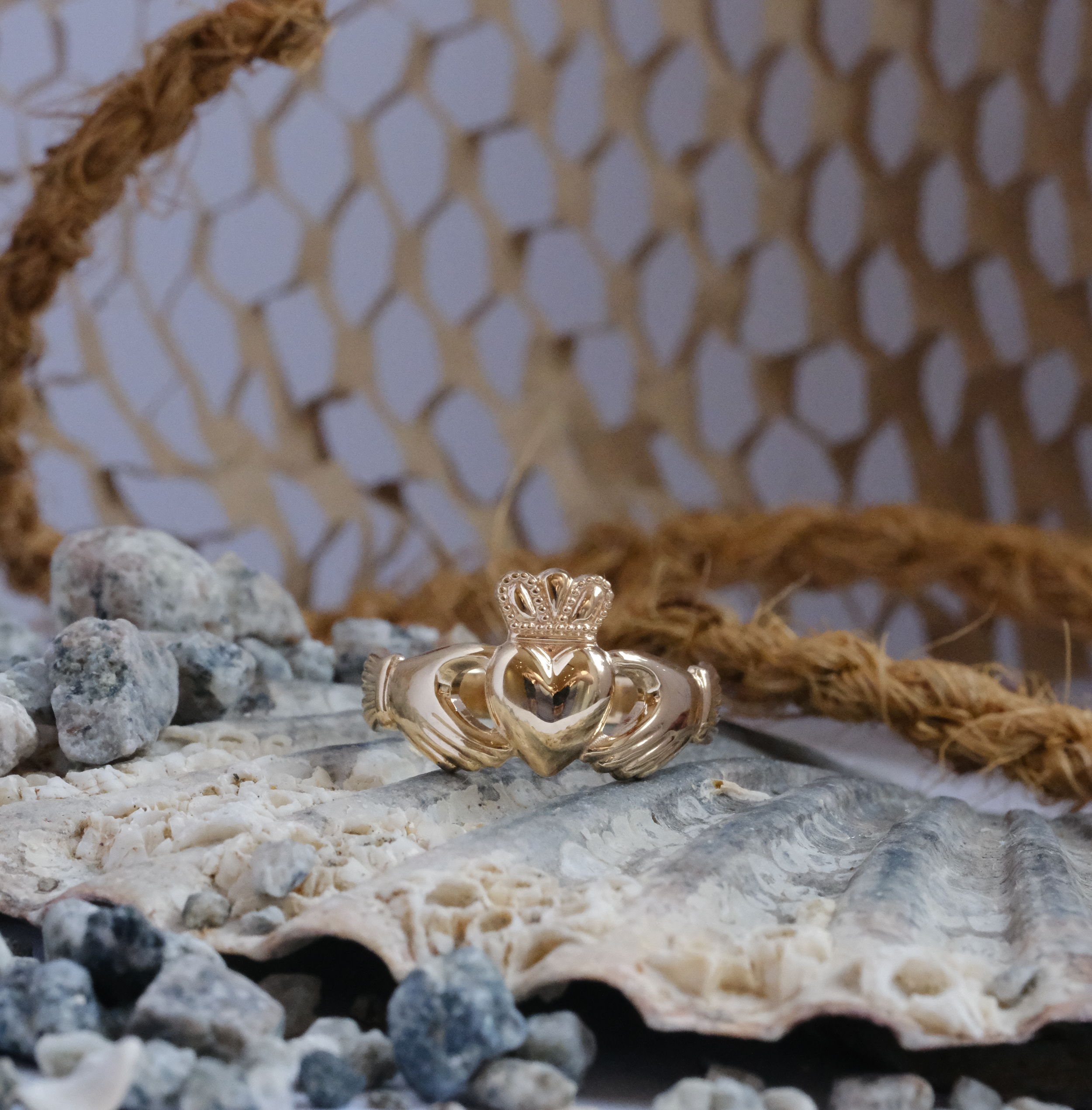

Why Gold Is the Traditional Claddagh Metal
Gold is the traditional metal for Claddagh rings, dating to the ring's creation by goldsmith Richard Joyce in Galway, Ireland, in the late 17th century. Gold Claddagh rings were historically passed from mother to daughter as family heirlooms. All Irish gold Claddagh rings are hallmarked at Dublin Castle by the Irish Assay Office, which has certified precious metals since 1637.
The first Claddagh ring was forged in gold. Richard Joyce, the Galway goldsmith credited with creating the ring in the late 1600s, learned his craft from a Moorish master in Algiers — and gold was the medium he worked in.
For three centuries, gold Claddagh rings have been the heirlooms that Irish families pass from mother to daughter, grandmother to granddaughter. Sterling silver versions exist and are popular, but gold carries the weight of tradition. When a Claddagh ring shows up in a museum or a family collection from the 18th or 19th century, it is gold.
There is also a practical reason. Gold does not tarnish. A gold Claddagh ring pulled from a drawer after thirty years looks the same as the day it went in. Silver oxidizes, darkens, requires polishing. Gold just waits.
10K vs 14K vs 18K Gold — Which Is Best for a Claddagh Ring?
Gold Claddagh rings are available in 10K (41.7% gold), 14K (58.3% gold), and 18K (75% gold). 14K is the most popular choice, balancing durability with rich color. 10K is the hardest and most affordable. 18K has the deepest color but is softer. All Irish gold Claddagh rings are hallmarked at Dublin Castle.
The number before the K tells you how much of the ring is actually gold. Pure gold is 24K — soft, bright, and too malleable for a ring you wear every day. So gold is alloyed with other metals to make it harder. The lower the karat, the more alloy, the harder the ring.
10K Gold Claddagh Ring
41.7% pure gold. The most affordable real gold option and the fastest-growing search term for Claddagh rings (+823% year-over-year).
10K gold is harder than 14K or 18K because it contains more alloy. That hardness makes it excellent for daily wear — it resists scratches and holds the fine details of the crown, hands, and heart longer than softer karats. The color is slightly paler than 14K yellow gold — still warm, but with a touch less depth.
10K is the legal minimum to be called "gold" in the United States. In Ireland, it carries the Dublin Castle hallmark just like 14K and 18K.
Best for: Budget-conscious buyers, daily wearers, younger wearers getting their first Claddagh.
14K Gold Claddagh Ring
58.3% pure gold. This is the sweet spot — and the most popular karat for Claddagh rings sold in the US and Ireland.
14K gold balances durability with that rich, warm color that people picture when they think of a gold ring. It is hard enough for daily wear (a jeweler will rarely need to repair a 14K band), but it is gold enough to have the classic warmth and depth that 10K cannot quite match.
The price sits between 10K and 18K — typically 30-40% more than 10K, and 30-40% less than 18K.
Best for: Most people. Daily wear, engagement rings, wedding bands, heritage pieces.
18K Gold Claddagh Ring
75% pure gold. The richest color, the heaviest feel, and the highest price point.
18K gold has a depth of color that is immediately noticeable next to 14K — it glows warmer, and the surface has a buttery quality. But the trade-off is softness. 18K gold scratches more easily than 14K. The fine details of the Claddagh — the crown spires, the fingertips on the clasped hands — will show wear sooner than the same details in a 14K ring.
18K is the standard for luxury European jewelry. If you come from a tradition where gold means gold — not alloyed, not pale — 18K is what you want.
Best for: Special occasions, heirloom pieces, people who prioritize richness of color over absolute durability.
| Karat | Gold Purity | Durability | Color Depth | Price Range | Best For |
|---|---|---|---|---|---|
| 10K | 41.7% | Highest | Warm, slightly pale | $ | Daily wear, first Claddagh |
| 14K | 58.3% | High | Classic warm gold | $$ | Most people, engagement, wedding |
| 18K | 75% | Moderate | Richest, deepest | $$$ | Luxury, heirloom, collector |
Yellow Gold, White Gold & Rose Gold Claddagh Rings
Yellow Gold
The traditional Claddagh gold. The same warm tone Claddagh rings have carried for over 300 years. Yellow gold requires no plating — the color is the metal itself. It does not fade, does not need recoating, and does not change over time. A yellow gold Claddagh ring from 1750 looks exactly the same as one made yesterday.
Yellow gold pairs naturally with emerald (green and gold are Ireland's colors) and with warm-toned birthstones like garnet, citrine, and ruby.
White Gold
A cooler, more contemporary tone. White gold is yellow gold alloyed with palladium or nickel and then plated with rhodium — a platinum-group metal that gives the bright, reflective finish.
The plating wears over time. Depending on how often you wear the ring, you will need a rhodium re-dip every two to three years. It costs about $30-40, takes minutes, and brings the ring back to its first-day brightness.
White gold pairs better with diamonds and blue-toned stones (sapphire, blue topaz) — the cooler metal lets the stone dominate.
Rose Gold
Rose gold is gold alloyed with copper, giving it a warm pinkish hue. Rose gold Claddagh rings are a more recent development — not traditional, but increasingly popular, especially among women who prefer the softer, vintage-feeling color.
The copper content means rose gold is actually slightly harder than yellow gold at the same karat. It also means rose gold can develop a very faint patina over years of wear, which some people love and others polish away.
What Does the Dublin Castle Hallmark Mean on a Gold Claddagh Ring?
The Dublin Castle hallmark is a government-certified stamp applied by the Irish Assay Office, confirming the gold purity of Irish jewelry. It includes the maker's mark, fineness mark (e.g., 585 for 14K), the crowned harp symbol, and a date letter. The Irish Assay Office has operated since 1637 — nearly 400 years of certification.
Every Irish gold Claddagh ring goes through the Irish Assay Office at Dublin Castle before it reaches a customer. This is not a brand stamp — it is a government-certified guarantee of metal purity.
The hallmark includes:
- The maker's mark — identifies the specific manufacturer
- The fineness mark — confirms the gold purity (375 for 9K, 585 for 14K, 750 for 18K)
- The Assay Office mark — the crowned harp, confirming it was tested at Dublin Castle
- The date letter — tells you the year the ring was tested
The Irish Assay Office has been certifying precious metals since 1637 — making it one of the oldest operating assay offices in the world. When you see the Dublin Castle hallmark on a gold Claddagh ring, you are seeing the same certification standard that has protected buyers for nearly 400 years.
This matters because gold purity cannot be verified by looking at a ring. A 10K ring and a 14K ring can look identical to the naked eye. The hallmark is the only guarantee.
Gold Claddagh Ring vs Silver — Which Should You Choose?
| Factor | Gold Claddagh Ring | Silver Claddagh Ring |
|---|---|---|
| Tradition | The traditional metal — 300+ years | Popular from 19th century onward |
| Durability | No tarnish, holds detail | Tarnishes, needs polishing |
| Weight | Heavier (substantial on hand) | Lighter |
| Allergies | 14K+ is hypoallergenic | Can cause reactions in some |
| Heirloom | Lasts generations unchanged | Requires maintenance over decades |
| Price | $$–$$$ | $ |
| Hallmark | Dublin Castle certified | Dublin Castle certified |
Neither is wrong. Silver is a genuine, accessible way to wear a Claddagh from Ireland — it carries the same Dublin Castle hallmark and the same symbolism. Gold is what the ring was born in, and it endures without asking anything of you.
If you are buying a Claddagh ring to wear every day for years, gold pays for itself in the long run — it never tarnishes, it holds fine details, and it does not need maintenance. If you want a Claddagh ring to mark a connection to Ireland without a major investment, silver is exactly right.
Gold Claddagh Rings for Men — Weight, Width & Style
Men's gold Claddagh rings are about presence. A wider band (5-7mm), heavier gauge, and bolder design make the ring substantial on the hand. In gold, that weight becomes tangible — you feel it.
What men should know about gold Claddagh rings:
- Band width: 5mm is standard for men. 7mm makes a strong statement. Wider bands use more gold, so the price scales with width.
- 10K is popular for men because it is the hardest. Hands take punishment — 10K gold stands up to daily work better than softer karats.
- Brushed or matte finish on a men's gold Claddagh gives it a less flashy, more rugged look. Polished shows every scratch. Brushed hides wear naturally.
- Yellow gold is the most common choice for men. White gold ranks second. Rose gold is less common in men's Claddagh rings but growing.
- Matching sets: Many couples choose matching gold Claddagh rings — same karat, same color, different band widths. His and hers, same commitment.
All men's gold Claddagh rings carry the Dublin Castle hallmark — same certified standard, regardless of ring size.
Gold Claddagh Rings for Women — Delicate, Personal & Built to Last
Women's gold Claddagh rings balance tradition with personal style. The narrower band (2-4mm), finer crown details, and optional gemstone settings make these rings elegant for daily wear.
What women should know about gold Claddagh rings:
- 14K yellow gold is the most popular metal. It has the depth of color without the softness of 18K — perfect for everyday wear.
- White gold pairs best with diamond settings — the cooler metal lets the stone do the work.
- Gemstone options: A gold Claddagh with a diamond, emerald, or birthstone in the heart personalizes the ring. May (emerald) and September (sapphire) are the most requested birthstones in gold settings.
- Stacking: Women often pair a gold Claddagh engagement ring with a matching Celtic knot wedding band. Look for rings specifically designed to nest together.
- Rose gold is the fastest-growing color among women buying Claddagh rings. It sits beautifully with warm skin tones and has a vintage quality that yellow and white gold do not.
Gold does not tarnish. A gold Claddagh ring does not need maintenance beyond occasional cleaning — it stays bright without polishing, re-plating, or special storage.
Explore More Claddagh Guides
- Claddagh Ring Meaning — Love, loyalty & friendship — the full symbol guide
- How to Wear a Claddagh Ring — Four positions, four meanings
- Silver Claddagh Ring — Sterling silver styles & care
- Claddagh Birthstone Ring — Every month, every stone
- Women's Claddagh Ring — Styles, metals & gemstones
- Men's Irish Rings — Men's Claddagh styles & fit
- Claddagh Ring History — The legend of Richard Joyce
- ← Back to all symbols — The complete guide