

What Is Saint Patrick's Trail?
Saint Patrick's Trail connects sites associated with Ireland's patron saint. The formal walking route (Saint Patrick's Way) runs 132 km between Armagh and Downpatrick in Northern Ireland. Patrick arrived in Ireland around 432 AD, founded his church at Armagh around 445 AD, and is buried at Down Cathedral in Downpatrick. Croagh Patrick in County Mayo and the Hill of Slane in County Meath are also key sites in the Patrician tradition.
Saint Patrick's Trail traces the path of Ireland's patron saint across the landscape. It combines a formal waymarked walking route with a broader network of heritage sites that span the island.
The formal trail, Saint Patrick's Way (The Pilgrim's Walk), covers 132 km between Armagh and Downpatrick in Northern Ireland. But Patrick's story extends well beyond those two cities. His tale begins in Roman Britain, moves to the slopes of Slemish Mountain in County Antrim (where he was held as a slave), passes through the Hill of Slane in the Boyne Valley (where he challenged the druids), reaches Armagh (where he founded his church around 445 AD), and ends at Down Cathedral in Downpatrick (where he is buried). A separate tradition places him on Croagh Patrick in County Mayo, where he fasted for 40 days.
The historical Patrick is known from two texts he wrote himself: the Confessio and the Letter to Coroticus. These are the only surviving documents written by Patrick in his own hand, making them among the earliest written records from Ireland. According to the Confessio, Patrick was captured from Roman Britain at age 16 by Irish raiders, enslaved for six years (traditionally on Slemish Mountain), escaped, and later returned to Ireland as a missionary around 432 AD.
The legends layered on top of Patrick's historical life are themselves important cultural heritage. The story of the shamrock (explaining the Trinity to the pagan Irish), the banishing of snakes, and the confrontation with the druids at Tara all appear in later hagiographies by Muirchu and Tirechan in the 7th century. These stories shaped Irish Christianity and identity for 1,500 years.
For the full story, see our St. Patrick's Day guide.
The Stops Along Saint Patrick's Trail
The sites below follow the chronological order of Patrick's life, not a single driving route.
H3: 1. Slemish Mountain, County Antrim
According to tradition, Patrick spent six years as a slave on the slopes of Slemish Mountain, herding sheep for a local chieftain. It was during this isolated captivity that he turned to intensive prayer. The mountain (438 meters) is a volcanic plug and can be climbed in about an hour. Every St. Patrick's Day, walkers gather for a commemorative climb.
Location: Near Broughshane, County Antrim. Approximately 1 hour from Belfast (40 km).
H3: 2. Saul, County Down
The traditional site of Patrick's first church in Ireland. After returning from Britain as a missionary, Patrick landed near the mouth of the River Slaney and was given a barn by a local chieftain named Dichu. Patrick converted the barn into a church. A modern church and round tower now stand on the site, and the nearby Saint Patrick's Centre in Downpatrick provides context.
Drive from Slemish: Approximately 1 hour 15 minutes (75 km).
H3: 3. Downpatrick and Down Cathedral, County Down
Patrick is reputed to be buried in the grounds of Down Cathedral. A large granite stone, placed in 1900, marks the traditional burial site. The cathedral itself, rebuilt in the 18th century on the site of a Benedictine monastery, sits on a hill overlooking the town. The Saint Patrick Centre on Market Street is an interactive exhibition telling Patrick's story through his own writings.
Walk from Saul: Approximately 3 km.
H3: 4. Hill of Slane, County Meath
In 433 AD, according to legend, Patrick lit the Paschal (Easter) fire on the Hill of Slane, visible from the Hill of Tara where the High King was celebrating a pagan festival. Lighting a fire before the king's fire was a direct challenge to royal authority. The story represents the moment Christianity publicly confronted pagan Ireland. The ruins of a Franciscan friary and church occupy the hilltop today, with views across the Boyne Valley.
Drive from Downpatrick: Approximately 1 hour 30 minutes (100 km).
H3: 5. Hill of Tara, County Meath
Patrick's confrontation with the druids at Tara is one of the founding legends of Irish Christianity. Whether historically accurate or not, the story places Patrick at Ireland's most important pre-Christian site, directly challenging the spiritual authority of the High King. The Hill of Tara is detailed in our Ireland's Ancient East guide.
Drive from Hill of Slane: Approximately 20 minutes (15 km).
H3: 6. Armagh
Armagh is the ecclesiastical capital of Ireland, a title that traces directly to Patrick. He founded his first large stone church here on the hill of Ard Macha around 445 AD. Today the city has two cathedrals named after him: the Church of Ireland cathedral (medieval, on the original site) and the Roman Catholic cathedral (completed 1873). The Armagh Public Library, founded in 1771, holds a first edition of Gulliver's Travels annotated by Jonathan Swift.
Drive from Hill of Tara: Approximately 1 hour 30 minutes (110 km).
H3: 7. Croagh Patrick, County Mayo
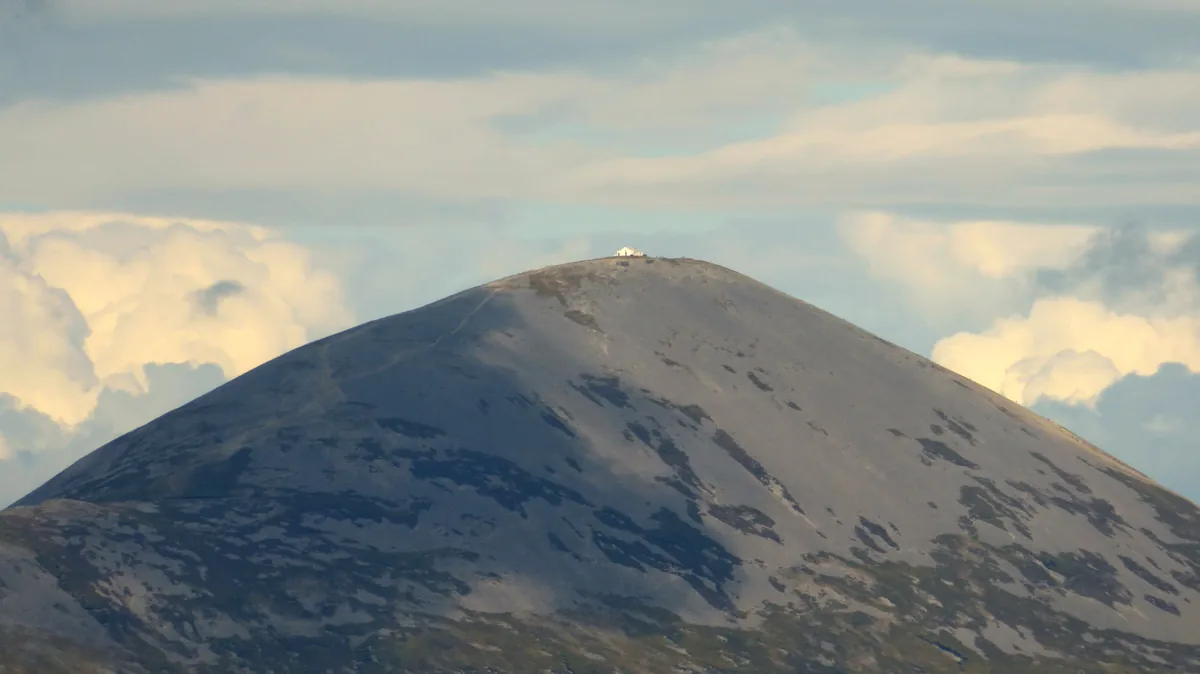
Ireland's "Holy Mountain," rising 764 meters above Clew Bay on the west coast. Legend says Patrick fasted at the summit for 40 days and banished the snakes of Ireland. Over 25,000 pilgrims climb Croagh Patrick on Reek Sunday each July, many barefoot. The climb takes approximately 3-4 hours round trip. The mountain is a stop on both the Wild Atlantic Way and the Tochar Phadraig pilgrim trail.
Drive from Armagh: Approximately 3 hours (250 km).
Walking Saint Patrick's Trail: What You Need to Know
Saint Patrick's Way is a 132 km formal walking trail between Armagh and Downpatrick in Northern Ireland, taking 5-7 days. A wider heritage circuit of all Patrician sites covers approximately 600 km by car and takes 2-4 days. The Croagh Patrick pilgrimage on Reek Sunday (last Sunday in July) draws over 25,000 climbers.
The trail has two components: the formal walking route and the wider heritage sites.
| Detail | Information |
|---|---|
| Formal trail (Saint Patrick's Way) | 132 km between Armagh and Downpatrick |
| Duration (Way) | 5-7 days walking |
| Full heritage circuit (all 7 sites) | Approximately 600 km driving |
| Driving duration | 2-4 days |
| Key museums | Saint Patrick Centre (Downpatrick), Armagh Public Library, Navan Centre & Fort (near Armagh) |
| Best season | March (St. Patrick's Day), May-September for walking. Croagh Patrick: Reek Sunday (last Sunday in July) |
| Difficulty | Walking trail: moderate. Croagh Patrick: steep and rocky (3-4 hours round trip). |
Saint Patrick's Legacy and Irish Identity
Patrick's influence on Irish culture extends far beyond religion.
The shamrock, which Patrick allegedly used to explain the Trinity (three leaves, one stem), became Ireland's national emblem. The Celtic cross, traditionally attributed to Patrick's synthesis of the Christian cross with the pagan sun circle, became the defining form of Irish monumental art (see our Celtic Cross Meaning guide).
St. Patrick's Day (March 17) is the largest celebration of Irish identity worldwide, observed not just in Ireland but across the United States, Canada, Australia, and wherever the Irish diaspora settled. For the full story of the holiday's traditions and meaning, see our St. Patrick's Day guide.
The Patrician heritage also connects to the monastic tradition that followed. Patrick's mission created the conditions for Ireland's Golden Age of monasticism (6th-9th centuries), when Irish monks preserved classical learning during Europe's Dark Ages and produced masterworks like the Book of Kells. See the Celtic Monastery Trail for this story.
Explore Irish Heritage Jewelry →
Explore More Heritage Trails
- Tochar Phadraig: The pilgrim path from Ballintubber Abbey to the summit of Croagh Patrick
- Ireland's Ancient East: The Hill of Tara and Boyne Valley sites connected to Patrick's story
- Celtic Monastery Trail: The monastic golden age that followed Patrick's mission
- Wild Atlantic Way: Croagh Patrick and the western coast