

What Is St. Declan's Way?
St. Declan's Way is a 96-115 km waymarked pilgrim path from the Rock of Cashel (County Tipperary) to Ardmore (County Waterford). It follows the route Saint Declan, a pre-Patrician 5th-century saint, walked to meet Saint Patrick at Cashel. The trail crosses the Knockmealdown Mountains and was officially opened in 2021. It is Ireland's equivalent of the Camino de Santiago.
St. Declan's Way follows the route that Saint Declan walked from his monastery at Ardmore to meet Saint Patrick at the Rock of Cashel in the 5th century. Today, pilgrims walk it in the opposite direction: starting at Cashel and walking south to Ardmore, reaching the sea after crossing the Knockmealdown Mountains.
Saint Declan is one of Ireland's pre-Patrician saints. He, along with Ailbe of Emly, Ciaran of Saigir, and Abban of Moyarney, established Christian communities in Munster before Patrick arrived in Ireland. Declan is known as "the Patrick of the Deisi," the people of the Waterford and Tipperary region he converted to Christianity. The tradition of walking to Ardmore to visit Declan's monastery, holy well, and grave is at least 1,500 years old.
The trail was revived by a voluntary committee beginning in 2015 and officially opened as a waymarked long-distance trail in September 2021. It is waymarked with blue arrows featuring "Duibhin Deaglan" navigation markers. The route crosses farmland, mountain terrain, and small towns, passing through Cahir, Ardfinnan, Goatenbridge, Mount Melleray Abbey, Lismore, Cappoquin, and Aglish before reaching the coast at Ardmore.
St. Declan's Way is frequently called "Ireland's Camino" because it combines physical pilgrimage with spiritual heritage in a way that parallels the Camino de Santiago in Spain.
The Stops Along St. Declan's Way
Stops are listed from Cashel to Ardmore (south). The trail typically takes 4-6 days.
H3: 1. Rock of Cashel, County Tipperary
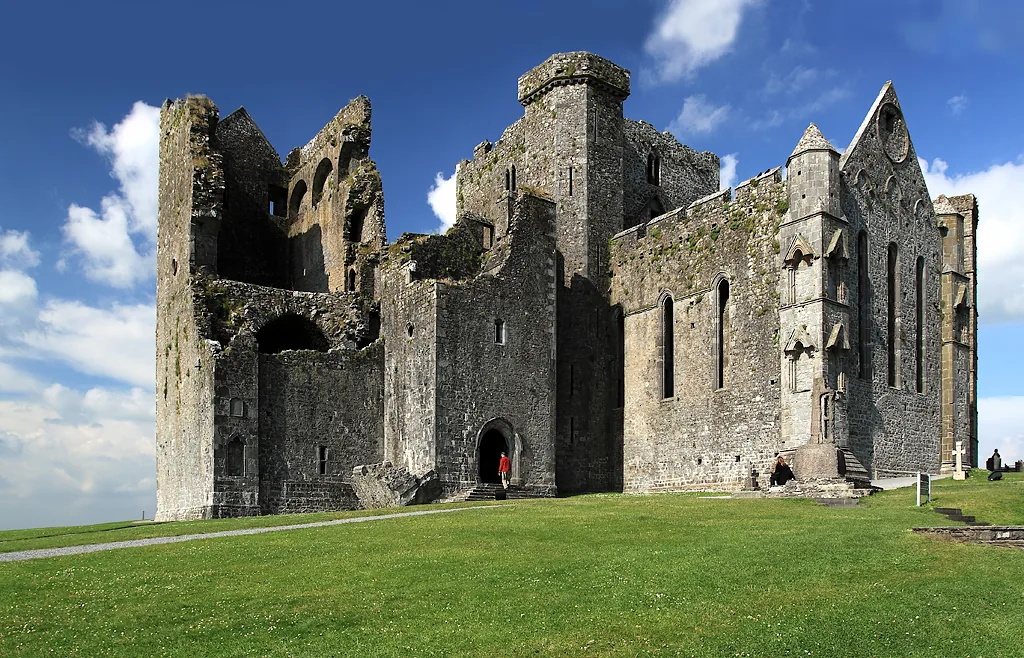
The starting point. The Rock of Cashel rises from the Tipperary plain and was the seat of the Kings of Munster. According to legend, it was at Cashel that Declan met Patrick. The medieval cluster on the summit includes a round tower, a Gothic cathedral, Cormac's Chapel (with Ireland's only surviving Romanesque frescoes), and the Hall of the Vicars Choral. See our Ireland's Ancient East guide for full details.
The trail begins at the car park of the Rock of Cashel.
H3: 2. Cahir, County Tipperary
Cahir Castle, one of Ireland's largest and best-preserved medieval castles, sits on an island in the River Suir. The town is a natural rest stop with full services. The trail passes directly through Cahir.
Walk from Cashel: Approximately 5-6 hours (20 km).
H3: 3. Knockmealdown Mountains
The trail crosses the Knockmealdowns, the mountain range that divides Tipperary from Waterford. This is the most physically demanding section of the walk, with mountain terrain and altitude. The crossing brings you from the green, sheltered Golden Vale of Tipperary into the more rugged landscape of West Waterford. Clear-day views from the ridge extend across both counties.
Walk from Cahir (via Ardfinnan and Goatenbridge): Approximately 2 days.
H3: 4. Mount Melleray Abbey
A Cistercian monastery founded in 1832 by Irish monks expelled from France. The abbey offers accommodation and a quiet rest point. The official opening ceremony for St. Declan's Way was held here in September 2021.
Walk from Knockmealdown crossing: Approximately 2-3 hours.
H3: 5. Lismore, County Waterford
Lismore is a heritage town on the River Blackwater, dominated by Lismore Castle (the Irish home of the Duke of Devonshire, visible but not open to the public, though the gardens are). The town has deep ecclesiastical history: Saint Carthage founded a monastery here in the 7th century, and it was one of the great centers of learning in medieval Ireland.
Walk from Mount Melleray: Approximately 3-4 hours (15 km).
H3: 6. Ardmore, County Waterford
The trail ends at St. Declan's Monastery in Ardmore, one of the oldest Christian sites in Ireland. The round tower (one of the best-preserved in the country) and the ruins of a cathedral still stand. St. Declan's Holy Well and Oratory (where Declan is believed to be buried) are nearby. The cliff walk at Ardmore provides views along the Waterford coast.
Ardmore is also home to St. Declan's Stone on the beach, around which a traditional "pattern day" is held annually on July 24 (St. Declan's Day).
Walk from Lismore (via Cappoquin and Aglish): Approximately 1.5 days.
Walking St. Declan's Way: What You Need to Know
St. Declan's Way is a 96-115 km pilgrim path taking 4-6 days to walk. The trail crosses varied terrain including farmland, roads, and the Knockmealdown Mountains. Blue waymarkers guide walkers along the route. Accommodation is available in Cahir, at Mount Melleray Abbey, in Lismore, and in Ardmore. The trail officially opened in September 2021.
This is a serious walking trail requiring moderate fitness and preparation.
| Detail | Information |
|---|---|
| Distance | 96-115 km (depending on route variations) |
| Duration | 4-6 days |
| Terrain | Varied: farmland, country roads, mountain crossing (Knockmealdowns), coastal path (Ardmore) |
| Difficulty | Moderate to challenging. The Knockmealdown crossing is the hardest section. |
| Waymarking | Blue arrows with "Duibhin Deaglan" markers |
| Trail etiquette | Close all gates. Route crosses active farmland. |
| Best season | May to September |
| Accommodation | B&Bs and guesthouses in Cahir, Lismore, and Ardmore. Mount Melleray Abbey offers accommodation. |
| Starting point | Rock of Cashel car park, County Tipperary |
| End point | St. Declan's Monastery, Ardmore, County Waterford |
Pre-Patrician Christianity and Irish Identity
Declan's story challenges the common narrative that Patrick brought Christianity to Ireland alone. The pre-Patrician saints show that Christianity arrived in Munster from multiple directions, possibly through trade connections with Roman Gaul and Britain.
This matters for Irish identity because it means the conversion was not a single event led by one figure but a gradual, multi-layered process that blended with existing beliefs. The holy wells, pattern days, and pilgrimage traditions along St. Declan's Way combine Christian devotion with older practices that predate the arrival of any saint.
The Celtic cross itself may have emerged from this blending of traditions, combining the Christian cross with the circular sun symbol of pre-Christian Ireland. See our Celtic Cross Meaning guide.
Explore Irish Heritage Jewelry →
Explore More Heritage Trails
- Tochar Phadraig: Another ancient Irish pilgrim path, from Ballintubber Abbey to Croagh Patrick
- Ireland's Ancient East: The Rock of Cashel and Waterford are key stops on this broader route
- Saint Patrick's Trail: The Patrician counterpart to Declan's pre-Patrician heritage
- Celtic Monastery Trail: The monastic tradition Declan helped establish