

What Is Ireland's Ancient East?
Ireland's Ancient East is a heritage tourism initiative launched by Failte Ireland in 2015, covering 17 counties in eastern and southern Ireland. It connects over 5,000 years of history across three themed zones. Key sites include Newgrange (3200 BC), the Hill of Tara (seat of the High Kings), Monasterboice (finest Celtic high crosses), Clonmacnoise (6th-century monastic university), Kilkenny (medieval city), the Rock of Cashel, and Waterford (Ireland's oldest city, founded 914 AD).
Ireland's Ancient East is the eastern counterpart to the Wild Atlantic Way. While the Wild Atlantic Way follows a single 2,500 km coastal road, Ireland's Ancient East works differently. It is not one fixed driving route but a network of heritage sites connected by themes: Ancient Ireland, Early Christian Ireland, Medieval Ireland, and Anglo Ireland.
Failte Ireland launched the initiative in 2015 to encourage visitors to explore the deep history concentrated in the eastern half of the country. The 17 counties are grouped into three zones. The "Land of 5,000 Dawns" covers the Boyne Valley and northeast (Meath, Louth, Cavan, Longford, Monaghan). The "Historic Heartlands" stretch across the midlands and south (Kilkenny, Tipperary, Offaly, Laois, Carlow, Kildare, Limerick). The "Celtic Coast" runs along the southeast (Waterford, Wexford, Wicklow, Cork).
What makes this region remarkable is the density of heritage. The Boyne Valley alone contains passage tombs older than the Egyptian pyramids. County Louth has high crosses that defined the Celtic cross form. County Meath holds the Hill of Tara, seat of the High Kings. County Offaly has Clonmacnoise, one of Europe's great monastic universities. Tipperary has the Rock of Cashel. And Waterford is the oldest city in Ireland, founded by the Vikings in 914 AD.
Every Celtic symbol on our site has roots in this region. The triskele spirals at Newgrange. The knotwork on the high crosses at Monasterboice. The illuminated pages of the Book of Kells. The Dublin Castle hallmark. If the Wild Atlantic Way is Ireland's natural beauty, Ireland's Ancient East is its cultural bedrock.
The Stops Along Ireland's Ancient East
The route below follows a logical path from Dublin south and west, touching the major heritage sites. Driving times are between consecutive stops.
H3: 1. Dublin: Trinity College and the Dublin Castle Hallmark
Trinity College Dublin houses the Book of Kells, Ireland's most famous manuscript, created around 800 AD by monks working between the island of Iona and the monastery at Kells. The Long Room library contains 200,000 of the oldest books in the collection.
Dublin Castle is also home to the Irish Assay Office, established in 1637, where Irish gold and silver jewelry is tested and hallmarked. Every piece of hallmarked Irish jewelry carries a stamp from this office. For the full story, see our Dublin Castle Hallmark guide.
Starting point for the route.
H3: 2. Newgrange (Bru na Boinne), County Meath
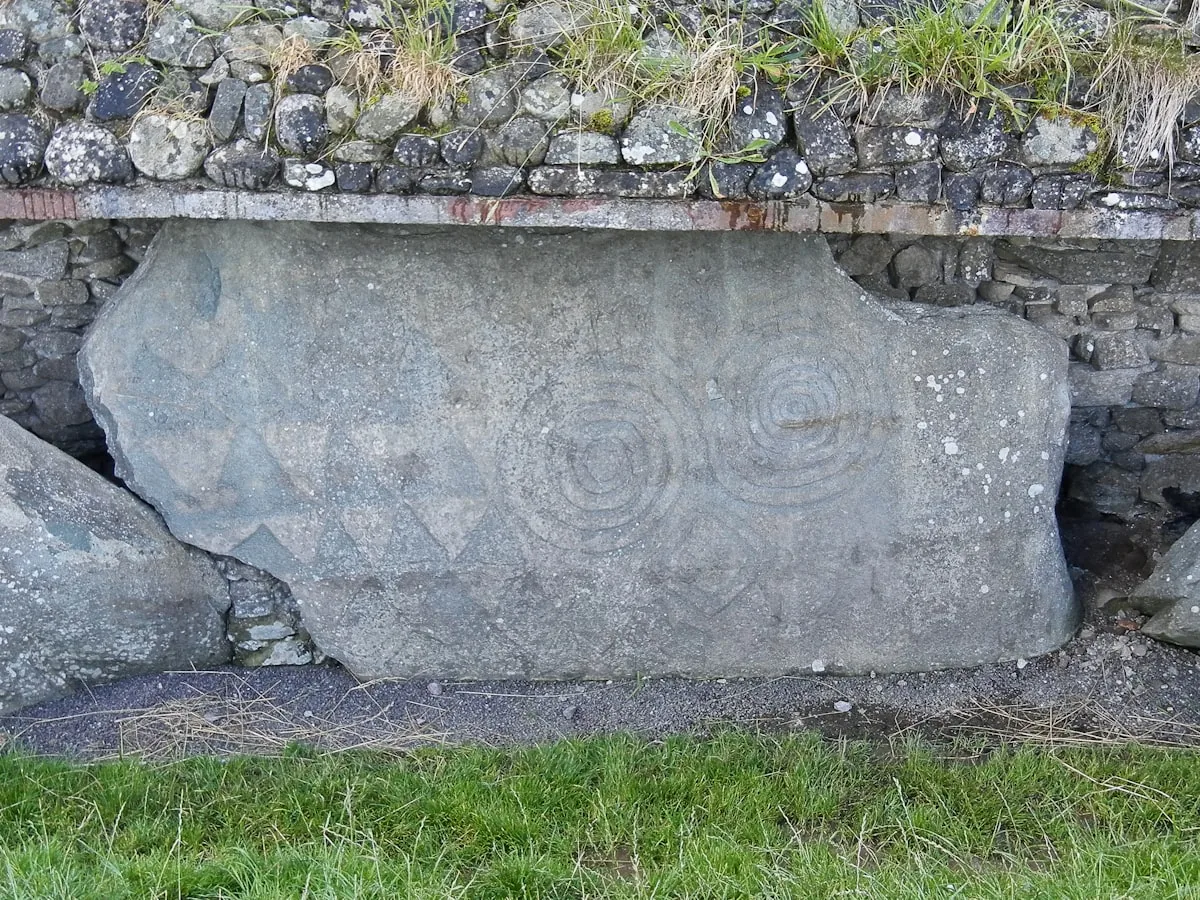
Newgrange is a 5,000-year-old Neolithic passage tomb, built around 3200 BC. That makes it older than Stonehenge and older than the Great Pyramids of Giza. The mound measures 85 meters in diameter, ringed by 97 kerbstones carved with spiral and lozenge designs, including Ireland's most famous example of megalithic art on Kerbstone 1.
The passage runs 19 meters into the mound, leading to a cruciform chamber with a corbelled roof that has remained watertight for over 5,000 years. On the mornings around the winter solstice (December 19-23), a beam of sunlight enters through a specially constructed roof box above the entrance and travels down the passage, illuminating the inner chamber for 17 minutes.
Newgrange is part of the Bru na Boinne UNESCO World Heritage Site, alongside the passage tombs at Knowth and Dowth. Access is through the Bru na Boinne Visitor Centre.
The triskele spiral carved into the entrance stone at Newgrange is the ancestor of the Celtic triskele found in Irish jewelry today. See our Triskele Meaning guide.
Drive from Dublin: Approximately 1 hour (50 km).
H3: 3. Hill of Tara, County Meath
The Hill of Tara was the seat of the High Kings of Ireland from the Iron Age through the early medieval period. The site contains earthworks dating from the late Stone Age, including the Mound of the Hostages (a passage tomb roughly contemporary with Newgrange), the Rath na Ri (Fort of the Kings, built around 100 BC), and the Lia Fail, the legendary Stone of Destiny said to roar when touched by the rightful king.
All five ancient roads of Ireland converged at Tara. It was the political and spiritual center of Gaelic Ireland for over 2,000 years. According to tradition, Saint Patrick came to Tara to challenge the druids and convert the High King to Christianity.
Drive from Newgrange: Approximately 30 minutes (25 km).
H3: 4. Monasterboice, County Louth
Monasterboice is home to the finest Celtic high crosses in Ireland. Muiredach's Cross, dating to the early 10th century (before 923 AD), stands 5.5 meters tall and is covered on every face with biblical scenes carved in sandstone. An inscription at the base reads "A prayer for Muiredach who had this cross made." The West Cross, at nearly 7 meters, is the tallest high cross in Ireland.
The monastic site was founded in the 6th century by Saint Buithe. A round tower over 28 meters tall still stands. The high crosses at Monasterboice are among the most important sources for understanding how the Celtic cross form developed from simple stone markers into the elaborate sculptural tradition that defines Irish art.
For the full story of the Celtic cross, see our Celtic Cross Meaning guide.
Drive from Hill of Tara: Approximately 45 minutes (55 km).
H3: 5. Kells, County Meath
Kells is where the Book of Kells was completed after monks fled the Viking raids on Iona around 807 AD. The monastery at Kells became a major center of learning, and the town still has a round tower and four high crosses in the churchyard. The manuscript itself was moved to Trinity College Dublin in 1661 for safekeeping. For the full story, see our Book of Kells guide.
Drive from Monasterboice: Approximately 45 minutes (50 km).
H3: 6. Clonmacnoise, County Offaly
Founded by Saint Ciaran in the 6th century, Clonmacnoise was one of Europe's great centers of learning. Situated on the banks of the River Shannon, the monastery attracted scholars from across Europe and produced some of Ireland's finest manuscripts and metalwork. The site today includes the ruins of a cathedral, nine churches, two round towers, and the Cross of the Scriptures (a 10th-century high cross, with the original now protected in the visitor center). Over 700 early Christian grave slabs survive, the largest collection in Western Europe.
Drive from Kells: Approximately 1 hour 45 minutes (130 km).
H3: 7. Kilkenny
Kilkenny is Ireland's best-preserved medieval city. The "Medieval Mile" runs from Kilkenny Castle (a 12th-century Norman fortress) to St. Canice's Cathedral, passing through streets that have retained their medieval layout. The Black Abbey, founded by the Dominicans in 1225, still functions as a church. Kilkenny is also a center for Irish craft and design, with studios and workshops throughout the city.
Drive from Clonmacnoise: Approximately 1 hour 30 minutes (120 km).
H3: 8. Rock of Cashel, County Tipperary
The Rock of Cashel rises from the Tipperary plain like a fortified island. It was the seat of the Kings of Munster for centuries and the place where Brian Boru was crowned High King of Ireland in 978 AD. The rock was granted to the church in 1101.
The cluster of medieval buildings on the summit includes a round tower, a high cross, a Gothic cathedral, the Hall of the Vicars Choral, and Cormac's Chapel, which contains the only surviving Romanesque frescoes in Ireland. According to legend, it was at Cashel that Saint Patrick converted King Aenghus to Christianity, accidentally driving his crozier through the king's foot during the baptism. The king bore the wound in silence, believing it was part of the ceremony.
Drive from Kilkenny: Approximately 45 minutes (55 km).
H3: 9. Waterford Viking Triangle
Waterford is the oldest city in Ireland, founded by Viking settlers in 914 AD. The Viking Triangle, the historic core of the city, is anchored by Reginald's Tower, the oldest civic building in Ireland, in continuous use for over 800 years. The tower now houses the Waterford Viking Museum.
Waterford connects directly to the story we tell on our Celtic vs Viking page. The Norse and Gaelic cultures merged here into the Hiberno-Norse tradition that influenced Irish art, including the Urnes-style knotwork visible in Celtic jewelry.
Drive from Rock of Cashel: Approximately 1 hour 15 minutes (90 km).
Visiting Ireland's Ancient East: What You Need to Know
Ireland's Ancient East covers 17 counties and can be explored in any order, as it is a network of heritage sites rather than a single driving route. Dublin is the most common starting point. Newgrange and the Book of Kells at Trinity College require advance booking in peak season. The driving route through the nine key stops listed above takes approximately 8-10 hours total, best split over 3-5 days.
Unlike the Wild Atlantic Way, Ireland's Ancient East is not a single road. You can explore it in any order. Here are the practical details.
| Detail | Information |
|---|---|
| Coverage | 17 counties in eastern and southern Ireland |
| Driving time (full loop above) | Approximately 8-10 hours total driving. Best split over 3-5 days. |
| Starting point | Dublin is the most common starting point. |
| Best season | Year-round. Heritage sites are mostly indoors or covered. Summer (May-September) has the longest daylight for outdoor sites like Tara and Monasterboice. |
| Booking | Newgrange requires advance booking through the Bru na Boinne Visitor Centre. Book of Kells at Trinity College can sell out in peak season. Other sites are walk-in. |
| Roads | Main roads and motorways. Much easier driving than the Wild Atlantic Way's narrow coastal roads. |
Ireland's Ancient East and Celtic Jewelry
Nearly every symbol in Irish jewelry traces back to the sites along this route.
The triskele spiral at Newgrange (3200 BC) is the oldest version of the triple spiral found in Celtic rings and pendants. The Celtic cross reached its artistic peak at Monasterboice, where Muiredach's Cross set the standard for the ringed cross design that Irish jewelers still use. The Trinity knot and interlace patterns found throughout the Book of Kells translate directly into Celtic knotwork jewelry. And the Dublin Castle hallmark, stamped on authentic Irish gold and silver, connects every hallmarked piece to the same city where this heritage route begins.
The dense layering of symbolism in this region is the reason Irish jewelry carries so much meaning. These are not decorative inventions. They are visual traditions with 5,000 years of continuous use, from carved stone to illuminated manuscript to hallmarked gold.
Explore More Heritage Trails
- Wild Atlantic Way: Ireland's 2,500 km western coast route, the natural complement to the Ancient East
- Book of Kells Journey: Follow the manuscript's path from Iona to Kells to Trinity College
- Viking Trail: Trace the Norse settlements from Dublin to Waterford to Limerick
- Celtic Monastery Trail: Glendalough, Clonmacnoise, Skellig Michael, and the island monasteries