


What Is the Dublin Castle Hallmark?
The Dublin Castle hallmark is a government-certified stamp applied by the Irish Assay Office, guaranteeing the metal purity of Irish jewelry. It is applied independently from the manufacturer. The Irish Assay Office operates from Dublin Castle and is one of the oldest continuously operating assay offices in the world, having certified precious metals for nearly 400 years.
A hallmark is a stamp on a piece of metal that proves it is what the seller says it is.
When a jeweler in Ireland makes a ring from 14K gold, the ring goes to the Irish Assay Office at Dublin Castle. There, an independent examiner tests the metal. If it passes — if the gold is genuinely 58.3% pure — the ring receives a series of tiny stamps pressed into the inner band. These stamps are the hallmark.
The hallmark is not a brand. It is not a marketing claim. It is a government-certified guarantee of metal purity, issued by an office that operates independently from the jeweler. The jeweler cannot stamp the hallmark themselves.
This matters because gold purity is invisible. A 10K ring and a 14K ring can look identical to the naked eye. You cannot determine metal purity by weight, by color, or by the shine. The only way to know for certain that the gold in a ring is what the seller claims — without destroying the ring to test it — is the hallmark.
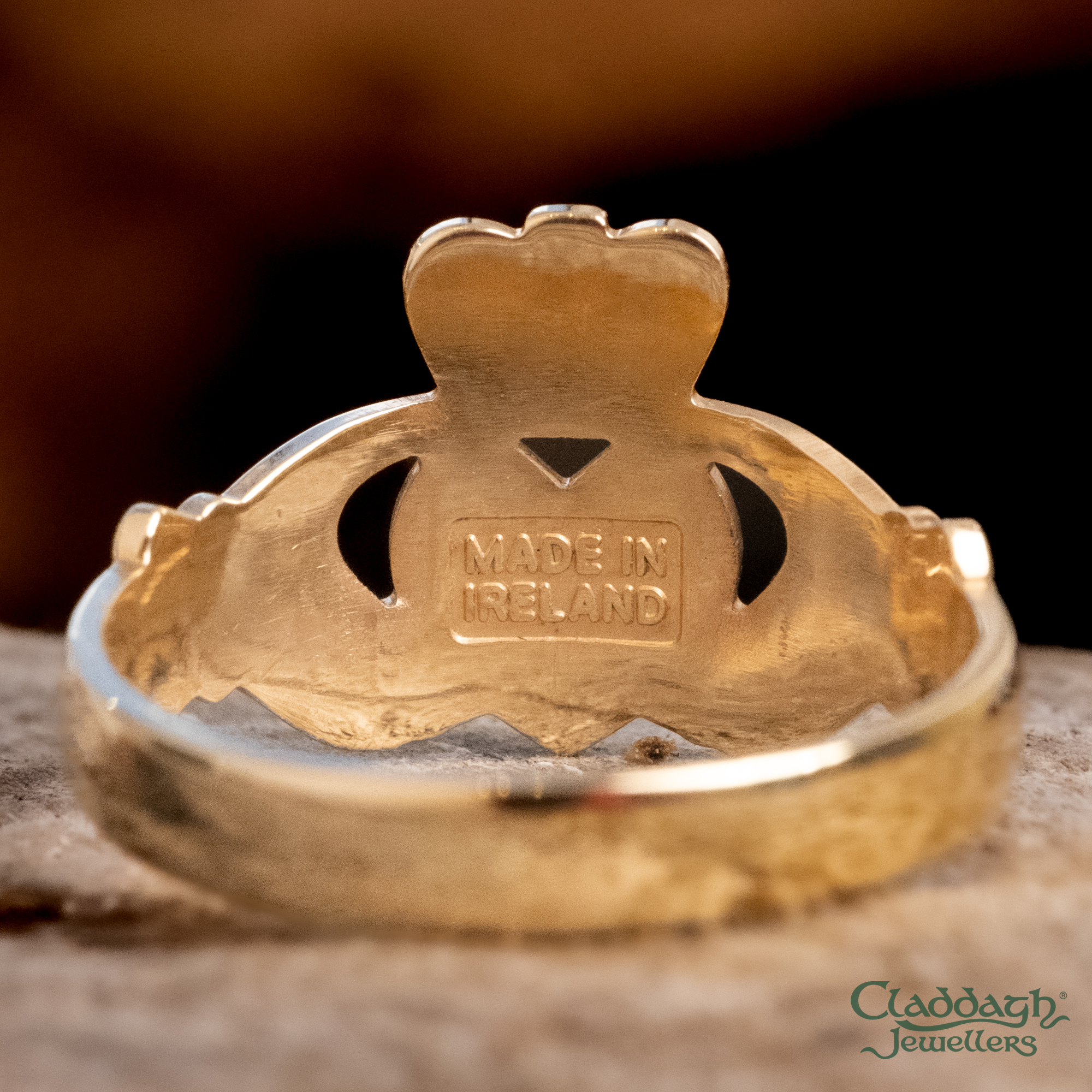
Reading a Dublin Castle Hallmark — What Each Stamp Means
A full Dublin Castle hallmark contains four marks: the maker's mark (manufacturer identity), the fineness mark (gold: 375/585/750, silver: 925), the crowned harp (Dublin Castle Assay Office), and a date letter (year of hallmarking). These stamps are applied independently by the Irish Assay Office after metal testing. They cannot be applied by the manufacturer.
A full Dublin Castle hallmark contains four marks stamped into the metal:
1. The Maker's Mark
A unique stamp registered by the specific manufacturer. Every jeweler and workshop that submits pieces for hallmarking has their own maker's mark — typically initials in a specific shape. This stamp tells you exactly who made the piece.
2. The Standard Mark (Fineness)
This stamp confirms the metal purity. The number inside the mark tells you the purity in parts per thousand:
Gold:
| Number | Karat | Purity |
|---|---|---|
| 375 | 9K | 37.5% gold |
| 585 | 14K | 58.3% gold |
| 750 | 18K | 75.0% gold |
| 916 | 22K | 91.6% gold |
Silver:
| Number | Standard | Purity |
|---|---|---|
| 925 | Sterling Silver | 92.5% silver |
| 800 | European Silver | 80.0% silver |
Platinum:
| Number | Purity |
|---|---|
| 950 | 95.0% platinum |
3. The Assay Office Mark
The crowned harp — ♔🏵 — the specific symbol of the Dublin Castle Assay Office. This mark confirms the piece was tested at Dublin Castle. No other assay office uses this exact mark.
Ireland has only one assay office. In countries like the UK, there are multiple (London, Birmingham, Edinburgh, Sheffield). In Ireland, there is Dublin Castle. One office, one standard.
4. The Date Letter
A single letter that identifies the year the piece was hallmarked. The letter changes annually, cycling through the alphabet. By looking up the date letter in a published table, you can identify the exact year a piece of Irish jewelry was tested.
This is especially useful for antique Claddagh rings and heritage pieces — the date letter tells you precisely when the ring was hallmarked, which helps verify its age and provenance.
The History of Hallmarking in Ireland
Hallmarking in Ireland is not a modern invention. The Irish Assay Office has been testing and certifying precious metals for nearly 400 years.
The key dates:
- 1637 — The Dublin Goldsmiths' Guild received a royal charter to assay gold and silver, establishing the formal hallmarking system
- 1783 — The Company of Goldsmiths of Dublin was incorporated, formalizing the assay process
- 1807 — Legislation required all Irish gold and silver to be assayed and hallmarked before sale
- 1927 — After Irish independence, the assay function transferred to the Irish government
- Ongoing — The Irish Assay Office continues to operate from Dublin Castle, testing every piece of precious metal jewelry submitted
The longevity of this system is its power. When you see a Dublin Castle hallmark on a Claddagh ring, that stamp connects to a tradition of metal verification that has operated continuously through colonialism, independence, civil war, economic depression, and modernization. The standard has never dropped.
How to Check If Your Irish Jewelry Has a Dublin Castle Hallmark
Where to Look
The hallmark is stamped on the inside surface of the piece — inside the ring band, on the clasp of a necklace, on the back of a brooch, or on the post of an earring. You may need a magnifying glass or jeweler's loupe to read it clearly — the marks are small.
What to Look For
- A number (375, 585, 750, 925, 950) — confirms metal purity
- A crowned harp symbol — confirms Dublin Castle testing
- A maker's stamp — initials or a symbol in a shaped border
- A single letter — the date letter for the year of testing
Red Flags — When the Hallmark Is Missing
If a piece of jewelry is sold as "Irish gold" or "Irish silver" but has no hallmark, one of two things is true:
- It was not made in Ireland. Jewelry imported from outside Ireland is not required to carry the Dublin Castle hallmark. It may carry a hallmark from another country's assay office (e.g., Birmingham's anchor mark) or no hallmark at all.
- It was not submitted for testing. In Ireland, it is a legal requirement to hallmark precious metals before sale. A piece without a hallmark either predates the requirement or was not submitted — which raises questions about purity.
The hallmark is the only guarantee. Without it, you are trusting the seller's claim. With it, you have government-certified proof.
Why the Dublin Castle Hallmark Matters for Claddagh Rings
The Claddagh ring is the most imitated piece of Irish jewelry in the world. Versions are manufactured in China, India, the United States, and across Europe. Many of these are marketed as "Irish" or "Celtic" without any connection to Ireland.
The Dublin Castle hallmark is the only way to verify that a gold or silver Claddagh ring:
- Contains the gold or silver purity claimed — 14K means 14K, not gold-plated or gold-filled
- Was tested by an independent government office — not self-certified by the seller
- Was manufactured in Ireland — the hallmark is only applied to pieces submitted to the Irish Assay Office
A gold Claddagh ring with a Dublin Castle hallmark is verifiably real. A gold Claddagh ring without one is a matter of trust.
The same applies to sterling silver Claddagh rings — the .925 stamp combined with the crowned harp hallmark confirms genuine sterling silver, tested at Dublin Castle.
Understanding the Hallmark on Men's Irish Rings
Men's Claddagh rings, Celtic knot bands, and Ogham rings in precious metals all carry the Dublin Castle hallmark. Here is what men should check:
- Inside the band — look for the fineness number and crowned harp
- Width matters — wider men's bands (5-7mm) have more space for clear hallmark stamps. On narrow bands, marks may be smaller and harder to read
- 10K (375) is legitimate — 10K is the legal minimum to be called gold in the United States, and it carries the Dublin Castle hallmark in Ireland
- Brushed or matte finishes do not affect the hallmark — the stamps are pressed into the metal, not painted on
If you are buying a men's Claddagh ring or Celtic ring as a wedding band for daily wear, the hallmark is your assurance that the metal will hold up for decades.
Understanding the Hallmark on Women's Irish Jewelry
Women's Claddagh rings, pendants, earrings, and bracelets in precious metals all carry the Dublin Castle hallmark. Key points:
- Rings — hallmark inside the band. Check with a loupe or ask the jeweler to show you
- Pendants — hallmark on the bail (the loop connecting the pendant to the chain) or on the back
- Earrings — hallmark on the post or butterfly back. Very small — a loupe helps
- Bracelets — hallmark near the clasp
Gemstone rings: The hallmark certifies the metal, not the gemstone. A Claddagh birthstone ring with a Dublin Castle hallmark has verified metal purity, but the gemstone is certified separately (by a gemological lab, if certified at all).
Silver tarnish does not affect the hallmark. If your silver Claddagh ring tarnishes, the hallmark is still there underneath — polishing reveals it again.
Explore Irish Jewelry
- Gold Claddagh Ring — 10K, 14K & 18K gold styles
- Silver Claddagh Ring — Sterling silver & care
- Claddagh Ring Meaning — Love, loyalty & friendship
- Claddagh Birthstone Ring — Every month, every stone
- Claddagh Wedding Band — Wedding rings with three promises
- Claddagh Necklace — Pendants & chains
- ← Back to all guides — The complete Irish heritage hub