
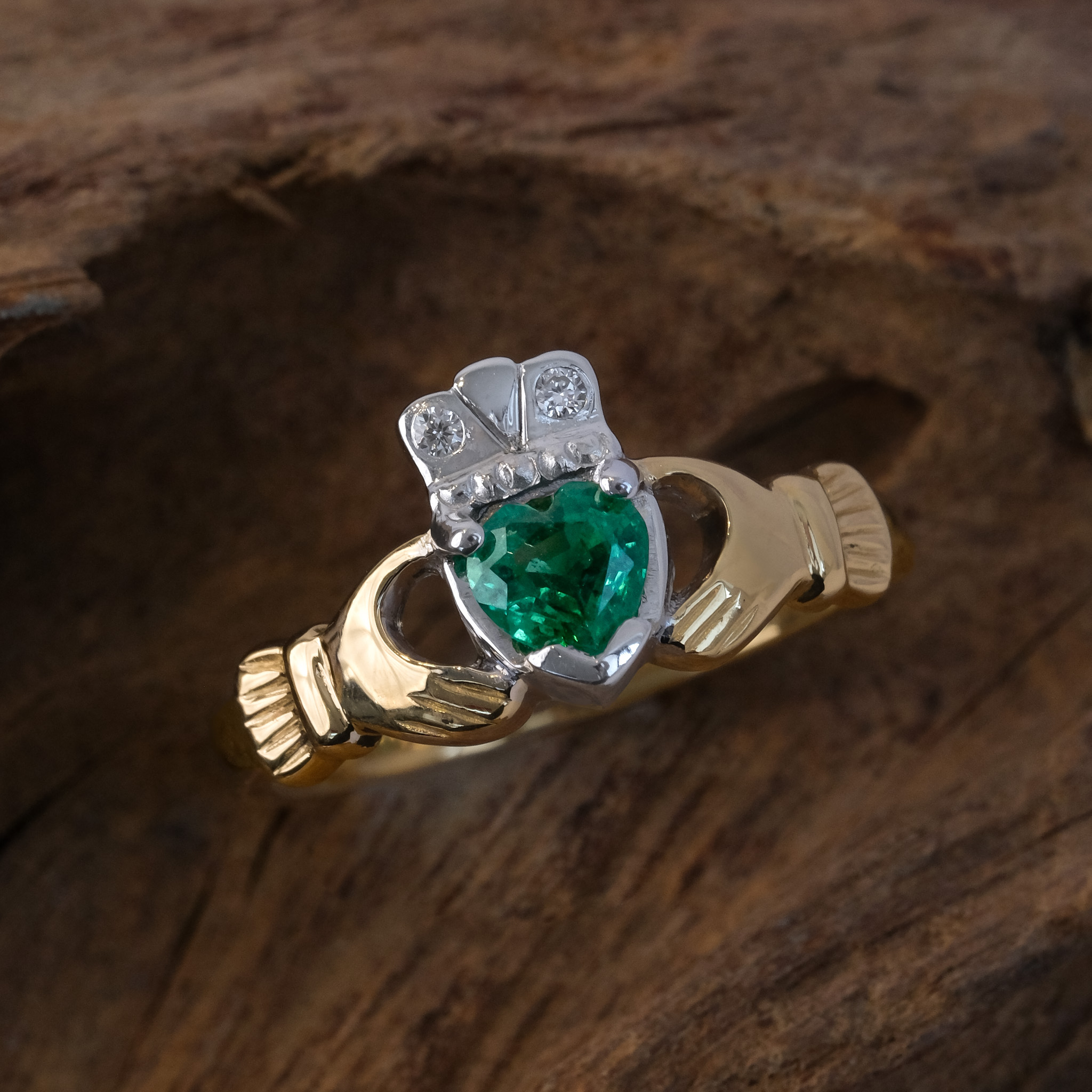

Can You Use a Claddagh Ring as an Engagement Ring?
Claddagh rings have been used as engagement rings in Ireland for centuries, predating the modern diamond engagement ring tradition. The Claddagh belongs to the older European "fede ring" tradition dating to Ancient Rome. When worn on the left ring finger with the heart pointing inward, the Claddagh signifies that the wearer is engaged or married. The ring's three symbols (heart for love, crown for loyalty, hands for friendship) represent a complete promise to a partner.
The short answer is yes, and it is one of the most meaningful engagement ring choices you can make.
In Ireland, Claddagh rings have been given as engagement rings and wedding rings for centuries. The tradition long predates the modern diamond engagement ring. Before De Beers launched their diamond marketing campaign in 1939, only about 10% of American engagement rings contained a diamond. The famous "A Diamond is Forever" slogan came in 1947, and by 1979, De Beers had grown diamond sales from $23 million to $2.1 billion. The Claddagh tradition is centuries older.
The Claddagh ring belongs to an even older category of European jewelry called fede rings (from the Italian mani in fede, meaning "hands joined in faith"). Clasped-hands rings date to Ancient Rome, where they signified pledged vows and trust.
When a Claddagh ring is used for engagement, the ring is worn on the left ring finger with the heart pointing inward, toward the wearer's heart. This position declares: "My heart belongs to someone."
The tradition of wearing an engagement ring on the fourth finger of the left hand was popularized by a 1686 treatise by Henry Swinburne, who claimed the finger contained a "vein of love" (vena amoris) leading directly to the heart. Modern anatomy has disproved this, but the tradition endured.
The Claddagh ring carries a deeper symbolism than a standard solitaire:
| Element | What It Means |
|---|---|
| Heart | Love, the foundation of the relationship |
| Crown | Loyalty, the promise to be faithful |
| Hands | Friendship, the bond that sustains love when romance fades |
A diamond engagement ring says "I love you." A Claddagh ring says "I love you, I am loyal to you, and you are my closest friend." It is a more complete promise.
Claddagh Ring vs Traditional Engagement Ring — Full Comparison
| Feature | Claddagh Ring | Traditional Engagement Ring |
|---|---|---|
| Origin | Galway, Ireland, 17th century | Europe, popularized in the US from 1939 by De Beers |
| Meaning | Love, loyalty, and friendship | Love and commitment |
| Symbol depth | Three symbols (heart, crown, hands) | One symbol (diamond = forever) |
| Tradition | Passed down through Irish families for generations | Purchased new for each couple |
| Heritage | Connects to 400 years of Irish identity | Modern commercial tradition |
| Gemstone | Optional: emerald, diamond, birthstone, or plain | Diamond (expected standard) |
| Worn by | Both men and women | Primarily women |
| Position meaning | 4 different positions signal relationship status | One position (left ring finger) |
| Price range | $100–$2,000+ (gold with gemstone) | $1,000–$10,000+ (average ~$6,000 in US) |
| Recognition | Instantly recognized in Ireland and by Irish diaspora | Universally recognized |
The Irish Tradition of Claddagh Engagement Rings
In traditional Irish families, the Claddagh ring was often the only ring. It served as courtship ring, engagement ring, and wedding ring, moving from one hand and position to another as the relationship progressed:
| Stage | Hand | Heart Direction | Meaning |
|---|---|---|---|
| Single | Right hand | Heart facing outward | "My heart is open" |
| In a relationship | Right hand | Heart facing inward | "Someone has captured my heart" |
| Engaged | Left hand | Heart facing outward | "We are promised to each other" |
| Married | Left hand | Heart facing inward | "Our hearts are joined" |
Many Irish families pass a Claddagh ring from mother to daughter on the daughter's engagement, making it an heirloom that connects generations. This tradition of inheritance is one of the most powerful aspects of the Claddagh. A diamond may be new; a family Claddagh carries decades of love.
Modern Claddagh Engagement Rings — Best of Both Worlds
Modern Claddagh engagement rings combine the traditional Irish design with the gemstone expectations of contemporary engagement jewelry:
Popular styles:
- Diamond Claddagh: The heart set with a diamond or diamond-accented crown. Combines Irish heritage with the sparkle that modern couples expect
- Emerald Claddagh: An emerald heart connecting the ring to Ireland's green identity. A distinctive choice with deep cultural meaning
- Birthstone Claddagh: The heart set with the recipient's birthstone. Personalizes the tradition
- Two-tone Claddagh: Gold band with white gold or platinum crown/heart. Modern aesthetic with traditional form
- Plain gold Claddagh: The most traditional option. Understated, elegant, and timeless
All Claddagh engagement rings from Claddagh Jewellers are hallmarked at Dublin Castle by the Irish Assay Office, certified genuine Irish jewelry.
Explore Claddagh Engagement Rings →
VIDEO: Watch us make the Ashford Diamond & Emerald Claddagh Ring
[EMBED: YouTube ID phtQF7MsKuY]
Why Choose a Claddagh Over a Traditional Engagement Ring?
Choose a Claddagh engagement ring if:
- You have Irish heritage and want your ring to honor that connection
- You want a ring with layered meaning (love + loyalty + friendship), not just "forever"
- You value tradition and heirloom quality over trend
- You want both partners to wear the same symbol (Claddagh rings are unisex)
- You appreciate value — a stunning Claddagh engagement ring costs a fraction of a comparable diamond solitaire
Choose a traditional engagement ring if:
- Universal instant recognition matters most to you
- You want a large center stone as the focal point
- Your partner expects a diamond (and expectations matter)
There is no wrong choice. Both express love and commitment. The Claddagh simply carries an additional layer: heritage, friendship, loyalty, qualities that a plain solitaire does not express.
Explore More
- Claddagh Engagement Ring Guide: Full buying guide
- How to Wear a Claddagh Ring: The 4 positions explained
- Claddagh Ring Meaning: Love, loyalty & friendship
- Claddagh Wedding Bands: Matching wedding rings
- ← Back to all guides: Irish heritage hub