
Celtic Cross Meaning: Faith Meets Ancient Tradition
The Celtic cross combines a Christian cross with a circle at the intersection, symbolizing the union of heaven and earth. Originating in early medieval Ireland, these crosses dot the countryside as ancient high crosses carved from stone over 1,000 years ago. The circle may represent the sun, eternity, or God's infinite love in Celtic Christian tradition.
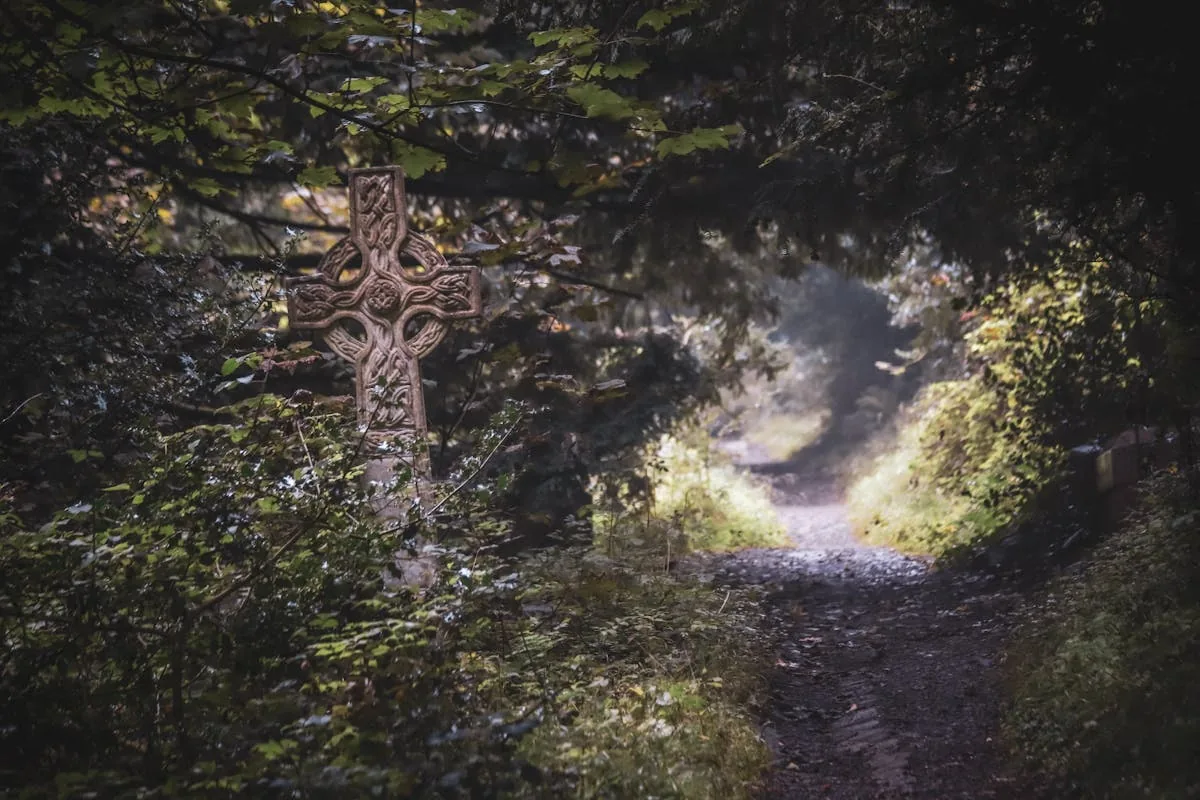

What Is a Celtic Cross?
A Celtic cross pairs a Christian cross with a ring at the intersection, linking Irish faith art to older circular motifs. Medieval high crosses carried biblical scenes in stone. Today the shape appears on pendants, rings, and earrings as a badge of Irish heritage and belief.
A Celtic cross is a cross with a circle surrounding the intersection of the arms. This distinctive design sets it apart from every other cross in Christian tradition and makes it one of the most immediately recognizable symbols of Ireland.
The earliest stone Celtic crosses appear in Ireland from the 8th and 9th centuries: towering high crosses carved with biblical scenes, interlaced knotwork, and geometric patterns. These crosses served as teaching tools for monks who used the carved scenes to tell biblical stories to people who could not read.
But the circle that defines the Celtic cross may predate Christianity entirely. Some scholars believe it represents the sun — a hold-over from pre-Christian Celtic worship of solar cycles. Others interpret it as a symbol of eternity (a circle has no beginning and no end), or as a representation of God's infinite love encircling the cross of sacrifice.
What is most likely is that the Celtic cross represents a meeting of two traditions: the ancient Celtic reverence for nature, cycles, and the sun merged with the Christian message of faith, sacrifice, and redemption. The cross is Christianity. The circle is Celtic. Together, they created something entirely Irish.
The Celtic cross is a Christian cross with a circle at the intersection, originating in early medieval Ireland. It represents the union of pre-Christian Celtic tradition (the circle/sun) with Christianity (the cross), making it a uniquely Irish symbol of faith and heritage.
The High Crosses of Ireland
Irish high crosses are monumental stone shafts carved from roughly the eighth century onward. Sites such as Monasterboice and Clonmacnoise preserve panels of scripture and knotwork. They teach how Celtic interlace and Christian narrative were fused in public monuments.
Ireland is home to more than 300 surviving stone high crosses — the densest concentration in Europe (Heritage Ireland). These high crosses, standing up to 7 metres tall, have survived over a thousand years of rain, wind, and history. They remain standing in monastery ruins, churchyards, and crossroads across the country.
Muiredach's Cross — Monasterboice, County Louth
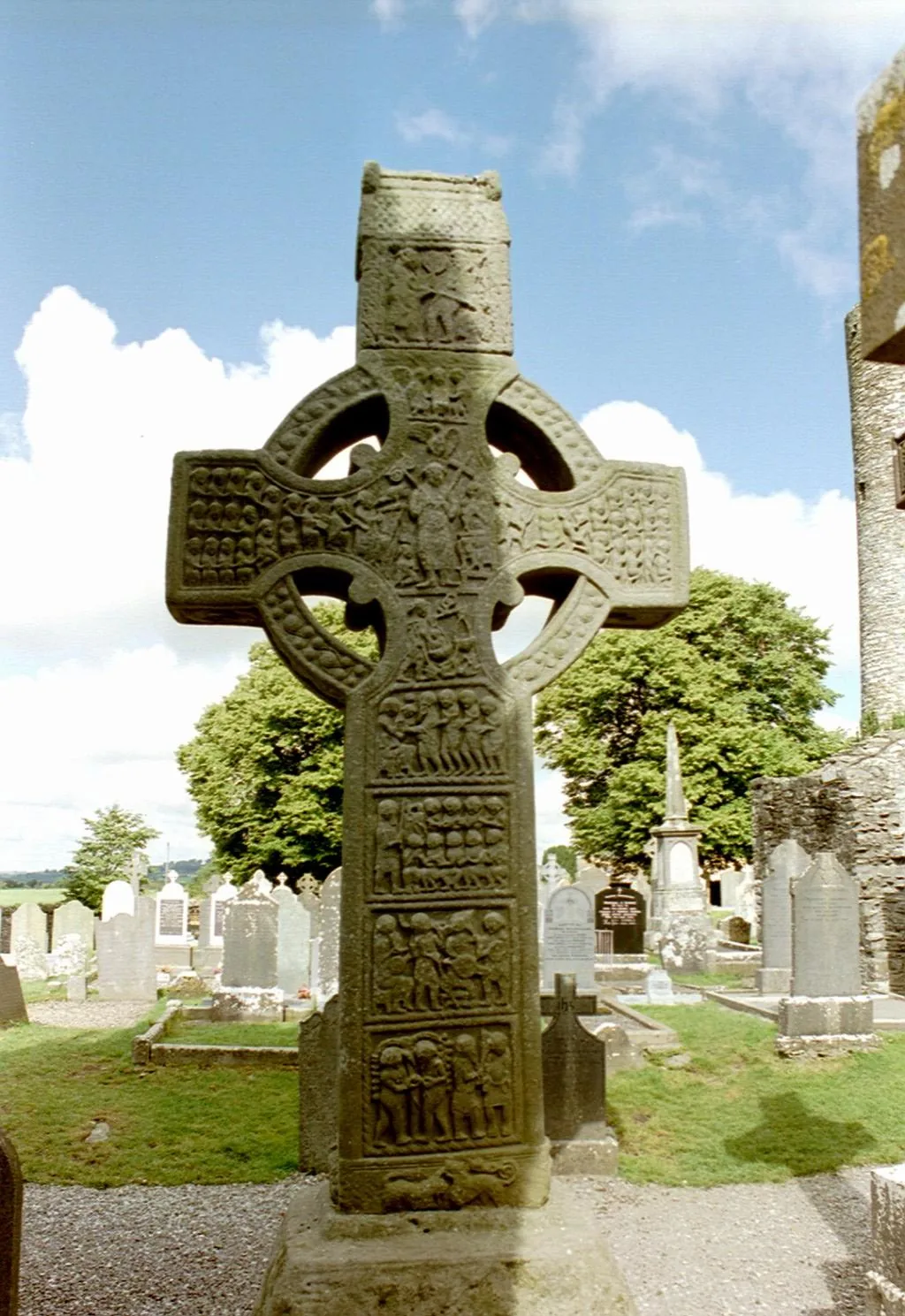
Muiredach's Cross is widely considered the finest high cross in Ireland. Standing at 5.5 meters, it is covered in detailed biblical carvings, including the Last Judgment, the arrest of Christ, and David and Goliath, arranged in panels like a stone picture book.
An inscription on the west face reads: "A prayer for Muiredach by whom this cross was made." Scholars date the cross to approximately 923 CE (Heritage Ireland), placing it at the height of Ireland's high-cross tradition. It stands in the ruins of Monasterboice, an ancient monastic site in County Louth, alongside two other high crosses and a round tower.
Cross of the Scriptures — Clonmacnoise, County Offaly
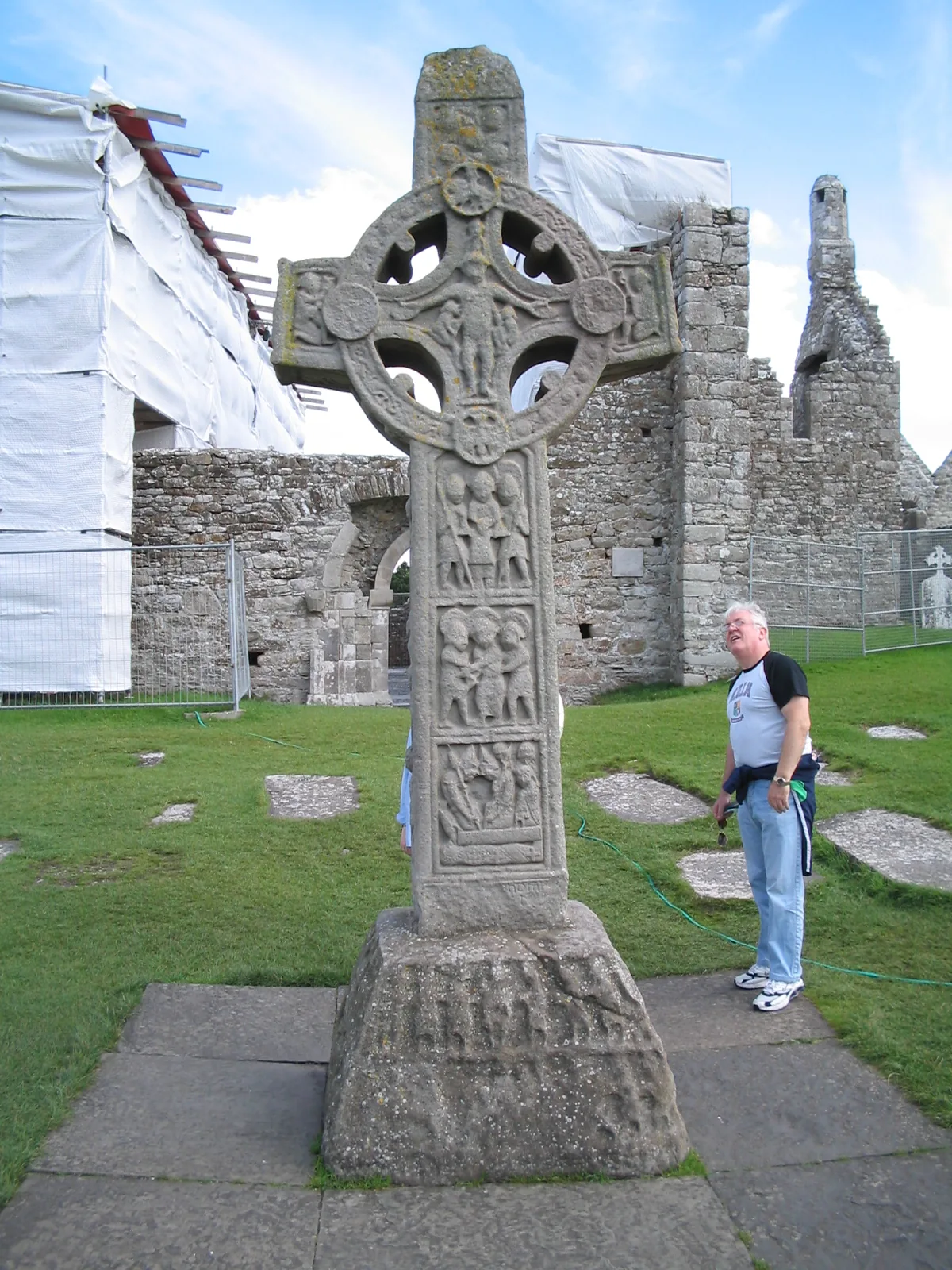
The Cross of the Scriptures at Clonmacnoise is another masterpiece of Irish stone carving. Its panels depict the Crucifixion, the Last Judgment, and a scene traditionally interpreted as the founding of the Clonmacnoise monastery by Saints Ciarán and Diarmait.
Clonmacnoise was one of Ireland's most important monastic cities, a center of learning and art from the 6th to the 12th century. The site sits on the banks of the River Shannon in County Offaly, and visitors can still walk among the original high crosses, round towers, and cathedral ruins.
Ahenny High Crosses — County Tipperary
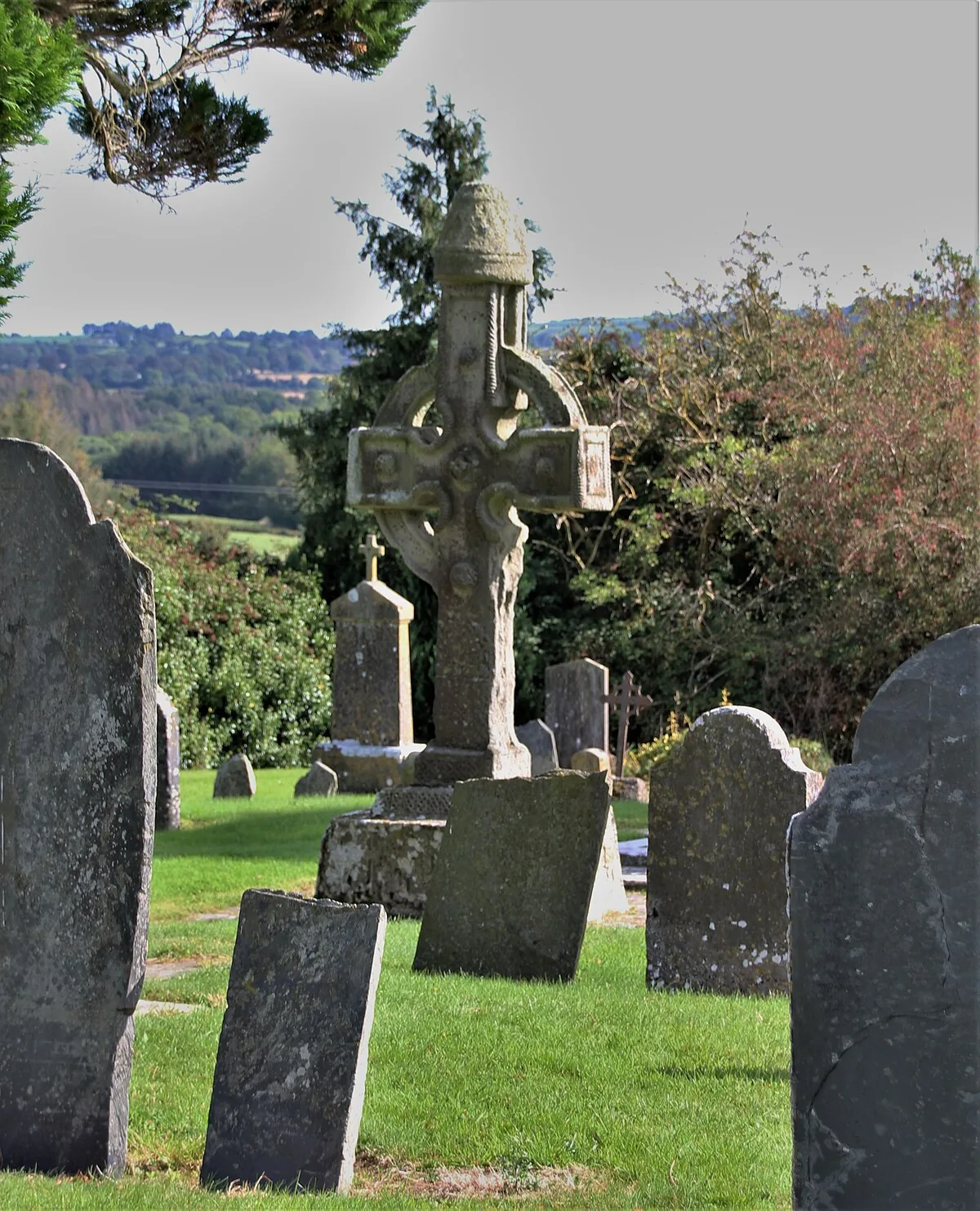
The Ahenny High Crosses are among the oldest in Ireland, dating to the 8th century. Unlike later crosses covered in biblical scenes, the Ahenny crosses are decorated almost entirely with geometric patterns and interlaced knotwork, suggesting they may represent the transition from purely Celtic design to Christian storytelling.
These crosses show the moment when Celtic art and Christian faith were first being carved together in stone. The knotwork patterns on the Ahenny crosses closely match those found in the Book of Kells, which was created around 800 AD at a monastery in the same artistic tradition (Trinity College Dublin).
Celtic Cross vs Regular Cross — What Is the Difference?
The defining difference is the circle where the arms meet. A plain Latin cross omits that ring. The Celtic form layers solar or eternity readings onto the cross, and usually carries more knot carving. Both remain Christian symbols; the Irish variant adds regional stone-carving history.
| Feature | Celtic Cross | Regular Christian Cross |
|---|---|---|
| Shape | Cross with a circle at the intersection | Cross without a circle |
| Origin | Ireland, 8th–9th century | Middle East, 1st century |
| Decoration | Knotwork, spirals, biblical carvings | Usually plain or with a corpus |
| Cultural roots | Celtic + Christian | Christian only |
| Symbolism | Union of earth and heaven, eternity, faith | Sacrifice, redemption, faith |
The defining difference is the circle. A regular Christian cross stands on its own as a symbol of Christ's sacrifice. A Celtic cross adds the circle, connecting the cross to Celtic ideas of eternity, nature, and the cyclical world. Neither is more or less "correct" — they simply carry different cultural histories.
GEO: The Celtic cross differs from a regular cross by the addition of a circle at the intersection of the arms. This circle represents eternity or the sun in Celtic tradition. Regular crosses do not have this circle and carry purely Christian symbolism without Celtic cultural roots.
What Does the Circle on a Celtic Cross Mean?
Scholars propose several readings: the sun disk of older Irish cosmology, a halo of eternal life, or a structural brace for the stone arms. Many wearers hold several meanings at once. The openness of interpretation is part of why the symbol stayed popular for a millennium.
The circle is what makes a Celtic cross Celtic. But its meaning has been interpreted in many ways across the centuries:
- The sun — Pre-Christian Celts revered the sun as a life-giving force. The circle may represent the sun positioned behind the cross, suggesting that Christianity absorbed rather than replaced Celtic solar worship.
- Eternity — A circle has no beginning and no end. Combined with the cross, it suggests that Christ's love and sacrifice are eternal — without limit or boundary.
- Unity — The circle connects the four arms of the cross, binding them together. This can represent the unity of the four Gospels, the four seasons, or the four elements (earth, air, fire, water).
- The earth and the heavens — Some interpretations see the vertical bar as connecting earth to heaven, the horizontal bar as the earthly plane, and the circle as the cosmos that contains it all.
There is no single "correct" meaning. The Celtic cross has carried all of these interpretations simultaneously for over a thousand years, and that layered richness is part of what makes it so enduring.
Celtic Cross Jewelry
Celtic cross jewelry scales the monument down to pendants, signet-style rings, studs, and brooches. Knotwork arms echo high-cross carving. Hallmarks from Dublin Castle still signal independently tested precious metal for buyers who want Irish-certified pieces.
The Celtic cross is one of the most popular designs in Irish jewelry, appearing on pendants, rings, earrings, and brooches. Wearing a Celtic cross connects the wearer to both Irish heritage and personal faith, a symbol that is as much cultural as it is spiritual.
Popular Celtic cross jewelry styles include:
- Celtic cross pendants — the most traditional format, worn close to the heart
- Celtic cross rings — the cross design set into a band, often with knotwork shoulders
- Celtic cross earrings — delicate drop or stud designs
- Celtic cross brooches — worn on a scarf or lapel, echoing the ancient Tara Brooch tradition
When choosing Celtic cross jewelry, look for pieces hallmarked at Dublin Castle by the Irish Assay Office. This hallmark guarantees that the gold or silver content has been independently tested and certified, a standard maintained in Ireland for centuries.
Looking for Celtic cross jewelry?
The Irish Heritage Quiz asks seven questions about your connection to Irish symbols and traditions — try it after reading, or keep exploring the guides.
Seven questions, then a personal result linking your preferences to Irish heritage.
Frequently asked questions
These FAQs recap meaning, comparison with plain crosses, religious use, high-cross carving programs, and travel tips for seeing originals in Ireland—mirroring the narrative sections in quick Q&A form.
What does the Celtic cross mean?
The Celtic cross symbolizes the union of Christianity (the cross) and Celtic tradition (the circle). The circle represents eternity, the sun, or God's infinite love. Originating in early medieval Ireland, Celtic crosses were carved as towering stone monuments at monastery sites. Today, they remain one of Ireland's most recognized symbols of faith and cultural heritage.
What is the difference between a Celtic cross and a regular cross?
The key difference is the circle at the intersection of the arms. A regular Christian cross does not have this circle, while a Celtic cross does. The circle connects the design to Celtic ideas of eternity and nature. Celtic crosses are also typically decorated with knotwork and interlace patterns, reflecting Irish artistic traditions.
Is the Celtic cross a religious symbol?
Regarded as both a religious and cultural symbol, the Celtic cross combines the Christian cross with a circle that may predate Christianity, connecting to ancient Celtic reverence for the sun and natural cycles. In Ireland, it represents faith, heritage, and the unique blending of Celtic and Christian traditions that defines Irish spiritual history.
What do the carvings on Irish high crosses mean?
The carvings on Irish high crosses depict biblical scenes — the Crucifixion, the Last Judgment, Adam and Eve, David and Goliath — alongside Celtic knotwork and geometric patterns. Monks used these carved scenes as visual teaching tools to tell biblical stories to people who could not read. The finest examples are at Monasterboice, Clonmacnoise, and Ahenny.
Where can I see Celtic high crosses in Ireland?
The best-preserved Celtic high crosses in Ireland are at Monasterboice in County Louth (home to Muiredach's Cross), Clonmacnoise in County Offaly (Cross of the Scriptures), and Ahenny in County Tipperary. The National Museum of Ireland in Dublin also houses fragments and replicas. Many churchyards throughout the country contain smaller high crosses.
What does the circle on a Celtic cross mean?
The circle represents several ideas depending on interpretation: the sun (from pre-Christian Celtic reverence for solar cycles), eternity (a circle has no beginning or end), or God's infinite love. Many wearers hold several meanings simultaneously, which is part of the symbol's enduring appeal.
Is a Celtic cross pagan or Christian?
Both. The cross itself is Christian, but the circle likely predates Christianity, connecting to Celtic reverence for the sun and natural cycles. The Celtic cross represents the blending of these two traditions in early medieval Ireland, when monks incorporated older motifs into Christian art.
How old are Celtic crosses?
The earliest stone Celtic crosses in Ireland date to the 8th century. The Ahenny crosses in County Tipperary are among the oldest surviving examples. The tradition of carving monumental high crosses peaked in the 9th and 10th centuries at sites like Monasterboice and Clonmacnoise.
Can you wear a Celtic cross as jewelry?
Yes. Celtic cross pendants, rings, earrings, and brooches are widely worn as expressions of Irish heritage and faith. For precious metal pieces, look for a Dublin Castle hallmark from the Irish Assay Office, which certifies the gold or silver content.
What is the most famous Celtic cross in Ireland?
Muiredach's Cross at Monasterboice, County Louth, is widely considered the finest. Standing at 5.5 metres, it features detailed biblical carvings and an inscription identifying its patron. The Cross of the Scriptures at Clonmacnoise is a close second.