
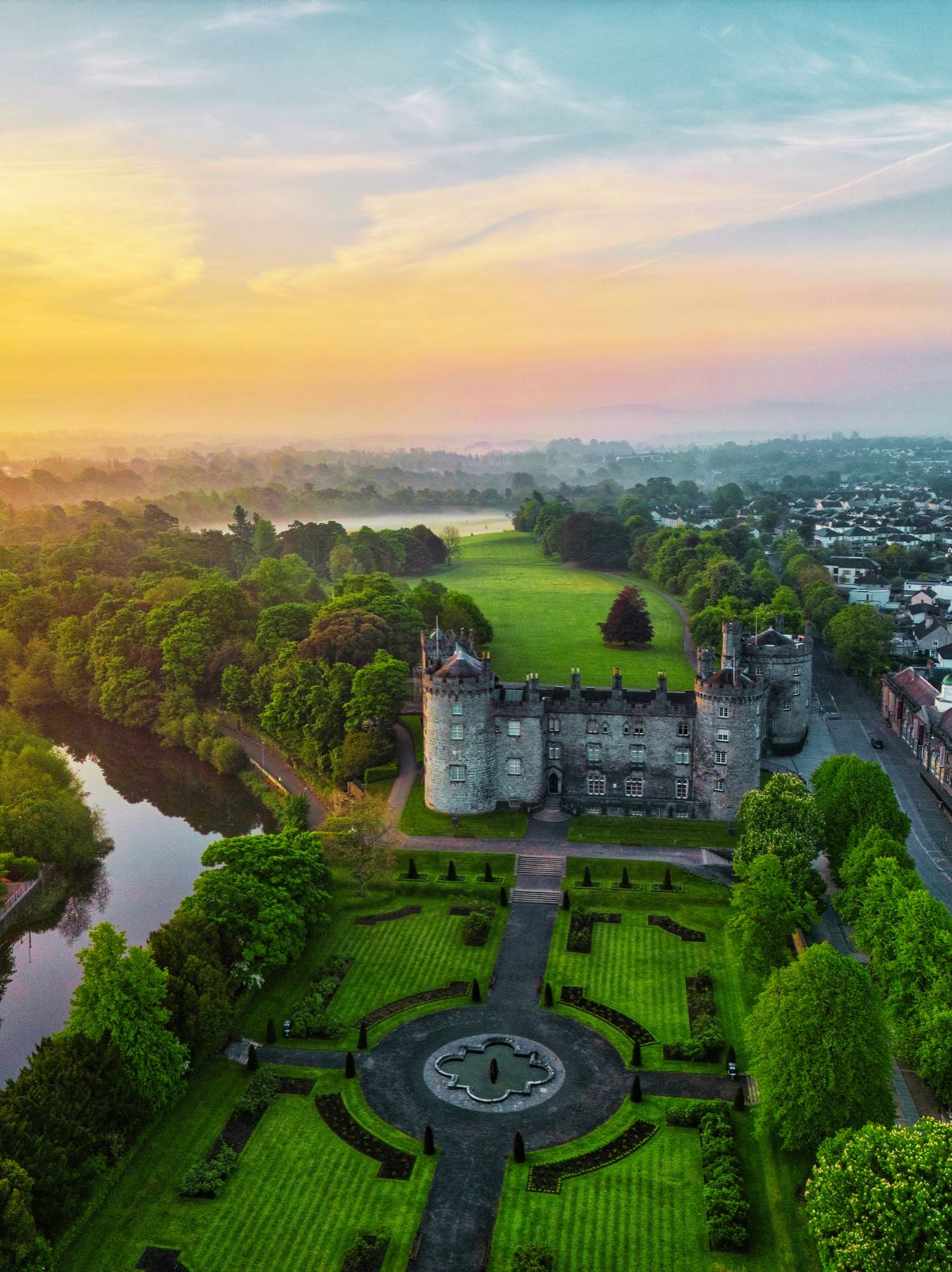

What Is Bunratty Castle?
Bunratty is the castle that feeds you.
It is a large tower house standing where the River Ratty meets the Shannon estuary in County Clare, ten minutes from Shannon Airport. The castle you see today — the fourth on this site — was built c. 1425 by the MacNamara clan. It later became the principal seat of the O'Briens, Earls of Thomond, who held it for centuries.
By the 20th century, Bunratty was a ruin. Roofless. Grass growing between the stones. The kind of castle that farmers used as a convenient shed.
Then the 7th Viscount Gort bought it in 1953 and spent three years on a meticulous restoration. He filled the castle with his private collection of 15th- and 16th-century furniture, tapestries, and art — period-appropriate pieces sourced from across Europe. The restoration was completed in 1956, and Bunratty opened to the public in 1960. It is one of the most complete and authentic tower house restorations in Ireland.
Bunratty Castle is a 15th-century tower house in County Clare, Ireland, built c. 1425 by the MacNamara clan. The 7th Viscount Gort restored the castle in 1953–1956 with period-appropriate furnishings. It opened to the public in 1960 and is one of the most complete tower house restorations in Ireland.
Who Built Bunratty Castle?
The site has been fortified for 800 years. The timeline:
- c. 1250 — Robert De Muscegros, a Norman lord, built the first motte-and-bailey fortification on this site
- c. 1277 — Thomas De Clare built the second castle, a stone structure destroyed during Irish raids
- c. 1353 — A third castle was built and also destroyed
- c. 1425 — The MacNamara clan built the current tower house. It is a classic late-medieval design: a rectangular keep with four corner towers, thick limestone walls, and a massive Great Hall on the upper floor
The O'Brien dynasty — descendants of Brian Boru, the High King of Ireland — took control of Bunratty in the late 15th century and made it their principal seat. The Earls of Thomond held court here, received visitors, and administered Clare from the Great Hall.
The castle changed hands violently during the Confederate Wars of the 1640s. In 1646, during a Parliamentarian siege, the castle was defended by Rear-Admiral Penn — the father of William Penn, who would later found Pennsylvania. Irish castle history connects to American history in ways you do not expect.
After the Cromwellian wars and the Williamite confiscations, Bunratty declined. The roof collapsed. The interiors rotted. By the early 20th century, it was a shell.
The current Bunratty Castle was built c. 1425 by the MacNamara clan. The O'Brien dynasty (descendants of High King Brian Boru) held the castle as their principal seat. During the Confederate Wars in 1646, the castle was defended by Rear-Admiral Penn, father of William Penn, founder of Pennsylvania.
What Is Inside Bunratty Castle?
Bunratty's interior is not a museum of empty rooms. Viscount Gort filled every chamber with period furniture, and it feels like a working medieval household.
The Great Hall dominates the upper floor — a soaring space where the Earl of Thomond would have received guests, dispensed justice, and hosted feasts. The long oak tables and carved chairs date to the period. The hall is where the medieval banquets are held today.
The Private Chapel contains rare 1619 stucco plasterwork — ornate ceiling decorations that survived centuries of neglect. It is one of the finest examples of early 17th-century plasterwork in Ireland.
The castle has 15 garderobes — medieval privies built into the walls. That number is unusual for a tower house and suggests the castle was designed to accommodate a large household or garrison.
The murder holes above the entrance passage are original — openings in the ceiling through which defenders could drop stones, boiling water, or anything else unpleasant on attackers trying to force the door.
The spiral stairs are narrow, steep, and designed for defense: they wind clockwise so that a right-handed swordsman defending from above has room to swing, while an attacker climbing up does not.
What Is the Bunratty Medieval Banquet?
The medieval banquets are what made Bunratty famous beyond heritage circles. They have been running since 1963, when Dr. Brendan O'Regan — the visionary behind Shannon's duty-free shopping — created them to attract transatlantic passengers who were stopping at Shannon Airport.
The format has barely changed in 60 years:
- A piper welcomes guests at the castle door
- You drink mead (honey wine) from a communal cup
- You sit at long tables in the Great Hall
- A four-course feast is served — you eat with a knife and your fingers. No forks. This is the 15th century.
- The Bunratty Castle Singers perform traditional Irish music and ballads between courses
- A "Lord and Lady" preside over the evening in period costume
The banquets have hosted heads of state, celebrities, and — according to local legend — at least one visiting president who struggled with eating ribs without cutlery. The evening is theatre, tourism, and a surprisingly good night out. Bookings are essential, especially in summer.
Bunratty Castle's medieval banquets have been running since 1963, created by Dr. Brendan O'Regan to attract Shannon Airport travelers. Guests drink mead, eat a four-course feast with their hands, and are entertained by the Bunratty Castle Singers in the castle's Great Hall. Bookings are essential.
What Is Bunratty Folk Park?
The Bunratty Folk Park is a 26-acre living museum beside the castle. It recreates the Ireland of the 1800s — rural village life before electricity, before cars, before the world changed.
Over 30 buildings have been reconstructed on the site, ranging from the simplest laborer's cottage to the grandest farmhouse:
- The Village Street — a complete 19th-century Irish village with a post office, pub, doctor's house, draper's shop, hardware store, and schoolhouse. Every building is furnished with period items.
- The Blacksmith's Forge — a working forge where smiths demonstrate traditional ironwork
- The Bothan Scóir — a laborer's one-room dwelling, the poorest type of rural housing. Beaten-earth floor, a single hearth, no chimney. This is how the majority of rural Irish people lived.
- Bunratty House — a Georgian farmhouse representing the wealthier gentry class
- The Corn Barn, Flour Mill, and Creamery — agricultural buildings showing how food was processed
The park has farm animals — donkeys, pigs, chickens — and the thatched cottages are maintained using traditional methods. It is the best place in Ireland to understand what rural life looked like before the 20th century.
Bunratty Folk Park is a 26-acre living museum beside Bunratty Castle in County Clare, Ireland. It recreates 19th-century Irish village life with over 30 reconstructed buildings including a complete village street, blacksmith's forge, laborer's cottage, and Georgian farmhouse. Farm animals and traditional crafts demonstrations are on site.
How Do You Visit Bunratty Castle & Folk Park?
| Detail | Info |
|---|---|
| Location | Bunratty, County Clare (on the N18, between Limerick and Shannon) |
| Built | c. 1425 (current tower house); 4th castle on this site |
| Builders | MacNamara clan; later O'Brien dynasty |
| Distance from Shannon Airport | 8 km / ~10 minutes |
| Distance from Limerick city | 16 km / ~20 minutes |
| Castle + Folk Park | Combined ticket |
| Medieval Banquet | Separate booking required |
| Managed by | Clare County Council |
| Website | bunrattycastle.ie |
Getting there:
- By car — directly off the N18 Limerick–Shannon road. Large car park on site.
- From Shannon Airport — a 10-minute drive, making it a natural first or last stop for transatlantic travelers
- From Limerick — 20 minutes via the N18
- From Ennis — 25 minutes south on the M18
Nearby: Dromoland Castle Dromoland Castle is a five-star castle hotel just 15 minutes from Bunratty in Newmarket-on-Fergus. Originally a 16th-century O'Brien tower house, it was expanded into a baronial estate in the 1820s. If you want to sleep in a castle after eating in one, Dromoland is the obvious choice.
Tips:
- Allow at least 3 hours for castle + folk park together
- The Folk Park alone takes 90 minutes if you enter every building
- Upper castle levels are accessed by narrow spiral stairs — not wheelchair accessible
- The medieval banquet is a separate ticket and must be booked in advance (bunrattycastle.ie)
- Summer evenings: the banquet runs at 5:30 PM and 8:45 PM
Bunratty Castle and Folk Park are located in County Clare, Ireland, 10 minutes from Shannon Airport and 20 minutes from Limerick city. The castle and folk park are a combined ticket. Medieval banquets must be booked separately. Dromoland Castle, a five-star castle hotel, is 15 minutes away.
Explore Ireland's Castles
- Irish Castles Guide — Ireland's 3,000 castles from tower houses to cliff ruins
- Blarney Castle & the Blarney Stone — The Stone of Eloquence in County Cork
- Dublin Castle — 800 years at the heart of Irish history
- Kilkenny Castle — Norman stronghold turned public park
- Cliffs of Moher — 40 minutes from Bunratty on the Clare coast
- Irish Stew Recipe — The real thing, from a Galway kitchen
- ← Back to all guides — The complete Irish heritage hub